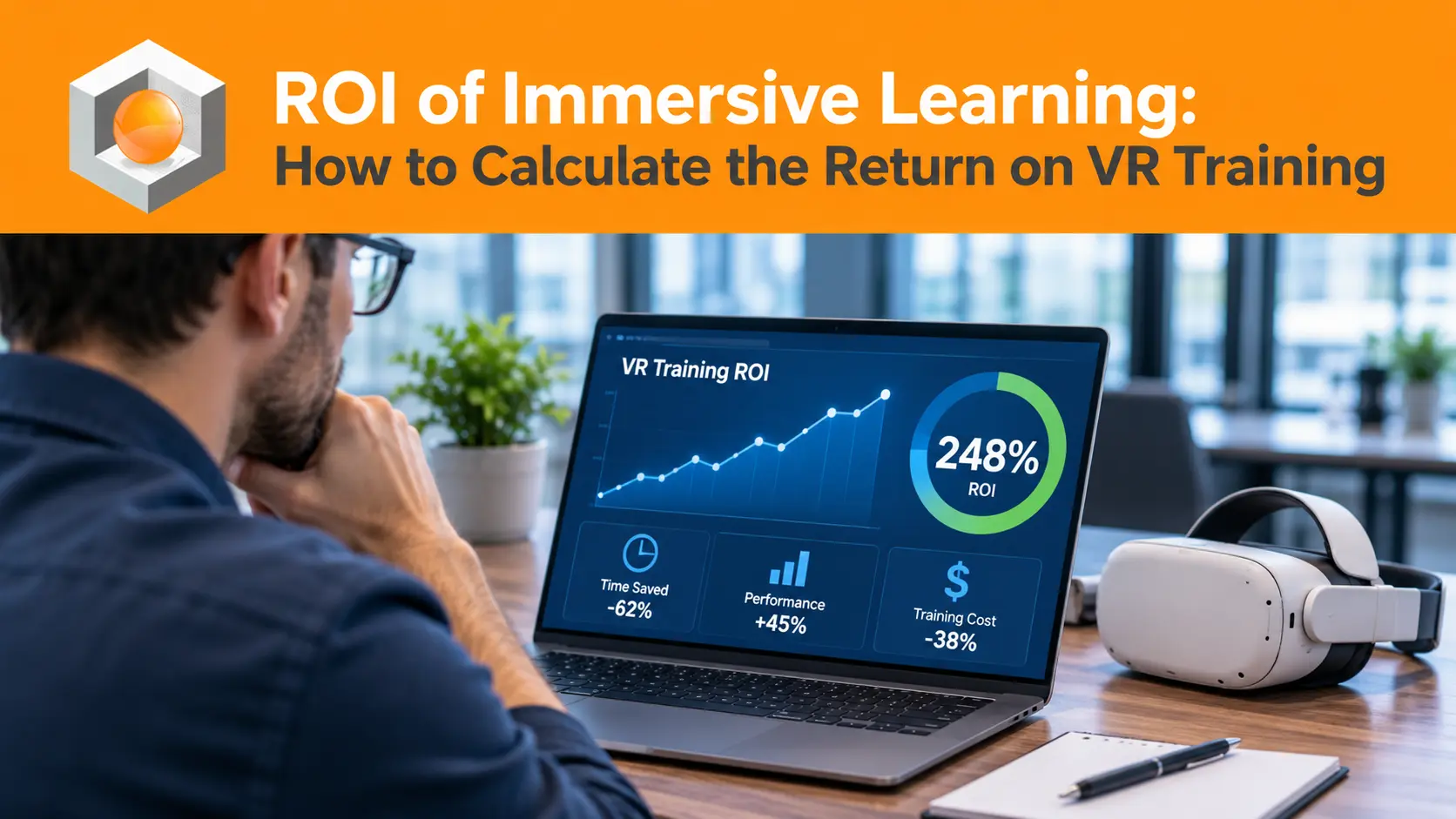
The ROI of immersive learning is the net financial return a VR or XR training programme produces, divided by everything it costs and expressed as a percentage. Most business cases for VR training fail at the second half of that sentence. They list benefits such as faster training, higher confidence and fewer errors without pricing the full cost side, and the finance reviewer stops reading.
This guide sets out the calculation the way a finance reviewer expects to see it: the formula, every cost line that belongs in the denominator, the five places VR training actually returns money, the learner volume at which it breaks even, and a worked example with the arithmetic shown. It also states where the return is weak, because a business case that admits its limits is the one that gets approved.
The Short Answer
ROI (%) = (monetised benefits minus total programme cost) divided by total programme cost, multiplied by 100. For VR training, three variables decide the result: how many people go through the programme, how much paid learner time it saves compared with the current format, and what the errors or incidents it prevents would otherwise cost. High-volume, high-risk training is where VR returns the most. Low-volume, knowledge-only training is where it struggles.
What the ROI of Immersive Learning Actually Measures
Immersive learning covers training delivered in virtual, augmented or mixed reality, where the learner performs a task inside a simulated environment instead of reading about it or watching it. Its ROI measures one thing: whether the money returned by that training exceeds the money spent on it. Benefits that cannot be converted into money still matter, but they belong in a separate column of the business case, not inside the percentage.
Benefits Are Not ROI
A VR module that learners rate highly has produced a reaction, not a return. The same applies to test scores taken straight after a session. Both are useful signals and neither is a financial result. Confusing the two is the most common reason a VR pilot is judged a success by the training team and a cost by the finance team.
The Five Levels of Training Evaluation
The standard way to separate these is the Kirkpatrick Model, extended with a fifth level by the Phillips ROI Methodology. Each level answers a different question, and only the last one is ROI.
| Level | Question it answers | What VR training can capture |
|---|---|---|
| 1. Reaction | Did learners find the training relevant and engaging? | Post-session survey, completion rate |
| 2. Learning | Did knowledge or skill improve? | Scored attempts, errors per attempt, time per scenario |
| 3. Behaviour | Do people perform differently on the job? | Supervisor observation, audit findings, near-miss reports |
| 4. Results | Did operational outcomes change? | Incident rate, rework, downtime, time to competence |
| 5. ROI | Did monetised results exceed the full cost? | Net benefit divided by total cost |
VR has an unusual advantage at Level 2. Every action in the headset is recorded, so a learner's errors, hesitations and sequence mistakes are captured per attempt instead of being estimated from a quiz. That data is what makes Levels 3 to 5 provable later.
The ROI Formula for VR Training
Three figures carry a training business case. They use the same inputs and answer slightly different questions.
ROI (%) = (Total monetised benefits − Total programme cost) ÷ Total programme cost × 100
Benefit-cost ratio = Total monetised benefits ÷ Total programme cost
Payback period (months) = Total programme cost ÷ Monthly monetised benefits
An ROI of 100% means the programme returned its full cost plus the same amount again. A benefit-cost ratio of 2.0 says the same thing in the form many finance teams prefer. The payback period matters most for budget approval, because it tells the reviewer when the investment stops being a cost on their books.
Two rules keep the number credible. Count benefits over the same period as costs, usually one year for the first calculation. And isolate the effect of training: if incident rates fell in a year that also brought new machine guarding, only part of that improvement belongs to the training.
The Cost Side: What Belongs in the Denominator
Underestimating cost is how VR business cases lose credibility. A complete calculation includes six lines.
| Cost line | What it covers | Often missed because |
|---|---|---|
| Content | Building or configuring scenarios: a ready-made catalogue module, a tailored version or a fully custom build | Teams price the build and forget updates when procedures change |
| Platform and licences | Software to deliver, manage and report on sessions | It is priced per year, not once |
| Hardware | Headsets, controllers, cases, charging and hygiene equipment | Spares and replacement cycles are left out |
| Device management | Provisioning, updates and kiosk settings across the fleet | Manual effort grows with every site added |
| Facilitation | Staff time to run sessions and support first-time users | It is assumed to be zero because VR feels self-paced |
| Learner time | Paid hours learners spend in training | It is rarely counted, though it is often the largest line |
The content line varies more than any other. Configuring an existing module costs a fraction of a fully custom build, which is why the level of tailoring a programme chooses is a financial decision before it is a design decision. Integration with the learning management system belongs on the list too if results have to flow into existing records, and the guide to VR training LMS integration covers what that involves.
Technical Note
Learner time is the hidden lever
In most programmes, the wages paid to people while they train exceed the cost of the training itself. A format that cuts the time a learner spends away from work reduces the largest cost line in the calculation. That is why time to competence is usually the first benefit to model, and why a shorter VR session can return more than a cheaper but longer classroom day.
Where VR Training Returns Money
A benefit only counts once it is expressed in money. For VR training, five sources account for most of the return.
1. Less Time Away From Work
PwC's study of VR soft skills training delivered the same course in three formats. Learners completed it in 29 minutes in VR, 45 minutes through e-learning and 2 hours in a classroom. Shorter sessions mean fewer paid hours off the job, fewer instructor days and less scheduling around shifts. For how the formats compare beyond time, see VR training versus e-learning.
2. Fewer Errors and Incidents
This is where high-risk training earns most of its return. In one case reported in Deloitte's research on spatial computing for training, reverse polarity errors in a wiring task fell from 18% to zero after immersive training. Sheathing errors fell from 20% to zero. An error that reaches the line costs rework at best and an injury at worst. VR lets people make that error in a scenario first, which is the logic behind VR safety training and modules such as HSE Risk Hunt.
To monetise this benefit, use the organisation's own figures: the average cost of a recordable incident, a lost-time day, a scrapped part or a line stoppage. Multiply by the reduction the pilot shows, then keep only the share that can be attributed to training.
3. No Lost Production or Consumables
Some training is expensive because of what it uses up or interrupts. Live fire extinguisher practice discharges real extinguishers and needs a safe outdoor area. Lockout and machine-specific training often needs the machine itself, which means stopping it. A simulated version needs none of these, so training can run while production continues. Fire extinguisher VR training is one example: the PASS sequence is practised hands-on without discharging any equipment.
4. Lower Delivery Cost Across Sites
Classroom programmes scale in a straight line. Every new site adds trainer travel, venue time and scheduling. A VR programme scales differently: once the content exists, each additional site mainly adds headsets and a facilitator. The gap widens with every location, as the guide to scaling enterprise VR training across sites shows through real rollouts.
5. Confidence That Transfers to the Job
The same PwC study found that VR learners were up to 275% more confident to act on what they had learned after training. Confidence is not money on its own, but it is an early indicator of whether training transfers to the job, and transfer is what produces the error and incident benefits above.
Learner Volume Decides the Result
Fixed costs explain why the ROI of VR training depends so heavily on how many people go through it. Content and setup are paid once, and each additional learner adds little. PwC's analysis put numbers on this for soft skills training, after accounting for the higher cost of developing VR content.
| Learners | VR cost compared with classroom | VR cost compared with e-learning |
|---|---|---|
| 375 | Cost parity | Higher |
| 1,950 | Lower | Cost parity |
| 3,000 | 52% lower | Lower |
The pattern holds beyond soft skills. A refresher programme for 1,200 operators a year sits comfortably past break-even. A specialist procedure taught to 40 people a year rarely does, unless the error it prevents is severe enough to carry the case on its own.
Expert Note
Volume can be built, not only found
Programmes that start below break-even often reach it by sharing one module across departments or sites, by using the same scenario for induction and annual refreshers, or by starting from a configured catalogue module instead of a custom build. Each of these spreads the fixed cost across more learners without adding much to it.
Want to see these numbers for your own programme?
RoT STUDIO can map your learner volume, sites and training topics against the cost lines above and show where VR pays back first.
Talk to Our TeamA Worked Example: ROI for an HSE Refresher Programme
The figures below are illustrative. They show the method, not a benchmark, and should be replaced with the organisation's own costs. The scenario: a manufacturer runs an annual HSE refresher for 1,200 operators across three sites. Today it is a four-hour classroom session with 12 learners per class. The VR alternative uses two configured catalogue modules in a session of one hour and fifteen minutes, with one facilitator supervising four headsets.
| VR programme cost (year one) | Assumption | Amount |
|---|---|---|
| Content | Two catalogue modules configured to site procedures | $40,000 |
| Platform and licences | Annual licence | $15,000 |
| Hardware | 20 headsets at $800 including cases and charging | $16,000 |
| Device management | $200 per headset per year | $4,000 |
| Facilitation | 375 facilitator hours at $40 | $15,000 |
| Learner time | 1,500 learner hours at $40 | $60,000 |
| Total cost | $150,000 |
| Classroom cost avoided (per year) | Assumption | Amount |
|---|---|---|
| Instructor time | 100 sessions of 4 hours at $75 | $30,000 |
| Learner time | 4,800 learner hours at $40 | $192,000 |
| Venue, travel and materials | 100 sessions at $600 | $60,000 |
| Total avoided | $282,000 |
Monetised benefits = $282,000 classroom cost avoided + $25,000 one avoided recordable incident = $307,000
ROI = ($307,000 − $150,000) ÷ $150,000 × 100 = 105%
Benefit-cost ratio = $307,000 ÷ $150,000 = 2.05
Payback period = $150,000 ÷ ($307,000 ÷ 12) = about 6 months
Learner time drives this result. The classroom format costs 4,800 paid hours a year and the VR format costs 1,500. The avoided incident adds to the return, but the case does not depend on it: remove it and the first-year ROI is still 88%.
Year two is stronger because the build is not repeated. With $6,000 of content updates instead of new development, the same programme costs about $100,000 and the ROI rises to roughly 207%.
Now run the same model for 150 learners a year. The content, licence and hardware costs barely shrink, while the classroom costs they replace fall sharply. Total cost is about $74,400 against $60,700 of benefits, an ROI of around −18%. That is the break-even principle in practice, and the reason volume is the first question to answer.
Where Immersive Learning ROI Is Weakest
A credible business case names the situations where VR is the wrong investment.
- Low-volume topics with no plan to reuse the content across sites, roles or years.
- Knowledge-only content, such as a policy update, which a short e-learning module covers at lower cost.
- Procedures that change every few months, where content maintenance cancels out the delivery savings.
- Programmes with no baseline, where nobody recorded the current training time, error rate or incident cost before the pilot, so nothing can be compared afterwards.
There is also a measurement trap. A University of Leeds report on immersive technology in healthcare education points out that face validity, meaning trainees find a simulation realistic, is not evidence of learning. What matters is whether skills transfer to real performance. A VR programme judged only on how impressive it feels has not been evaluated at all.
How to Measure ROI in a VR Training Pilot
The ROI of a VR programme is largely decided before the pilot starts, by what gets recorded.
- Record the baseline. Current training time per learner, error rates, incident costs and delivery costs.
- Pick one or two Level 4 metrics. Choose outcomes the training should move, such as incidents in a specific task or time to competence for new hires.
- Use the headset data. Completion, errors per attempt, time per scenario and repeat attempts per learner.
- Send results into existing records. Training data should sit alongside HR and safety data, not in a separate system.
- Compare groups. Measure a VR-trained group against a classroom-trained group over the same period to isolate the effect of training.
- Recalculate at three and twelve months. Behaviour change and incident data take time to appear.
Frequently Asked Questions
What is the ROI of immersive learning?
It is the net financial return of a VR, AR or MR training programme divided by its total cost, expressed as a percentage. It counts only benefits that can be converted into money, such as saved learner hours, avoided incidents and lower delivery costs. These are set against every cost line, including content, licences, hardware, facilitation and learner time.
How do you calculate ROI for VR training?
Subtract the total programme cost from the total monetised benefits, divide the result by the total programme cost and multiply by 100. Use the same period for both sides, usually one year, and attribute to training only the share of any improvement that the training caused.
How many learners does VR training need to pay for itself?
It depends on the content cost and on what the training replaces. In PwC's analysis of soft skills training, VR reached cost parity with classroom delivery at 375 learners and with e-learning at 1,950. High-risk topics can pay back at lower volumes when the incidents they prevent are expensive.
How long does it take to see a return on VR training?
Savings in training time and delivery cost appear as soon as VR sessions replace the old format. Reductions in errors and incidents take longer to show, because they need several months of operational data. A first full ROI calculation at twelve months, with an interim check at three, is a practical rhythm.
Is VR training cheaper than classroom training?
Per learner, it usually becomes cheaper once volume passes break-even, because sessions are shorter and need no trainer travel or venue. For small groups, the fixed cost of content and hardware can make it more expensive. The answer depends on volume more than on the technology.
Which training topics give the highest ROI in VR?
Topics that combine high learner volume with high consequences: safety procedures, hazard recognition, emergency response, equipment operation and onboarding for frontline roles. They are also the topics where live practice is dangerous, disruptive or impossible to stage.
What should a VR training pilot measure to prove ROI?
A baseline of current training time, error rates and incident costs, the headset data on errors per attempt and time per scenario, and one or two operational outcomes the training should change. Without a baseline, there is nothing to compare the results against.
Conclusion: Calculate Before You Commit
The ROI of immersive learning is not a fixed number to quote. It is a calculation each programme has to run with its own volume, costs and risks. The method is simple: price every cost line, monetise only what can be measured, check learner volume against break-even and record a baseline before the pilot. A VR business case built that way survives a finance review, because it was written for one.
How RoT STUDIO Approaches This
At RoT STUDIO, we start every programme with the cost question before the design question. Most organisations do not need a custom build to see a return. Ready-to-deploy modules from the VR Training Catalogue can be configured to a site's hazards and procedures, the RoT STUDIO License lets in-house teams build and update their own scenarios, and Customized VR/XR Services cover the cases where nothing existing fits.
The same thinking runs through our projects. Tosyalı Holding needed to train iron and steel teams on site without stopping production, and Ford Otosan Romania used the Trainer module to prepare assembly line teams for electric vehicle production. More examples are on our case studies page.