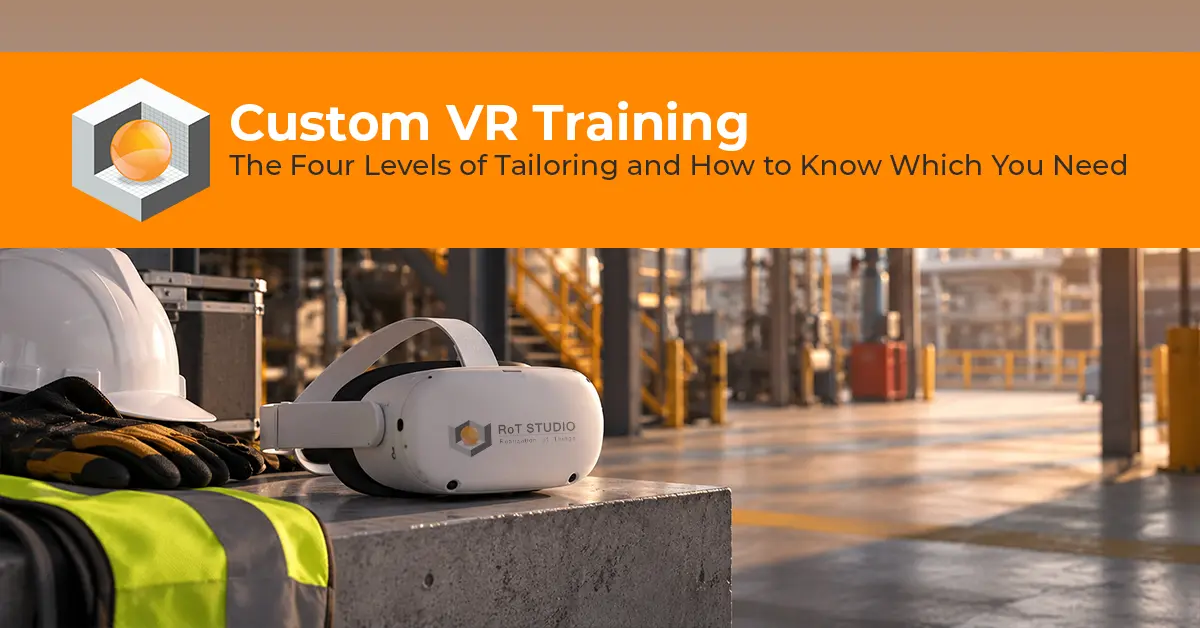
Almost every conversation about VR training reaches the same question within ten minutes. Can you customise it for us?
The answer is always yes, which is why it is the wrong question. It tells nobody anything, and it quietly sets up the most expensive mistake in this category: commissioning a bespoke environment for a scenario where a ready-made module configured properly would have taught the same thing, months earlier and for a fraction of the cost.
The useful question is narrower. How much tailoring does this particular scenario actually need, and what is the test for knowing. There are four levels, they cost very different amounts, and picking the right one is most of what determines whether a VR training programme survives past its pilot.
Level One: Deploy a Module As It Stands
The lowest level of tailoring is none at all, and for a large share of training needs it is the correct answer. A ready-made scenario runs in a representative environment rather than your own, and for skills where the hazard behaves the same everywhere, that is sufficient.
A lockout sequence isolates the same energy types in any plant. An extinguisher works the same way on the same fire class regardless of whose building is burning. The anatomy of a brain does not vary by hospital. Where that is true, a representative environment teaches the skill and a replica of your site adds cost without adding learning.
The HSE Training Catalogue covers the hazard classes behind most serious industrial incidents:
HSE Risk Hunt Training for hazard identification across a live industrial environment. LoTo Lock Training for isolating electrical, mechanical, pneumatic and hydraulic energy in sequence. Working at Height VR Training for harness inspection, anchor selection and fall clearance. Fire Extinguisher VR Training for extinguisher selection and technique against realistic fire classes.
Alongside those sit Industrial Facility Fire Awareness for ignition sources and evacuation decisions, Underground Mining Risk Hunt for confined underground workings, Earthquake Risk Hunt Training for structural and non-structural risk, and Information Security Risk Hunt for physical and behavioural security risks in an office.
The clinical side under RoT HEALTHCARE follows the same logic, since procedure and anatomy are consistent across institutions. That covers the Ophthalmic Surgery VR Training Simulator, the Anatomy VR Brain Module and Anatomy Musculoskeletal System Module, Colorectal Surgery Nursing Training, and the Surgical Catheterization Procedure.
Behavioural training sits here too, because a difficult conversation is a difficult conversation in any building. The HR and Soft Skills range covers Leadership Training, Time Management and Challenging Customer Management, where what varies between organisations is the counterpart's behaviour rather than the room.
The test for Level One: if the hazard or procedure behaves identically wherever it occurs, and nobody needs to recognise the physical location, deploy as it stands.
Level Two: Configure the Module to Your Standards
This is the level most organisations should be using and the one most often skipped, because it is invisible from a demo. The environment stays as built; what changes is everything governing how the scenario is scored and what counts as correct.
Hazard placement can be set against your own risk register rather than a generic one. Pass conditions can reflect your procedures, so that a step your organisation treats as mandatory is mandatory in the scenario. Terminology can match what your people actually call things, which matters more than it sounds when a trainee is looking for a component under a name nobody on site uses. Language, signage and PPE can be adjusted to what your workforce wears.
Configuration typically takes days rather than months and changes the scenario from a generic exercise into something recognisably about your operation, without rebuilding a single wall. For a large share of programmes this is where tailoring should stop.
The test for Level Two: if your procedures or standards differ from the generic version, but the physical space does not need to be yours, configure rather than build.
Level Three: Build the Environment From Your Own Plant
Sometimes recognising the actual place is the training. A worker who has rehearsed an evacuation in a generic corridor has learned the principle. A worker who has rehearsed it in their own building, with their own exits and their own sightlines, has learned the route.
Customized VR/XR Services covers this level, building environments from engineering drawings, CAD data, photogrammetric scans or site reference. It also covers the scenarios that sit outside the catalogue entirely, which is most bespoke work: a specific machine, a specific procedure, a hazard particular to one industry.
The Carmeuse Turkey programme is the clearest example of what this level produces when it is the right choice. Customised training, an online platform and centralised management, with the client's own health and safety manager attributing both international awards and a zero lost-time accident goal to the collaboration.
The test for Level Three: if a trainee needs to recognise the location, the machine or the layout to perform correctly, build it. If they do not, this level is spending money on scenery.
Consensus work in simulation research draws a firm line between a simulation that looks convincing and one that produces transfer, meaning the behaviour actually appears on the job. Visual fidelity drives the first and has a much weaker relationship with the second.
This is why the tailoring question should be answered by asking what the trainee needs to recognise in order to act correctly, not by how impressive the environment looks in a demonstration.
That is the conversation worth having before anyone quotes a build. Describe the training problem to the RoT STUDIO team and we will tell you the cheapest level that solves it, including when that is a module you deploy next week.
Level Four: Tailor It Yourself, Continuously
The three levels above all depend on RoT STUDIO making the change. That works until procedures change often, or until a subject matter expert wants to adjust a scenario on a Tuesday afternoon without opening a project.
The RoT STUDIO License moves the authoring inside the organisation. The Trainer Module builds procedural training through a drag-and-drop workflow with no coding, after a two-day course. The Designer Module takes imported CAD models and lets teams step inside their own prototypes at full scale for visualisation and ergonomic validation.
The case studies show what each module is for. Ford Otosan Romania used the Trainer Module to prepare an assembly line for electric vehicle production, with a virtual trainer there describing designing his own scenarios with only CAD knowledge. Tosyalı Holding built on-site training across iron and steel production the same way.
On the design side, ErBatu Machine used the Designer Module for a design-to-experience workflow in machine manufacturing, and Gazi University Faculty of Medicine moved anatomy teaching into VR with it.
The test for Level Four: if your procedures change more often than a development cycle can keep up with, or you have many variants across sites, own the authoring. If content will be stable for years, a licence is overhead.
The Specialist Track: When the Audience Is Not a Workforce
One programme sits outside the ladder because the tailoring question is different. Earthquake Awareness Training runs in two modes, adult and children, using mixed reality to place past and expected earthquake scenarios into a real room.
What is tailored here is not the hazard or the site. It is the audience. A public-facing programme has to work for someone who has never worn a headset, may be a child, and will experience it once rather than as part of a training cycle. That changes session length, intensity, onboarding and safeguarding in ways no industrial module needs to consider.
The Mersin Municipality programme is the delivered example, taking earthquake preparedness to the public sector through mixed reality rather than full VR, precisely because keeping the real room visible matters for that audience.
Comparative study work on immersive course economics found VR content costing meaningfully more to build than classroom or e-learning equivalents, and reaching breakeven against classroom delivery at several hundred learners. Against e-learning the crossover sits far higher again.
The practical reading: bespoke content earns back on headcount and repetition. A custom build for fifty people who will run it once is difficult to justify, and the same money spent configuring a catalogue module usually is not.
Choosing the Level Without a Sales Conversation
Four questions settle it in most cases, and they can be answered internally before anyone requests a quote.
| Ask this | If yes | Level |
|---|---|---|
| Does the hazard behave the same anywhere? | Deploy the catalogue module as it stands | One |
| Do your procedures or standards differ from generic? | Configure hazards, pass conditions and terminology | Two |
| Must the trainee recognise your actual site or machine? | Build the environment from your data | Three |
| Do procedures change faster than a project cycle? | Take the licence and author in-house | Four |
Most organisations end up on more than one level at once, and that is the healthy pattern rather than a compromise. Catalogue modules cover the common hazards, one or two bespoke builds handle the things that genuinely need the real site, and a licence sits underneath for the content that keeps changing. Starting at Level Three for everything is how a programme runs out of budget before it reaches a second department.
Frequently Asked Questions
These come up in almost every scoping conversation, usually once the levels have been explained and someone starts working out where their own programme sits.
How long does each level take to deploy?
Deploying a catalogue module as it stands is a matter of scheduling rather than development. Configuration usually runs in days. Building a custom environment depends almost entirely on how quickly the client can supply drawings, site access and subject matter review, which is more often the constraint than the modelling itself. Taking a licence adds a two-day course before a team can author independently.
Can we start at one level and move to another?
That is the usual and recommended path. Catalogue modules prove the delivery model internally with minimal commitment, which makes the case for bespoke work far easier to fund. Organisations that want to keep iterating afterwards take the licence once they know what they actually want to change.
What do you need from us to build a custom environment?
Engineering drawings or CAD data where they exist, otherwise site photography and measurement. The procedure as it is actually performed rather than as the manual describes it, which is a distinction worth taking seriously. Access to someone who can settle disputes about correct practice. And a decision on what counts as passing, agreed before development rather than after.
Does tailoring change what the training records?
The performance data is recorded per trainee at every level, covering attempts, decisions and completion. What tailoring changes is what counts as a correct decision, which is why configuration matters more than it appears. A module scored against generic pass conditions produces data about a generic standard rather than yours.
Which industries does this apply to?
The delivered work spans energy, transportation, aerospace and defence, manufacturing, education and HR, finance, telecom and healthcare. The levels behave the same way across all of them, because the question of whether a trainee needs to recognise the real environment is a property of the task rather than the sector.
What if our scenario is not in the catalogue at all?
Then the ladder collapses to two options rather than four: commission it as bespoke work, or author it internally with a licence. The question becomes whether your team wants to own the content long term. If the scenario is one-off, commissioning is simpler. If it is the first of many, the licence usually costs less across the programme.
Tailoring Is a Decision, Not a Feature
Every VR training vendor will tell you their content can be customised, and every one of them is telling the truth. The difference between programmes that scale and programmes that stall at pilot is rarely whether tailoring was available. It is whether somebody asked how much of it the scenario needed.
Answer that per scenario rather than per contract and the economics change completely. Common hazards run on catalogue modules within weeks. The two or three things that genuinely require your own plant get built properly, with the budget that was not spent replicating a corridor nobody needed to recognise. And anything that changes often ends up where it belongs, in the hands of the people who change it.
How RoT STUDIO Approaches This
Scoping starts from the training problem rather than the product. That means asking what the trainee has to recognise, how often the procedure changes, how many people will run it and what the organisation needs to evidence afterwards, then recommending the lowest level that answers those questions.
In practice that has produced ready-made HSE and clinical deployments, bespoke environments where the site had to be recognisable, and licensed authoring where clients wanted to keep control of their own content. The delivered examples sit in the RoT STUDIO case studies, and the practitioners discussing these decisions in their own words are on Immersive Industry Talks.
Tell RoT STUDIO what your teams need to be able to do, and we will map it across the four levels before anyone talks about headsets or budgets. Start the conversation with the RoT STUDIO team.