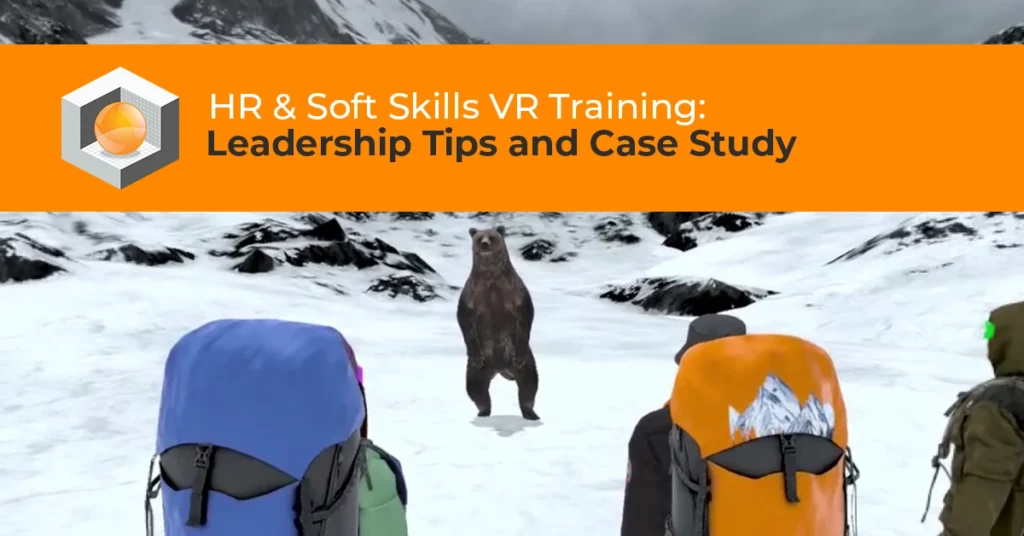
Most leadership programs fail quietly. Participants return from two-day workshops carrying workbooks that sit in drawers. The behavioral change that was promised in the course description never quite materializes in the meeting room — and HR leaders know this, yet the traditional training calendar persists. The real problem is not content; it is the absence of practice. Leaders cannot develop under pressure by reading about it, and feedback delivered weeks after a poorly handled performance conversation changes nothing.
Virtual reality changes the equation. Not because it is novel, but because it solves a problem that classroom instruction and e-learning modules fundamentally cannot: it gives leaders a safe, repeatable space to actually fail, receive feedback in the moment, and try again. That cycle — attempt, fail, adjust, repeat — is how skilled behavior is built. VR creates the conditions for it at scale, without the organizational risk of learning through real mistakes on real people.
This article examines what effective VR-based leadership training looks like in practice, where the common implementation mistakes occur, and what organizations in manufacturing, energy, healthcare, and HR-intensive industries are learning from real deployments. It also presents a structured case study from a mid-sized manufacturing organization that used immersive simulation to address an urgent leadership pipeline gap.
Why Traditional Leadership Development Methods Hit a Ceiling
The gap between training intent and behavioral change in leadership development has been documented thoroughly. A Brandon Hall Group study found that fewer than one in four organizations rate their leadership development programs as highly effective. The gap exists not because organizations lack good facilitators or compelling content, but because the transfer environment — the actual workplace — is radically different from the training environment.
Classroom instruction activates declarative knowledge. Participants learn what active listening means, what psychological safety requires, how to structure a difficult conversation. But knowing the framework and executing it under the social pressure of a real interaction are entirely different cognitive tasks. When a manager has to give corrective feedback to a defensive team member, the working memory demands of that moment overwhelm whatever model they memorized in a morning session.
Behavioral science describes this as the knowing-doing gap. The solution is not more knowledge transfer — it is practice in conditions that approximate the emotional and cognitive pressure of the actual situation. High-fidelity simulation does exactly this. Military training understood this principle decades before corporate L&D began applying it, and the mechanism is the same: repetitive exposure to realistic high-pressure scenarios, with structured debriefing afterward.
Expert Note: One pattern that consistently appears across enterprise deployments is that learners significantly underestimate their own stress responses until they encounter a well-designed VR scenario. A participant who describes themselves as a calm communicator will often exhibit measurably different behavior inside a performance conversation simulation — interrupting, avoiding direct statements, shifting body language. The data from in-headset behavioral tracking provides coaching material that no self-assessment instrument can replicate.
The emotional fidelity of modern VR environments is the critical variable. When a virtual colleague crosses their arms and responds with visible discomfort, the learner’s nervous system responds in ways that a roleplay exercise with a willing colleague cannot trigger. Research from PwC found that VR-trained employees felt more confident applying skills learned in training and were more focused than their classroom counterparts — not because the content was different, but because the learning experience more closely resembled the situations in which those skills needed to function.
The Leadership Competencies Most Suited to Immersive Training
Not every leadership skill benefits equally from VR simulation. Technical skills — how to run a budget review, how to structure a project plan — are better served by other methods. The competencies that benefit most from immersive simulation are those that depend on real-time behavioral regulation: reading social cues, managing emotional reactivity, communicating under ambiguity, and making judgment calls with incomplete information.
RoT STUDIO developed in partnership with Minerva (A Business Consulting company) identifies five core competency clusters that are directly addressable through VR simulation:
- Crisis management and composure under pressure
- Decision-making with time constraints and ambiguous data
- Team dynamics — facilitating conflict, navigating resistance, building psychological safety
- Communication under stress — delivering difficult messages, receiving critical feedback
- Strategic thinking — recognizing second-order consequences in simulated business scenarios
These competencies share a common structure: they require the leader to monitor their own internal state while simultaneously reading and responding to another person’s behavior. That dual-processing demand is precisely what makes them hard to build in low-stakes training settings and precisely what VR simulation can replicate.
Organizations that have deployed immersive leadership training consistently report that participants who struggled with composure in virtual crisis scenarios were also the ones flagged by their managers as reactive in real situations. The simulation does not just teach — it surfaces existing behavioral patterns with a precision that 360-degree feedback surveys rarely match.
The structured framework for measuring these behaviors in simulation aligns closely with what the broader VR training field has documented in applied contexts. Organizations looking to understand how immersive platforms address enterprise-scale training challenges can review the analysis of how VR/XR training solutions address DICE challenges — a framework that maps directly onto the high-stakes, high-pressure nature of leadership development scenarios.
Designing Leadership Scenarios That Actually Transfer
The quality of VR leadership training depends almost entirely on scenario design. A well-constructed headset environment with poor scenario architecture produces nothing more than an expensive distraction. What defines a scenario that transfers to real behavior?
The first requirement is emotional stakes. The scenario must create a situation where the participant genuinely wants to perform well and where there are perceivable consequences for a poor response — a team member whose engagement visibly drops, a decision whose downstream effects unfold in real time. Generic scenarios with generic characters produce generic training.
The second requirement is behavioral specificity. The simulation must be designed to elicit the specific behaviors that the training program aims to develop. A crisis management scenario that simply floods the participant with information and asks them to click through decisions does not develop leadership composure. A scenario in which the participant must speak, respond, and regulate their response while the situation deteriorates around them does.
The third requirement is a structured debrief architecture. What happens after the headset comes off is as important as what happens inside it. Participants need to review their behavioral data — the moments they hesitated, the exchanges where their response escalated rather than resolved tension — with a facilitator who can connect those patterns to real workplace situations. Without this step, the learning stays in the headset.
Technical Note: In multi-participant leadership simulations, the system architecture matters as much as the content. When participants can observe each other’s in-simulation performance — either in real time or through a replay mechanism — peer learning accelerates. The social comparison effect, which is well-established in behavioral science, significantly increases motivation to improve. Platforms that support group observation modes alongside individual simulation runs consistently produce better post-training behavioral change metrics than single-participant-only deployments.
Scenario branching is another design variable that separates effective programs from shallow ones. Linear scenarios — where the same outcome occurs regardless of how the participant responds — teach nothing about consequence. Branching architectures, where the team’s emotional temperature, the crisis severity, or the available options genuinely shift based on participant choices, create the kind of causal feedback that builds real decision-making skill.
Case Study: Building a Leadership Pipeline in a High-Turnover Manufacturing Environment
The following case study describes a deployment in a mid-sized European manufacturing organization with approximately 1,400 employees across three production facilities. The organization had identified a recurring problem: frontline team leader positions were consistently difficult to fill from within, and externally hired managers typically required 6–9 months before operating at full effectiveness in the role’s interpersonal demands.
The Organizational Challenge
Exit interviews and manager observation data identified three consistent failure points in new team leaders: inability to maintain composure during production disruptions, avoidance of direct performance conversations with underperforming team members, and difficulty building trust with teams that had experienced high leadership turnover. These were not knowledge deficits — the organization’s training program was thorough on compliance, process, and safety. They were behavioral deficits, and the standard training curriculum had no mechanism for addressing them.
The HR director’s assessment was direct: “We were graduating people from onboarding who knew everything they were supposed to know and couldn’t do any of it under pressure.” The organization needed a way to put new leaders under pressure before they were managing it live.
The Simulation Design
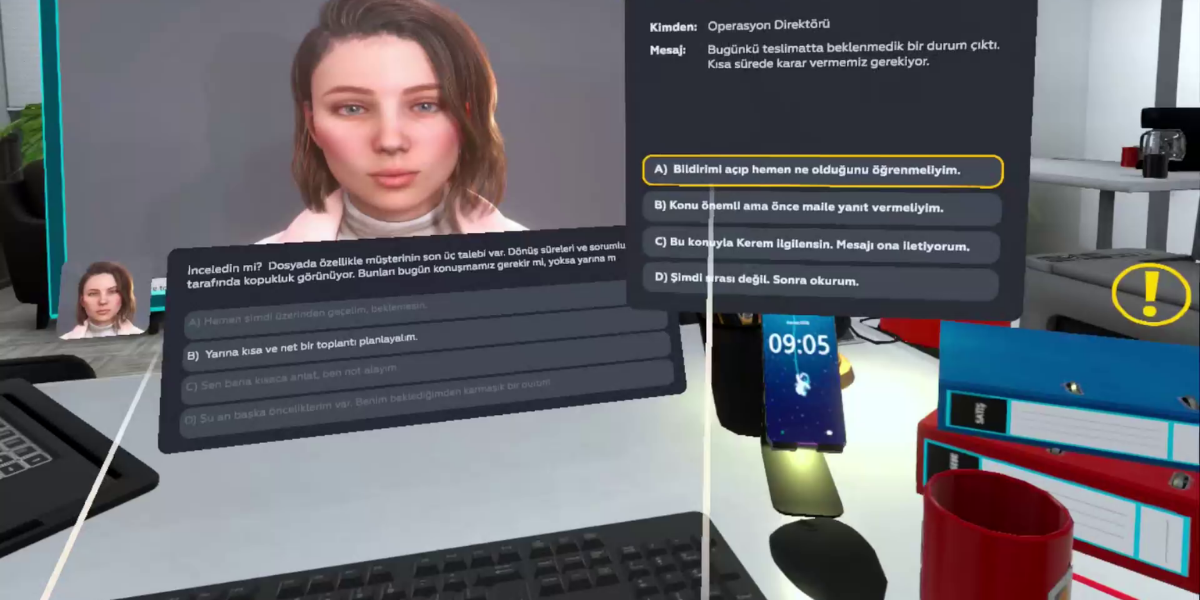
The immersive training program was structured around four scenario families, each mapped to one of the identified behavioral gaps. The crisis composure scenario placed the participant in the role of a shift supervisor managing a production stoppage with an escalating team response, incomplete information, and a countdown timer tied to a delivery commitment. The performance conversation scenario put the participant in one-on-one with a virtual team member displaying a well-researched pattern of defensiveness and deflection.
The trust-building scenario was designed with particular care, because trust is both the most critical and the most difficult leadership behavior to simulate. The scenario ran across two sessions — participants made choices in the first session that affected the team’s starting disposition in the second, creating a genuine sense of relationship continuity that single-session simulations cannot produce.
Each scenario was scored across eight behavioral indicators captured by the platform: response latency at key decision points, verbalization patterns (direct vs. evasive language), behavioral consistency between early and late scenario stages, and recovery behavior following a mistake. These metrics fed directly into the debrief process.
Results After One Cohort Cycle
After the first cohort of 34 new team leaders completed the program, the organization measured outcomes across four indicators at the 90-day mark. Time-to-effectiveness dropped from the historical 6–9 month range to approximately 4 months for the simulation-trained group. Manager ratings of composure under pressure showed meaningful improvement relative to the prior year’s cohort, which had received only the standard curriculum. Performance conversation avoidance — measured through 1:1 scheduling compliance and documentation rates — improved substantially.
The finding that generated the most internal discussion was not behavioral at all. Participation in the program was associated with a measurable reduction in early-tenure attrition among the team leaders themselves. The leading explanation from the HR team was straightforward: leaders who had practiced failure in a safe environment were less likely to be overwhelmed by their first real high-pressure situations, and less likely to disengage as a result.
This outcome aligns with what researchers have described as self-efficacy transfer — the confidence gained from mastering a simulated challenge carries into real-world performance, not because the person now knows more, but because they have direct experiential evidence that they can handle the situation.
For organizations considering the business case for VR training investment, the broader evidence base on performance outcomes and return metrics is examined in detail in the article on why manufacturers are switching to VR-based workforce training.
Implementation Considerations for HR and L&D Leaders
Deploying VR-based leadership training involves decisions that go beyond content selection. Organizations that approach implementation thoughtfully report significantly better outcomes than those that treat the headset as a drop-in replacement for existing methods.
Selecting Participants and Sequencing the Program
Immersive leadership training is most effective when participants are selected based on developmental readiness rather than organizational hierarchy. A senior executive who has no interest in behavioral feedback will extract less value from the program than a high-potential mid-level manager who is actively seeking development. The simulation environment requires genuine engagement — it cannot be completed passively.
Sequencing matters as well. Programs that introduce conceptual frameworks — what active listening actually involves, why performance avoidance is counterproductive — before the simulation run give participants a mental model to apply during debrief. Programs that reverse the sequence, leading with immersion and following with concepts, also work, but require more facilitator skill during the debrief to build conceptual anchors after the fact.
Integration with Existing Talent Systems
The behavioral data generated by VR leadership simulations is most valuable when it connects to existing talent management processes. Organizations that pipe simulation performance data into development plan documentation, succession planning reviews, or coaching conversations create a feedback loop that extends the training’s impact beyond the session. Those that treat the simulation as a standalone event generate engagement but limited sustained change.
The platform architecture question — which system captures and distributes simulation data, how it integrates with existing LMS infrastructure, and how permissions are managed across HR and line management — is worth addressing before procurement. The considerations here have meaningful overlap with the platform selection analysis covered in the guide to choosing the best VR platform for training.
Facilitator Capability
The weakest point in most VR leadership training deployments is not the technology — it is the debrief. Facilitators who are skilled at reviewing objective behavioral data, connecting specific in-simulation moments to real workplace patterns, and doing this without triggering defensiveness in the participant are rare. Organizations that invest in facilitator preparation alongside technology deployment report substantially better transfer rates. The headset delivers the experience; the debrief delivers the learning.
What the Evidence Says About Soft Skills Development Through VR
The research based on VR for soft skills training has grown substantially over the past several years. PwC’s 2020 study on VR learning effectiveness found that VR-trained employees demonstrated significantly higher emotional confidence in applying newly learned skills than those trained through classroom or e-learning methods. The same study found VR learners were more focused during training, a finding attributed to the elimination of competing environmental stimuli within the headset environment.
Research from Stanford’s Virtual Human Interaction Lab has documented that physical embodiment in virtual environments — the experience of inhabiting a character and having that character’s actions reflected back — produces attitudinal and behavioral changes that persist after the VR session. This embodiment effect is particularly relevant for empathy-based leadership training, where the goal is to change how leaders perceive and respond to other people’s experiences.
Deloitte’s analysis of enterprise learning effectiveness identifies experiential learning as producing the highest retention rates among common training modalities — significantly above lecture and reading-based methods. The mechanism is straightforward: memory encoding is stronger when emotional and sensory systems are engaged during learning. VR activates both.
For HR leaders operating in environments where safety and compliance training is already consuming a significant L&D budget, the question of whether immersive training investment can be shared across functions is worth examining. The cost structure analysis in the article on health and safety training with virtual reality provides relevant context for that calculation.
Frequently Asked Questions
Can VR training effectively develop soft skills like empathy and communication?
Yes, and the mechanism is well-documented. VR training creates high-fidelity social situations that trigger genuine emotional and physiological responses in participants. When a virtual character reacts with visible distress to a poorly delivered message, the learner’s nervous system responds in ways that mirror a real interaction. This response quality is what makes in-simulation practice transfer to actual behavioral change, which passive content modalities cannot replicate.
How long does a VR leadership training session typically last?
Individual scenario runs typically range from 8 to 20 minutes, depending on branching complexity. A full program session — briefing, simulation run, and structured debrief — generally runs 60 to 90 minutes. Most enterprise programs sequence four to six sessions over a 6–8 week period, allowing participants to attempt scenarios multiple times and track their behavioral development across the program.
What kinds of organizations benefit most from VR-based leadership training?
Organizations with large frontline leadership populations — manufacturing, logistics, healthcare, energy — see the strongest return, because the volume of leaders being developed makes per-participant cost ratios favorable and because the pressure conditions those leaders face daily are highly replicable in simulation. That said, any organization with a documented knowing-doing gap in leadership behavior is a candidate, regardless of industry.
How is performance measured in VR leadership simulations?
Modern VR leadership platforms capture behavioral data that goes beyond self-report. Response latency at decision points, verbalization patterns, consistency of behavior across scenario stages, and recovery behavior after mistakes can all be tracked and scored. This data feeds the post-session debrief and, in integrated deployments, connects to talent management documentation and ongoing coaching plans.
Is VR leadership training suitable for senior executives or only emerging leaders?
It is effective at both levels, but the program design must differ significantly. Emerging leaders typically benefit from foundational behavioral scenarios that build baseline competencies. Senior executive programs are most effective when scenarios are designed around the specific high-stakes situations that level of leadership faces, board-level communication, organizational crisis response, complex stakeholder dynamics. Generic programs applied to senior executives typically underperform.
VR Leadership Training Is an Infrastructure Investment, Not a Training Event
The organizations that extract the most value from immersive leadership training are those that treat it as a permanent capability rather than an initiative. A single cohort run with a novel technology produces interesting data and some behavioral change. A sustained deployment — where simulation is sequenced into leadership development at every organizational level, where behavioral data connects to talent processes, and where facilitators grow in their debrief capability over time — produces a measurable shift in how an organization’s leaders perform under pressure.
Three things are worth carrying forward from the evidence and case study examined here. First, scenario fidelity is the primary driver of training effectiveness, the emotional authenticity of the situation determines whether the learning transfers. Second, the debrief is not secondary to the simulation; it is the mechanism through which in-simulation experience becomes behavioral change. Third, the data generated by VR leadership simulation is an asset that extends well beyond the training session itself, informing development planning and succession decisions when integrated properly.
The technology will continue to mature, and the evidence base will continue to strengthen. But the organizations that are building leadership capability through immersive simulation right now are not waiting for the technology to improve — they are building internal expertise in simulation design, facilitation, and talent integration that will compound in value as the tools get better.
How RoT STUDIO Approaches This
At RoT STUDIO, leadership development through VR simulation is not an adjacent capability — it is a core part of what the Minerva Leadership Training program was built to address. The program places participants in carefully designed immersive scenarios covering crisis management, decision-making under time pressure, team dynamics, and communication under stress. Each scenario is built on a branching architecture that responds to participant choices, creating the kind of consequential feedback loop that drives genuine behavioral learning.
The Minerva program is available through RoT STUDIO’s ready-made VR Training Catalogue, meaning organizations can deploy a proven, structured leadership simulation program without the lead time and cost of a fully custom build. For organizations with specific role profiles, industry contexts, or cultural requirements, the Customized VR/XR Services team builds scenario environments from the ground up — including character design, behavioral scoring frameworks, and debrief integration with existing talent systems.
RoT STUDIO’s development infrastructure combines the 3D engineering depth of infoTRON’s legacy with European R&D capabilities centered at High Tech Campus Eindhoven. The end-to-end delivery model — from scenario design through facilitator preparation and ongoing content updates — means organizations are not managing a technology relationship alone; they are working with a team that understands how behavioral simulation actually functions across enterprise learning environments.
To discuss how Minerva or a customized VR leadership training program could address the specific behavioral development gaps in your organization, you can reach the RoT STUDIO team directly.