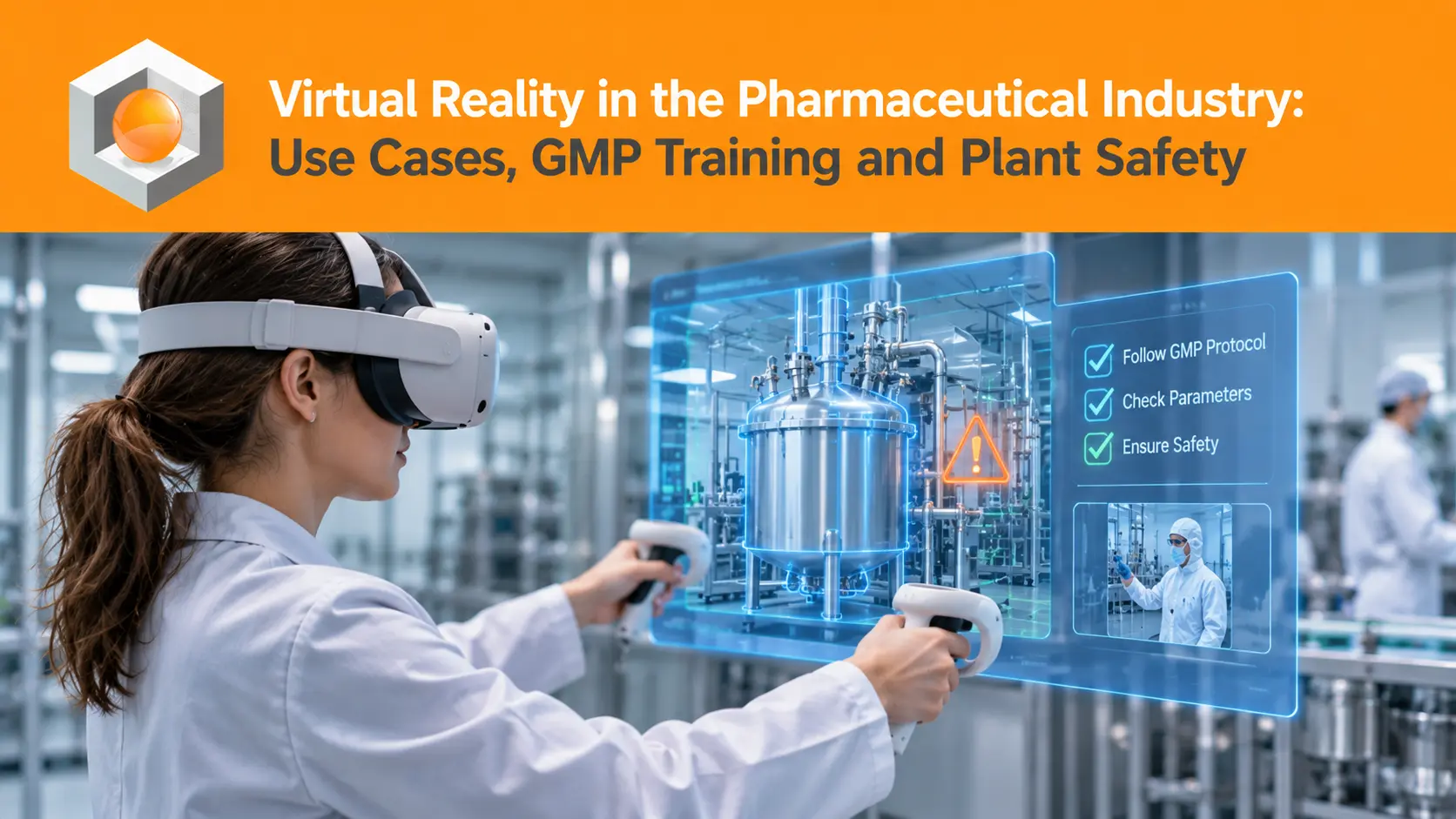
Virtual reality in the pharmaceutical industry is usually described through a list of uses: molecules in 3D, virtual lab tours, immersive sales presentations. The list is accurate, but it hides where VR does its most valuable work. That is the manufacturing floor, where training is a legal obligation and a single error can cost a batch, a qualification or someone's health.
Most writing on pharma VR training stops at the cleanroom door and treats the subject as a contamination problem only. A pharmaceutical plant carries two risks at once: the risk to the product, governed by GMP, and the risk to the people making it, governed by occupational health and safety. This guide covers the main use cases first, then shows how VR training addresses both risks in the same scenario.
The Short Answer
Pharmaceutical companies use virtual reality for drug discovery, facility design review, GMP and aseptic training, plant safety training, maintenance and commercial education. Manufacturing training is the strongest use case, because operators need practice in areas that regulation tries to keep people out of and on hazards nobody can safely stage. VR lets them rehearse gowning, aseptic interventions, potent powder handling, line clearance and maintenance before they do it for real. It prepares people for qualification; it does not replace it.
6 Use Cases of Virtual Reality in the Pharmaceutical Industry
1. Drug Discovery and Molecular Visualisation
Researchers step inside 3D molecular structures to inspect binding sites and shapes at a scale a flat screen cannot give. The value is insight, and it sits with a small group of medicinal and computational chemists.
2. Facility, Cleanroom and Line Design Review
Engineering and validation teams walk through a cleanroom layout or a production line before it is built, checking personnel and material flows, equipment access and ergonomics while changes are still cheap.
3. GMP and Aseptic Manufacturing Training
Operators rehearse gowning, cleanroom behaviour and aseptic interventions before entering classified areas. This is the most mature manufacturing use case and the one most closely tied to regulatory requirements.
4. Plant Safety and EHS Training
Pharmaceutical plants handle potent compounds, flammable solvents and combustible powders. VR training lets people practise containment, transfers and emergency response on hazards that cannot be recreated for training.
5. Maintenance, Changeover and Technician Training
Technicians learn changeovers, cleaning sequences and energy isolation on virtual equipment, which keeps the real line available for production.
6. Commercial, Medical and Patient Education
Sales and medical affairs teams use VR to explain how a disease progresses and how a product acts. Its value is in communication rather than operations.
Use cases 3, 4 and 5 share one feature: they take place on the manufacturing floor, where training is mandatory, measurable and expensive to deliver. The rest of this guide stays there.
Why Manufacturing Is the Strongest Use Case for VR in Pharma
Training Is a GMP Requirement, Not an HR Initiative
In the United States, 21 CFR 211.25 requires that everyone engaged in manufacturing, processing, packing or holding a drug product has the education, training and experience for the job, and that CGMP training is given by qualified individuals on a continuing basis and with sufficient frequency. In Europe, Chapter 2 of the EU GMP guidelines in EudraLex Volume 4 requires continuing training whose practical effectiveness is periodically assessed, plus specific training for people working in clean areas or with highly active, toxic or sensitising materials. Inspectors therefore ask two questions: did training happen, and did it work?
Annex 1 Raised the Bar for Sterile Manufacturing
The revised EU GMP Annex 1 was published in August 2022 and has applied since August 2023. It was developed jointly with PIC/S and the WHO, so its expectations reach well beyond the EU. For personnel in Grade A and B areas it requires training in aseptic gowning and behaviour, a gowning assessment that is repeated at least once a year with both visual and microbiological checks, and participation in a successful aseptic process simulation before anyone works in those areas unsupervised. The FDA guidance on sterile drug products produced by aseptic processing sets comparable expectations for training and qualification on the US side.
The Cleanroom Paradox
This creates a training problem with no easy physical answer. Operators need practice in exactly the places regulation wants fewer people and fewer interventions. Every training entry into a classified area uses gowns and monitoring, takes cleanroom time from production and adds contamination risk. A mistake made while learning becomes a deviation. An opinion piece in The Pharmaceutical Journal makes the same point from the workforce side: access to real manufacturing facilities for training is disruptive and expensive, which slows how quickly new staff become productive.
Technical Note
Read and understood is not competence
A signed procedure record proves that someone read a document. It does not show that they can carry out the steps in order, under time pressure, without touching a critical surface. That gap between documented training and demonstrated skill is what an effectiveness assessment is meant to find, and a simulation can measure it before the operator ever enters the room.
Two Risks on One Floor: Protecting the Product and the People
Most VR training built for pharma addresses only the product side. Yet many tasks on a pharmaceutical floor carry a GMP risk and a safety risk at the same time, and one scenario can train both.
| Task | Risk to the product (GMP) | Risk to the people (EHS) |
|---|---|---|
| Aseptic gowning and behaviour | Microbial and particle contamination of sterile product | Low |
| Aseptic interventions | Contamination during line intervention, failed batch | Pinch points and glove breaches at barriers |
| Dispensing and charging potent powders | Cross-contamination between products | Exposure to highly potent compounds, combustible dust |
| Solvent transfers | Wrong material or quantity added | Fire, static ignition, vapour exposure |
| Line clearance and packaging | Mix-ups and wrong labels reaching patients | Moving machinery |
| Maintenance and changeover | Contamination after an intervention on equipment | Release of stored energy |
Charging a potent active ingredient into a vessel is a good example. The containment steps that protect the operator from exposure are the same steps that stop the powder from contaminating the next product. Training them in one scenario reflects how the work is actually done, and it gives both the quality unit and the EHS team evidence from a single session.
Six Manufacturing Tasks VR Training Rehearses Well
Not every task needs a simulation. These six combine high consequence, little chance to practise for real and clearly defined correct steps, which is where VR returns the most.
1. Aseptic Gowning
Gowning is a long sequence in which the order and the touch points matter as much as the garments. In VR, the trainee dresses in a virtual changing area. The scenario records every step taken out of order and every contact between a gloved hand and a surface that should stay clean. The trainee repeats the sequence until it is automatic.
2. Cleanroom Behaviour and First Air
Unidirectional airflow is invisible in a real cleanroom, which is one reason good behaviour is hard to teach. A simulation can show it. When a hand or body passes between the clean air supply and an exposed critical surface, the scenario makes the interruption visible and records it.
3. Aseptic Interventions on the Filling Line
Clearing a jammed vial, refilling a stopper bowl or replacing a part through a glove port are moments of maximum risk, and they are rare enough that operators get little real practice. A scenario built from the site's own procedure lets them rehearse each permitted intervention at an isolator or barrier system that matches their line.
4. Potent Powder Handling and Containment
Dispensing and charging highly potent compounds depend on containment equipment used in the right order, with the right checks. A containment failure cannot be staged for practice, and a real one is an exposure incident. In VR, trainees work through the full sequence, including what to do when a seal fails or a spill occurs, with the scenario scoring each decision.
5. Line Clearance and Mix-Up Prevention
Line clearance asks people to find what should not be there: a label, a carton or a few tablets left from the previous batch. It is a search task, and searching is trainable. The hazard-finding format of HSE Risk Hunt carries over directly: the trainee inspects a packaging line seeded with leftover materials and is scored on what they find and what they miss.
6. Maintenance, Changeover and Energy Isolation
Changeovers, cleaning sequences and maintenance on process and packaging equipment follow fixed procedures with real safety stakes. Isolating energy before working on a blister line or a granulator is a clear example, and the same scenario logic used in LoTo Lock Training applies. Rehearsing in VR keeps equipment in production while technicians learn.
Planning GMP or safety training for a pharmaceutical site?
RoT STUDIO can turn your procedures and equipment data into VR scenarios that train product protection and people protection in the same session.
Talk to Our TeamWhat VR Cannot Replace in a GMP Environment
A simulation that claimed to qualify operators would create the compliance risk it is meant to reduce. The limits need to be stated plainly.
Expert Note
Scope boundary: VR prepares, qualification proves
VR training does not replace gowning qualification with microbiological monitoring, participation in aseptic process simulations or supervised on-the-job qualification. These remain physical, documented and assessed under the site's quality system. What VR changes is how people arrive at them: having already rehearsed the sequence, recognised the errors and repeated the task until it is consistent.
The evidence base is growing but still young. A 2025 feasibility study from the Technical University of Denmark on VR training for a pharmaceutical quality control instrument found better task performance and higher user confidence than traditional training, while noting a small sample and real setup costs. A University of Leeds report on immersive technology in healthcare education adds the key caution: trainees finding a simulation realistic is not evidence of learning. What counts is transfer to real performance, and in a pharma plant that is measurable through first-time qualification pass rates, intervention errors during aseptic process simulations and line clearance findings.
How VR Supports Training Records and Effectiveness
Every action in a VR scenario is recorded, which turns training into data. A site can see which steps of a sequence trainees get wrong most often, how many attempts each person needed and whether errors fall between the first and last attempt. That is the kind of evidence an effectiveness assessment asks for, and it is far more specific than a quiz score.
If that data is to sit in the GMP training record, it has to flow into the system the site already uses. It must also meet the same data integrity expectations as any other GMP record. The guide to VR training LMS integration covers how results reach an existing learning management system. How the VR system itself is validated is a decision for the site's quality unit, and it should be agreed before the pilot, not after.
Where to Start: A Practical Rollout for a Pharma Site
The most reliable first project is narrow: one task, one line, one group of trainees.
| Step | What happens | Output |
|---|---|---|
| 1. Choose the task | Use deviation, CAPA and incident data to pick one task where human error recurs on the GMP or the safety side | A defined scope with a known baseline |
| 2. Build from site sources | Convert the SOP and the equipment CAD data into the scenario so it matches the real line | A site-specific VR scenario |
| 3. Review with QA, EHS and SMEs | Subject matter experts, QA and EHS confirm every step against the approved procedure | Approved scenario content |
| 4. Pilot with new starters | Trainees complete the scenario before their first physical qualification attempt | Per-trainee performance data |
| 5. Compare outcomes | Compare qualification pass rates, observed errors and near misses with earlier cohorts | Evidence of effectiveness |
| 6. Extend | Add refreshers, further tasks or other lines | A programme instead of a pilot |
Step two is where most of the cost is decided. Converting existing engineering data is far faster than modelling a line from photographs, which is why the CAD to VR workflow matters for sites with detailed equipment models. The level of tailoring also matters: configuring an existing scenario format costs much less than building every scene from scratch.
Frequently Asked Questions
How is virtual reality used in the pharmaceutical industry?
Pharmaceutical companies use VR for drug discovery and molecular visualisation, facility and cleanroom design review, GMP and aseptic training, plant safety training, maintenance and technician training, and commercial and medical education. Manufacturing training has the most direct operational impact because it is mandatory, measurable and costly to deliver in real facilities.
Is VR training GMP compliant?
VR can be part of a documented GMP training programme in the same way classroom or e-learning modules are. Whether its records form part of the official training record, and how the system is validated, is decided by the site's quality unit under its own procedures.
Can VR training replace aseptic gowning qualification?
No. Under EU GMP Annex 1, gowning is assessed with visual and microbiological checks at least once a year, and unsupervised work in Grade A and B areas requires a successful aseptic process simulation. VR is used before these steps so operators arrive prepared.
Which pharma manufacturing tasks benefit most from VR?
Aseptic gowning, cleanroom behaviour, aseptic interventions, potent powder handling, line clearance, and maintenance and changeover. These tasks carry high consequences, offer little chance for real practice and have clearly defined correct steps.
Can VR training cover safety as well as GMP?
Yes. Many pharmaceutical tasks carry both a product risk and a people risk, such as charging potent powders or isolating energy before maintenance. A single scenario can train the containment and safety steps together and give evidence to both the quality and EHS teams.
Can VR scenarios be built from our own equipment and procedures?
Yes. Scenarios can be built from the site's SOPs and existing equipment CAD data so the virtual line matches what operators will use. QA, EHS and subject matter experts then review the scenario against the approved procedure before use.
Do operators feel motion sickness in VR training?
Discomfort mostly comes from design choices such as continuous joystick movement. Well-designed scenarios reduce it, for example through teleportation and short sessions. The guide to VR motion sickness covers the causes and the evidence.
Conclusion: Practise Outside the Room, Qualify Inside It
Virtual reality in the pharmaceutical industry has many uses, but the manufacturing floor is where it solves a problem nothing else solves well. Regulation asks for fewer people in classified areas and for training whose effectiveness can be shown, while the same plant handles hazards no one can stage for practice. VR moves rehearsal outside the cleanroom and away from live hazards, records how each person performs and sends them into qualification prepared. Used inside clear limits, it strengthens both the quality system and the safety system.
How RoT STUDIO Approaches This
At RoT STUDIO, we build VR training for regulated and high-risk environments from our European headquarters at 3EALITY, High Tech Campus Eindhoven, and our offices in Türkiye. Our background in HSE training is what lets us treat a pharmaceutical task as both a GMP task and a safety task. Through RoT HEALTHCARE, we already build equipment-centred training for medical teams.
Sites can start from scenario formats in our VR Training Catalogue, commission line-specific scenarios through Customized VR/XR Services, or build and update their own with the RoT STUDIO License, whose Designer module imports CAD data directly. Our HSE scenarios, such as HSE Risk Hunt and LoTo Lock Training, use teleportation for movement, an approach that keeps sessions comfortable for operators who are new to VR.