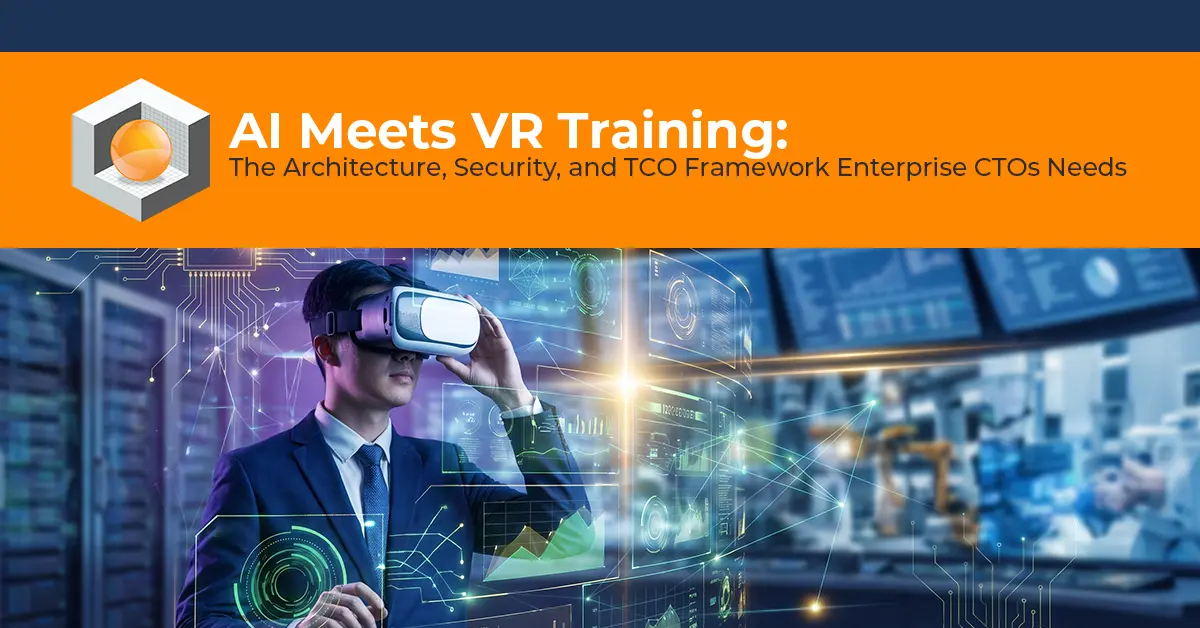
The CEO has asked the board what the organization’s AI strategy looks like across learning and development. The question lands on the desk of the CTO, who now owns the technical, governance, and procurement decisions that will follow. VR training platforms, already on the IT roadmap for most enterprises with industrial, healthcare, or HSE training scope, are being rapidly augmented with AI capabilities: LLM-driven conversational agents, procedural scenario generation, AI-translated multilingual content, adaptive difficulty engines, and AI-powered analytics. The marketing material is dense. The architectural decisions underneath are not.
This is the technical evaluation framework. Not the executive summary, not the L&D playbook, not the vendor pitch deck. The questions a CTO needs to ask before signing off on AI-augmented VR training procurement in 2026, and the framework for answering them across architecture, data governance, integration, and total cost of ownership.
The market context matters. The global enterprise VR training market reached $10.96 billion in 2026 and is projected to grow at 44.88% annually through 2035 (Forrester Total Economic Impact research, commissioned by Meta, reports 219% three-year ROI for enterprise VR training deployments). Approximately 91% of enterprises are either actively using or planning to adopt VR and AR training. 75% of Fortune 500 companies have VR training programs underway in 2026. The momentum is structural, not speculative. The technical questions underneath that momentum are where the CTO conversation has to start.
What “AI in VR Training” Actually Means: Cutting Through the Marketing Layer
VR training vendors are bundling six distinct AI capabilities under one marketing umbrella. For a CTO conducting vendor evaluation, distinguishing between them is the first prerequisite, because their architecture, data flow, and risk profiles differ materially.
The Six AI Capabilities Now Standard in Enterprise VR Training
LLM-driven conversational agents (NPCs that hold realistic dialogue with trainees) are most commonly deployed in soft skills training scenarios: customer service practice, leadership conversations, conflict resolution. Procedural scenario generation refers to algorithmic variation of training scenarios from a base template, producing dozens or hundreds of variants without manual authoring. AI-generated 3D assets cover environmental props, basic geometry, and ambient detail (tools like Luma, Meshy, and Scenario have matured significantly in 2025-26). AI translation and localization handle multilingual content adaptation, including voiceover generation and subtitle synthesis. Adaptive difficulty engines adjust scenario complexity based on trainee performance signals captured during the session. AI-powered analytics layer competency inference on top of raw performance data, flagging proficiency gaps without manual review.
Each of these capabilities has a different maturity level, a different cost profile, and a different governance burden. Treating them as a single feature is the most common procurement mistake CTOs encounter in vendor demonstrations.
Where AI in VR Training Is Mature, and Where It Remains Hype
Translation, asset generation, and conversational agents for non-safety-critical soft skills training are operationally mature in 2026. Multiple academic and industry studies have validated their effectiveness, including peer-reviewed work on LLM-based embodied conversational agents in clinical communication training and research on AI-driven avatars for teacher training simulations. AI translation alone can reduce multilingual content production cost by more than 50%, according to current vendor cost analyses. The standard DICE framework (Difficult, Impossible, Costly, Embarrassing) for evaluating VR training applicability has been extended in practice to include an AI-fit dimension: scenarios where the cognitive variability of a human counterpart adds training value rather than noise.
Fully autonomous procedural scenario generation for high-stakes training (safety, surgical, regulated industrial procedures) remains less mature. Vendors will demo it, but the content audit problem (verifying that generated scenarios meet regulatory and clinical standards) has not been solved at production quality. Adaptive difficulty engines exist but typically operate on relatively coarse signals (completion time, error count) rather than the rich behavioral data the marketing implies. CTOs should weight maturity assessments accordingly when evaluating procurement timing.
The Architecture Decision: Where Does the AI Actually Live?
The single most consequential technical decision for a CTO evaluating AI-augmented VR training is the deployment topology. Three patterns dominate 2026 enterprise architecture, each with distinct cost, control, and compliance characteristics.
Pattern 1: Vendor-Hosted, Fully Managed
All AI inference happens on vendor infrastructure. Trainee interactions, scenario data, and performance records flow to the vendor’s cloud, get processed by the vendor’s LLM provider (typically OpenAI, Anthropic, or a frontier model accessed via vendor abstraction), and return as scenario output. The advantage is operational simplicity and faster time to deployment. The constraints are data flow visibility, jurisdictional data residency, and dependency on vendor uptime and pricing. This pattern is appropriate for non-regulated soft skills training, general onboarding, and scenarios where training data is not commercially sensitive.
Pattern 2: Customer-Hosted, On-Premises or in Customer VPC
LLM inference runs in the customer’s own cloud environment (AWS, Azure, GCP) or on-premises. The training platform connects to a customer-provided model endpoint rather than the vendor’s hosted endpoint. Deployment complexity is higher, cost is higher (the customer carries model inference costs and infrastructure overhead), and time to deployment extends. The advantages are full data perimeter control, jurisdiction-specific data residency, and direct visibility into model behavior. For healthcare organizations operating under HIPAA, financial services operating under sector-specific data residency requirements, and defense or aerospace clients with classification constraints, this pattern is typically the only acceptable architecture.
Pattern 3: Hybrid With PII Redaction and Federated Inference
Increasingly the enterprise default in 2026. Personally identifiable information and commercially sensitive content are redacted or tokenized before leaving the customer’s data perimeter, with anonymized data sent to vendor-hosted AI services. Performance records and analytics data stay within customer infrastructure. This pattern requires careful contract negotiation on what specific data classes can be sent where, and it requires the vendor to support PII redaction at the platform level. It aligns most cleanly with EU AI Act guidance and with GDPR data minimization principles.
The Build-vs-Buy Decision in 2026
The third architecture question is whether to build a custom Unity or Unreal Engine training platform with bespoke AI integration (the 2024-25 default for large engineering organizations), or to procure a no-code or low-code VR training platform with AI capabilities baked in. The build path produces maximum flexibility and full control over the AI integration layer, at a cost typically two to four times higher than equivalent platform procurement and a deployment timeline measured in quarters rather than weeks. The buy path produces faster time to value and dramatically lower content authoring cost, at the cost of constraints on customization depth. For organizations evaluating the best VR platform for training, the 2026 procurement framing has shifted from raw capability comparison to architecture-fit and TCO modeling.
Data Governance and Security: The Questions Procurement Must Raise
AI-augmented VR training creates a new category of data flow that traditional vendor security questionnaires were not designed to evaluate. The training data is high-frequency, behaviorally rich, and increasingly used by frontier AI models in ways that traditional SaaS data governance frameworks do not fully address.
What Training Data Reaches LLMs (and Who Keeps the Records)
During an AI-augmented VR training session, the LLM layer can receive: trainee identity (or pseudonymized identifier), scenario context, decision points and choices, conversational transcripts (in soft skills scenarios), gaze tracking signals (on devices that capture them), and behavioral metadata such as hesitation patterns or repeated attempts. Vendor handling of this data varies enormously. The questions a CTO needs answered in writing during procurement: what data classes are sent to the LLM provider, what data retention applies at the vendor and at the LLM provider, whether the customer’s training data is used for model training (opt-in versus opt-out versus contractually excluded), and what data subject access request handling looks like under GDPR.
AI-Generated Content Audit and Policy
When a vendor’s AI generates training scenarios, who is responsible for what gets generated? This is a question 2026 enterprise contracts are starting to address explicitly. The risk is not theoretical. A generated emergency-response scenario that produces incorrect procedural guidance creates legal and operational exposure that did not exist when training content was hand-authored by certified instructional designers. Mature VR training vendors now offer content guardrails (subject matter expert review of generated content before deployment, sector-specific prompt constraints, post-generation validation against reference procedures). For high-stakes training scenarios, the absence of these guardrails should disqualify a vendor from procurement consideration, regardless of how impressive the demonstration appeared.
Sector-Specific Regulatory Exposure
Healthcare clinical training scenarios fall under HIPAA in the United States and equivalent regimes in EU jurisdictions; trainee interactions with simulated patient data and clinical decision points create regulated data flows. Industrial safety training under OSHA scrutiny and EU industrial safety frameworks requires documentation that AI-augmented systems must explicitly support (the question of whether session-level competency records meet OSHA, FDA, and NHS compliance frameworks intersects with the AI architecture in ways that procurement teams often overlook). The EU AI Act, in force across the bloc through 2025-26, classifies many training systems as limited-risk or high-risk AI systems depending on use case, with documentation and transparency obligations that vendors must demonstrably support. Defense, financial services, and critical infrastructure sectors carry sector-specific overlays on top of the general regulatory landscape.
Technical Note: Data Residency Becomes a Real Architecture Constraint
In 2026, EU-based enterprises operating under GDPR and EU AI Act constraints are increasingly required to keep AI inference within EU data perimeter for training systems that handle personal data. The practical implication for VR training architecture is that vendor-hosted patterns that route inference to US-based LLM providers are no longer compliant by default. The remediation paths are EU-hosted model endpoints (which OpenAI, Anthropic, and Azure now offer), PII redaction before egress, or fully customer-hosted inference. CTOs should treat data residency as a hard constraint during architecture evaluation, not a contractual afterthought.
Integration With the Existing Enterprise Stack
VR training platforms do not operate in isolation. The integration surface area between an AI-augmented VR training platform and the enterprise stack is meaningful, and procurement evaluation needs to surface integration requirements before architecture is locked in.
LMS Integration: xAPI, SCORM, LTI
Modern VR training platforms integrate with enterprise LMS infrastructure through one of three protocols: xAPI (the dominant standard for behavioral and competency data), SCORM (legacy but still required in many enterprise environments), and LTI for academic and certain professional credentialing contexts. AI-augmented platforms produce richer behavioral data than SCORM was designed to carry, making xAPI support effectively non-negotiable for new procurement. The integration questions: which xAPI verbs and statement profiles the platform emits, how AI-generated session metadata is preserved in the LMS record, and whether the LMS can serve as the system of record for AI-mediated competency assessments.
Identity, SSO, and Sensitive-Scenario Authentication
Enterprise SSO via SAML or OIDC is standard. The non-standard requirements emerge in sensitive training scenarios: clinical procedures, defense simulations, financial compliance scenarios. Multi-factor authentication may be required before specific scenarios can be launched, particularly when scenarios involve simulated patient data or classified content. Identity federation between the VR platform, the LMS, and the HRIS for competency tracking should be designed before deployment, not retrofitted after.
Analytics Pipeline and Data Lake Integration
The AI-augmented training session produces analytics events that organizations increasingly want to land in their central data lake (Snowflake, Databricks, BigQuery) for analysis alongside HR, performance, and operational data. Standard integration patterns use event streaming (Kafka, Kinesis) or scheduled batch export. For organizations with mature data infrastructure, the question of how training event data lands in the data lake, and what semantic layer is applied, is now part of the VR training procurement conversation rather than an afterthought.
Total Cost of Ownership: The Math CTOs Need to See
The procurement case for AI-augmented VR training rests on a TCO model that has shifted materially from the 2023-24 baseline. The framework below reflects 2026 vendor pricing realities and the operational economics of AI integration at enterprise scale.
The 10-15% AI Line Item That Produces 25-40% Content Savings
Industry cost analysis from VR Vision Group and equivalent enterprise XR pricing research indicates that AI capabilities add 10 to 15% to baseline VR training platform cost, while producing 25 to 40% in offsetting savings on content production (driven primarily by procedural scenario generation, AI-translated multilingual content, and AI-assisted asset creation). The net effect on three-year TCO is positive for most enterprise training programs at scale, but the savings are realized only when the content production pipeline actually uses the AI capabilities. Organizations that procure AI-augmented platforms but continue to manually author all content do not realize the savings; the AI line item becomes pure cost.
Hidden Costs: Inference at Scale, Fine-Tuning, Content Audit
Three cost categories tend to surface after procurement, not before. LLM inference at scale becomes a meaningful operational cost in deployments above approximately 500 active trainees, particularly for conversational scenarios that produce long dialogue traces. Model fine-tuning for sector-specific terminology or organizational voice runs typically $25,000 to $75,000 per major fine-tune cycle. Content audit for AI-generated scenarios in regulated industries requires subject matter expert time that procurement budgets often understate; in clinical and safety-critical training, audit overhead can consume 20 to 30% of the content development budget.
Three-Year TCO Scenarios for Common Deployment Patterns
A small enterprise deployment (500 trainees, two training scenarios, vendor-hosted architecture) typically runs $80,000 to $150,000 in year one, with year-two and year-three costs landing at 40 to 60% of year-one cost due to amortized content development. A mid-market enterprise deployment (2,000 trainees, six scenarios across multiple training categories, hybrid architecture with PII redaction) typically runs $300,000 to $600,000 in year one. Large enterprise multi-site deployment (10,000+ trainees, 15+ scenarios, customer-hosted architecture for regulated workloads) typically runs $1.5 million to $3.5 million in year one, with the highest line items being content development and integration engineering rather than platform licensing or hardware.
Vendor Evaluation: A 2026 Procurement Checklist for AI-Augmented VR Training
Market consolidation across 2025-26 has thinned the vendor landscape. MeetInVR closed in April 2026, citing the broader market shift triggered in part by Meta’s enterprise VR exit. Several smaller platforms have exited or been acquired. The vendors that remain operating at enterprise scale are concentrated in a small number of categories: dedicated enterprise training platforms (built for B2B from inception), spatial computing platforms with training extensions, and custom development agencies serving large industrial accounts. CTO procurement evaluation in 2026 needs to surface vendor financial stability as a real risk factor, not just feature comparison.
Questions Every RFI Should Include
Specific data flow diagrams for each AI capability the vendor advertises, including model provider, inference region, data retention, and customer data segregation. Sector-specific compliance documentation, including HIPAA business associate agreements where applicable, SOC 2 Type II reports, EU AI Act conformance documentation, and any sector-specific certifications. Exit ramp and data portability specifications: what happens to authored content, trainee performance records, and AI-generated assets if the contract is terminated. Roadmap and product continuity: financial stability assessment, recent funding events, customer concentration risk, and indemnification terms. Reference customers in comparable industry verticals, with the explicit invitation to speak directly with two or three of those customers without vendor mediation.
Lock-In and Exit-Ramp Considerations
VR training platforms have historically had high switching costs: authored content is typically platform-specific, integration work is non-trivial, and trainee performance records are not portable across systems by default. The 2026 procurement conversation has begun to address this directly. Mature vendors now offer content export in open formats, performance data export via standard xAPI statements, and contractual commitments around data return on termination. Organizations should not procure AI-augmented VR training without those commitments documented in the master agreement.
Frequently Asked Questions
Does AI in VR training mean we need to overhaul our existing LMS?
In most cases, no. AI-augmented VR training platforms integrate with existing LMS infrastructure through xAPI or SCORM (xAPI is preferred for the behavioral richness AI-augmented sessions produce). The LMS does not need to be AI-aware to serve as the system of record for competency tracking. The integration work is primarily on the event schema and authentication side, not on a full LMS replacement.
How does the EU AI Act apply to enterprise VR training systems?
The EU AI Act classifies AI systems by risk level. Training systems for employees generally fall into either limited-risk or high-risk categories depending on use case and consequence. High-risk classification typically applies to training systems used for safety-critical roles, regulated professions, or scenarios where the AI mediates competency decisions that affect employment. CTOs procuring AI-augmented VR training in EU jurisdictions should require vendors to provide explicit EU AI Act risk classification for the use case in question, along with documentation supporting that classification.
Should we build a custom VR training platform on Unity or Unreal, or procure a no-code platform with AI?
The decision turns on three variables. First, content velocity: organizations that need to update training scenarios frequently or author site-specific content benefit from no-code platforms where L&D and HSE staff can author directly. Second, customization depth: organizations with highly specific equipment, processes, or workflows that cannot be captured in catalogue templates lean toward custom development. Third, internal engineering capacity: custom builds require sustained engineering investment, while platform procurement requires sustained vendor management. For most mid-market and large enterprises in 2026, the platform-procurement path has the better TCO; the custom-build path is appropriate for organizations with engineering resources and unusually specific requirements.
What is the realistic timeline from procurement to multi-site deployment?
For organizations using a no-code platform with a ready-made content catalogue, multi-site deployment can be operational within four to eight weeks of contract signature. Custom scenario development adds two to four months per scenario, depending on complexity. AI integration configuration (data flow agreements, PII redaction setup, model endpoint configuration) typically adds two to six weeks. The longest-pole timelines are typically integration with enterprise SSO, LMS, and analytics infrastructure, not the VR platform itself.
How do we handle vendor lock-in for AI-augmented training content?
Three contractual mechanisms address this. Content export rights with specified open-format outputs. Performance data export via standard xAPI statements and documented schema. Continuity provisions for AI-generated assets, including the right to retain and use AI-generated content after contract termination. These provisions need to be in the master agreement before signature, not negotiated at termination. Mature enterprise VR training vendors offer these terms standardly; their absence is a meaningful procurement red flag.
Where is AI in VR training NOT ready for enterprise deployment?
Fully autonomous procedural scenario generation for safety-critical or clinically-regulated training remains the largest maturity gap. AI-generated scenarios in these domains require subject matter expert review at a depth that often eliminates the time savings. Adaptive difficulty engines based on rich behavioral signals (beyond completion time and error count) are still operationally limited. Real-time multi-user conversational AI in collaborative training scenarios works in demos but has not been validated at enterprise scale. CTOs should weight maturity assessments accordingly, particularly when vendors anchor their demonstrations on the most ambitious capabilities.
The Strategic Conclusion: AI in VR Training Is Real, and It Is a CTO-Level Decision
AI-augmented VR training is no longer an emerging category. The Forrester three-year ROI data, the Fortune 500 adoption rate, the 44.88% projected market CAGR through 2035, and the breadth of enterprise deployments across industrial, healthcare, and defense verticals all confirm that the procurement decision is real and now. The question is no longer whether to invest, but how to structure the architectural, governance, and integration decisions that determine whether the investment produces the outcomes the business case predicted.
For CTOs, the conversation is fundamentally different from the L&D conversation that runs in parallel. L&D evaluates pedagogy, content fit, and learner experience. CTOs evaluate architecture, data flow, regulatory exposure, integration complexity, and three-year TCO under multiple deployment scenarios. Both conversations need to happen, but the architectural decisions made on the CTO side determine whether the L&D outcomes are operationally achievable.
The framework above is the technical due-diligence baseline. The vendor evaluation that follows should be conducted against it explicitly, with each AI capability layer evaluated independently for data flow, deployment topology, content audit posture, and integration surface. Procurement teams that treat AI in VR training as a single feature will overpay or under-control, often both. Procurement teams that treat it as six distinct capability layers will land on architectures that match the organization’s actual risk and integration profile.
How RoT STUDIO Approaches This
RoT STUDIO’s VR training platform is built around the architectural principles enterprise CTOs increasingly require: no-code authoring that keeps content development in customer control rather than vendor-dependent engineering cycles, multi-device deployment across Meta Quest 3, PICO 4, PC VR, and mobile XR, and integration patterns designed for enterprise LMS, SSO, and analytics infrastructure. The platform’s deployment model supports vendor-hosted, customer-hosted, and hybrid architectures depending on the regulatory and data residency requirements of the use case.
For AI capabilities, RoT STUDIO’s approach is integration over reinvention. The platform is designed to accommodate AI translation and asset generation through customer-selected model endpoints, with PII redaction at the platform layer for organizations operating under EU AI Act, GDPR, HIPAA, or sector-specific compliance constraints. The ready-made VR Training Catalogue covers industrial safety, healthcare, HSE, disaster preparedness, and soft skills training, all configurable through the no-code authoring environment that allows customer teams to maintain control of content evolution. Customized VR/XR Services extend the platform into site-specific and equipment-specific scenarios where standard catalogue modules cannot capture the operational specifics.
For enterprise CTOs evaluating AI-augmented VR training architecture against the framework outlined above, the RoT STUDIO License platform and broader VR/XR Training Solutions are the starting point. Get in touch with the team to walk through what a deployment looks like for your specific architectural, regulatory, and integration profile.