The Designer Module of the RoT STUDIO License gave engineering teams a way to move CAD models directly into immersive scenes without waiting on external development studios. That closed the CAD-to-VR gap for the engineering side of enterprise VR content creation. But engineering-authored scenes are only half the operational story. The other half is what happens when the L&D team, the HSE department, the operations manager, or the training coordinator needs to convert a standard operating procedure into an interactive VR training scenario that runs across shifts, sites, and departments. That is the specific gap the Trainer Module of the same License platform closes.
The two modules are complementary rather than overlapping. The Designer starts from the design and works forward into visual richness, materials, lighting, and multi-user review. The Trainer starts from the training objective and works forward into interactive scenarios, procedural sequences, and session-level performance analytics that L&D teams and operations directors actually use to run programmes at scale. For organisations building enterprise training on the RoT STUDIO License platform, the two modules together produce a workflow that puts content creation and training deployment inside the organisation, at internal iteration velocity, without depending on external development cycles.
This piece is for heads of L&D, training programme managers, HSE directors, and operations leaders who are being asked to scale training across the workforce faster than the traditional classroom-and-instructor model can move. It focuses on the three operational capabilities that make the Trainer Module the specific answer to that scaling problem: no-code authoring through drag-and-drop workflow, safe and realistic practice for complex tasks, and training deployment that scales across departments without the linear cost increase traditional training models impose.
The SOP-to-Training Gap: Where Traditional Programmes Break Down
Understanding what the Trainer Module actually solves requires naming the gap the standard corporate training model has never fully closed. The gap is not attention. It is not budget. It is the structural distance between what an SOP documents and what a workforce actually learns.
Why Nobody Learns Procedures From Reading SOPs
The standard operating procedure captures the correct execution of a task with sufficient precision that a subject matter expert can verify compliance. It does not capture the sensory conditions of the task, the physical sequence of movements, the failure modes that occur when a step is done incorrectly, or the tacit judgment that experienced operators bring. A new hire reading the SOP will pass a written comprehension test and will still make the errors an experienced operator would not, because reading is not practice. The whole enterprise training industry has spent thirty years working on this gap through classroom instruction, video demonstration, e-learning modules, and instructor-led shadowing. Each format helps at the margins. None of them close the gap.
Why External VR Development Has Not Been the Answer
Virtual reality-based procedural training does close the gap. A trainee who executes the procedure in a VR scenario, receives corrective feedback at each decision point, and repeats the sequence multiple times has built substantively different procedural competency than a trainee who watched a video demonstration and signed an attendance sheet. This is not disputed at the industry level. The reason VR training has taken so long to reach enterprise scale is the content production bottleneck. Every scenario requires 3D asset preparation, interactivity authoring, testing across target hardware, and clinical or subject-matter validation. Handed off to an external Unity or Unreal development studio, this cycle typically runs four to six months per scenario at a cost that most organisations can sustain only for their highest-priority content.
Where the Trainer Module Sits in This Landscape
The Trainer Module is the platform layer that moves the SOP-to-VR-training conversion inside the organisation. An L&D specialist, an HSE trainer, or an operations manager can import the relevant 3D models, translate the SOP into an interactive procedural sequence, configure the assessment and feedback logic, and deploy the completed scenario across target VR hardware. No writing of code, no external studio engagement, no waiting on a development cycle disconnected from the operational reality the training is being built for. The Ford Otosan Romania implementation completed 210 highly realistic training sessions in six weeks against the assembly workforce transition to electric vehicle production. That figure is only possible when the content creation cycle runs at internal iteration velocity rather than external development cadence.
Angle 1: No-Code Authoring Through Drag-and-Drop Workflow
The first of the three operational capabilities that make the Trainer Module the practical answer to enterprise VR training scaling is that content creation happens without a single line of code. This is not a marketing framing. It is a specific architectural decision that shapes who inside the organisation can actually build training content.
The Drag-and-Drop Scene Assembly Workflow
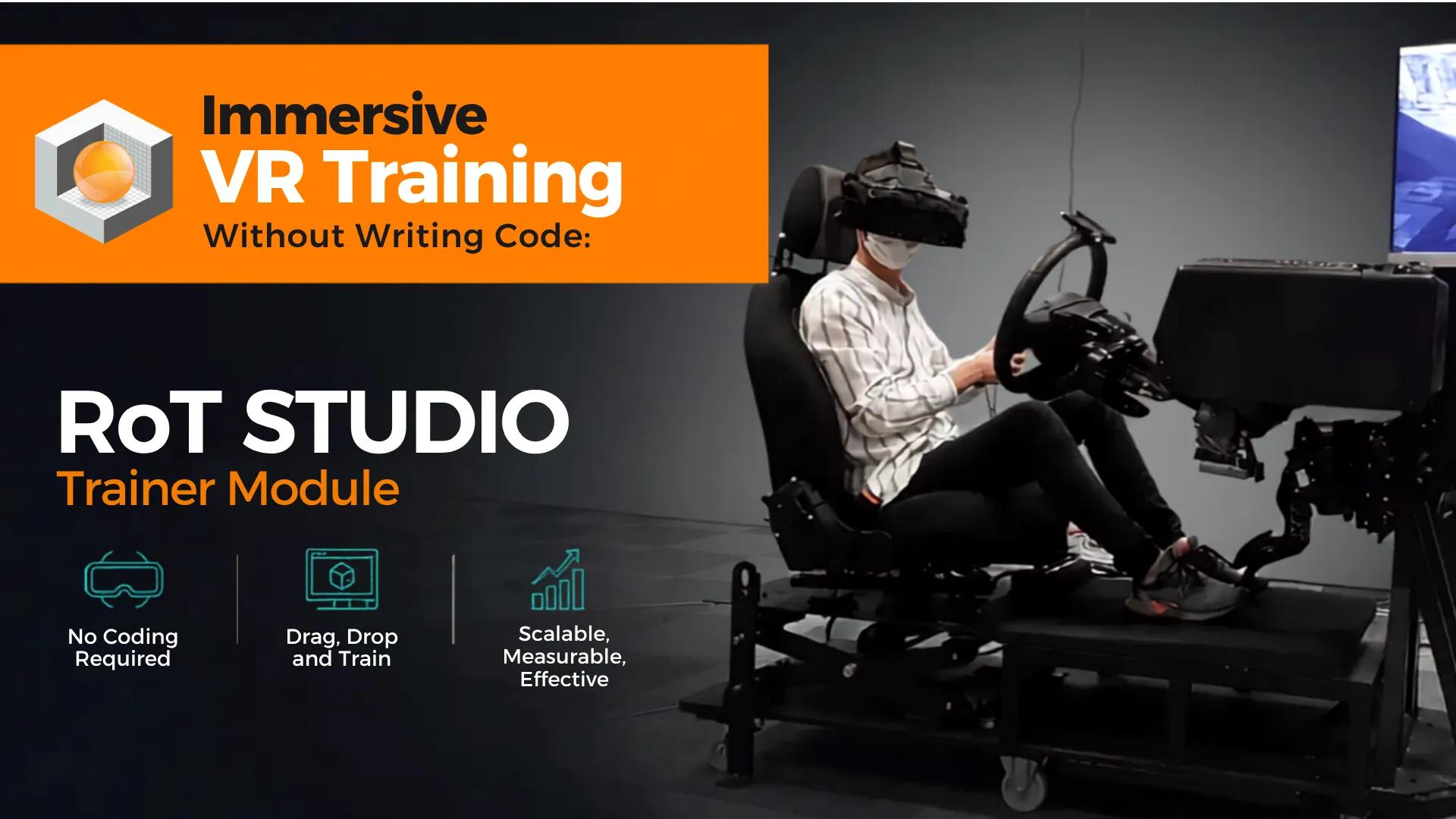
The Trainer environment is built around a drag-and-drop interface for scene assembly. An L&D author selects 3D assets from the library, places them into the scene, configures spatial relationships, applies textures and materials, and adjusts lighting through direct manipulation rather than through code editors, script files, or command-line tools. The workflow reads like a modern digital design tool: click, drag, drop, adjust, preview, iterate. Authors who have used PowerPoint, Adobe products, or standard collaboration platforms will recognise the interaction model within minutes of first opening the environment.
Task Nodes and Command Nodes: Where Interactivity Happens
Interactivity in the scene, the part that turns a static 3D environment into an actual training scenario, is authored through two graphical node categories that eliminate the coding step traditional VR authoring depends on. Task Nodes are the interactive primitives associated with objects in the scene: touch a control, grab a component, snap a part into position, complete a sequence of actions in a specific order. Command Nodes handle the multimedia and consequence logic: play an animation when a step is completed, trigger a sound cue on incorrect execution, show a video segment before the next task begins, adjust scenario difficulty based on trainee performance. Chained together, these nodes construct the full procedural training experience without asking the author to write a single line of code.
The Two-Day Proficiency Ramp
The RoT STUDIO team delivers a two-day training course that brings new authors to functional Trainer Module proficiency. Two days. Not two weeks, not a semester, not the multi-quarter ramp that hiring a Unity developer requires. Existing L&D team members, HSE trainers, operations coordinators, and process engineers can be brought into the content authoring workflow within a single working week, with productive output within the second week. This is the operational condition that makes internal content ownership viable at team scale rather than requiring the organisation to build or contract a specialist development function.
What This Means for L&D Team Composition
The composition question that historically constrained VR training adoption was straightforward: does the organisation hire Unity developers, contract with an external studio, or defer VR training until the content pipeline problem is solved. The Trainer Module makes a fourth option operationally viable: the L&D team you already have becomes the content pipeline. Existing L&D specialists retain their subject-matter knowledge and their pedagogical judgment, and gain the tools to translate both directly into VR training scenarios. This eliminates the coordination friction that hand-off models introduce and puts the training content decisions in the hands of the people who understand the workforce the training is being built for.
Angle 2: Safe and Realistic Practice for Complex Tasks
The second operational capability that defines the Trainer Module is the training environment itself: safe, controlled, and realistic enough that the practice produces transferable competency rather than superficial familiarity.
The Safety Layer: Practicing High-Stakes Tasks Without Consequence
Many of the tasks enterprise training programmes need to build competency around carry real consequence when done incorrectly. Live fire response training exposes trainees to physical fire and burn risk. Electrical work training requires energised equipment access. Underground mining, working at heights, chemical handling, and equivalent hazardous domains have historically carried an incident rate in the training itself. The Trainer Module removes the consequence layer during practice. A trainee can make every typical first-year error the workforce would otherwise make in the field, without producing physical injury, equipment damage, or downtime. The specific applications for this pattern are visible in the occupational health and safety training programmes that organisations have built on the platform, covering HSE Risk Hunt, Working at Heights, Underground Mining Risk Hunt, LoTo procedures, and equivalent high-consequence scenarios.
The Realism Layer: Procedural Specifics Matched to Actual Workflow
Safe practice only matters if the practice environment reflects the actual working conditions. A generic training scenario disconnected from the specific equipment, layouts, and procedures of the site produces surface familiarity that does not survive the transition to real work. The Trainer Module supports import of the organisation’s actual facility geometry, equipment CAD models, and procedural specifics, meaning training scenarios can be built against the site the trainee will actually work at, using the equipment the trainee will actually operate. This is the operational condition that makes VR training produce transferable competency rather than aspirational simulation.
Repetition Density: The Mechanism That Builds Competency
Procedural competency is built through repetition. A trainee who executes a procedure forty times has substantively different motor memory and decision fluency than a trainee who watched the procedure demonstrated three times and signed an attendance sheet. Live training environments cannot deliver repetition density: fire extinguisher discharges consume replacement charges, working at height sessions require setup and supervision, hazardous equipment training requires instructor oversight per trainee. The Trainer Module removes these repetition constraints. A trainee can complete a scenario dozens of times in a single session, building the motor and decision competency that field performance actually requires.
Tosyalı Holding: Iron and Steel On-Site Training at Enterprise Scale
Tosyalı Holding, a major Turkish iron and steel producer, implemented the Trainer Module to build on-site training programmes across their production facilities. The scenarios cover hazard identification, PPE selection procedures, and emergency response protocols, all delivered in the specific environmental context of the production sites workers actually operate in. The value of building the training internally on the Trainer Module rather than through external development is that the training content evolves with the facilities and processes it addresses. When equipment configurations change, when a safety incident produces a new learning, when procedural updates roll through the organisation, the training scenarios update at internal velocity rather than requiring an external content revision cycle.
Session-Level Performance Data: Documented, Analysed, Actionable
Practice without measurement is exercise. Practice with measurement is training. The Trainer Module captures session-level performance data automatically: which decisions the trainee made, how long each procedural step took, where errors occurred, how many repetitions were required before correct execution, which scenario variations were completed. This data supports three operational uses. First, competency documentation that satisfies internal quality standards and, where applicable, regulatory audit requirements. Second, individual coaching that identifies specific skill gaps and directs subsequent training toward them. Third, organisational analytics that surface systemic training gaps before they show up in incident reports or quality data.
Angle 3: Scaling Training Across Departments and Sites
The third operational capability of the Trainer Module is the one that most reliably justifies the platform investment at the executive level: training scenarios author once and deploy across the entire workforce, without the linear cost increase that traditional classroom and instructor-led programmes impose.
Author Once, Deploy Everywhere
A scenario built in the Trainer Module deploys across every site in the organisation with identical content fidelity. The fire response training a trainee completes in Rotterdam is the same content the trainee in Ankara or Sancaktepe completes. This is a structural change from the traditional model where each site develops its own training materials, delivers them through its own instructor pool, and produces variable training outcomes across the workforce. The consistency itself has operational value: workforce transitions between sites become easier because the training foundation is common, and organisational quality standards apply uniformly across the network.
Cross-Department Consistency Without Central Bottleneck
Departments across large organisations have historically operated their own training programmes with their own subject matter experts, their own content, and their own delivery methods. This produces localised strength and organisational inconsistency in roughly equal measure. The Trainer Module enables a different pattern: central L&D authors the foundation scenarios, individual departments author their specific variations on top of the foundation, and the resulting training portfolio maintains organisational consistency while preserving department-specific relevance. This is the specific pattern manufacturers switching to VR-based workforce training have adopted at scale during 2025 and 2026.
Ford Otosan Romania: 210 Training Sessions in Six Weeks
The Ford Otosan Romania implementation is the operational reality of what scale looks like when the content pipeline is internal. Tasked with transforming assembly training operations to prepare the workforce for electric vehicle production, the facility implemented the Trainer Module and executed 210 highly realistic training sessions in six weeks. This is not a traditional classroom-programme cadence. It is the operational rhythm that becomes possible when the content authoring cycle collapses from external-studio months to internal-team days. The scale enabled the workforce transition to keep pace with the production line changeover schedule, which is exactly the kind of operational timing that traditional training models cannot maintain.
Multi-Language, Multi-Timezone, Multi-Shift Delivery
Organisations operating across multiple language markets, multiple timezones, and multiple shift patterns face particular training scale challenges. Instructor-led delivery requires instructor time in each language, at each site, on each shift. The Trainer Module supports scenario delivery in multiple language configurations from the same underlying content, deployed asynchronously across shifts and timezones, without requiring instructor availability at the point of training. For multinational operators, this eliminates the training delivery bottleneck that geographic and linguistic diversity historically imposed.
LMS Integration and Organisational Analytics
The Trainer Module’s session-level performance data feeds into standard enterprise LMS infrastructure through xAPI and, where required, SCORM. This means the training analytics flow into the same organisational systems that track compliance, competency, and workforce development across the enterprise. HR leaders see training completion and competency data alongside other workforce indicators. Compliance functions see documented practice at the individual level, which supports audit requirements under sector-specific regulatory frameworks. Operations directors see workforce readiness against operational needs, at the site and departmental resolution their decisions actually require.
What This Enables at Enterprise Scale
The strategic picture the Trainer Module produces, when the three operational capabilities described above are combined, is a fundamental change in how enterprise training programmes operate.
L&D Teams Become Content Owners, Not Content Buyers
The historical L&D operating model treated training content as something the department procured, whether from internal development, external vendors, or content marketplaces. The Trainer Module makes L&D the content producer. This is not a scope expansion, it is a scope shift: the team stops managing vendor relationships and content revision cycles, and instead manages content strategy, quality standards, and organisational learning outcomes. The workload profile changes but the total effort does not increase, because the vendor management and content coordination work that gets eliminated is substantial.
The Training Update Cycle Collapses From Months to Days
When an equipment configuration changes, when a safety incident produces a new procedural requirement, when a regulatory update mandates a training modification, the response cycle collapses from months to days. This is the operational condition that keeps training content current with the workforce reality. Programmes that were previously stuck with training content that reflected the equipment as it existed twelve months ago now run training content that reflects the equipment as it exists today. The compounding effect on training programme quality is significant. The same pattern of engineering-adjacent iteration velocity that the CAD-to-VR bridge in the Designer Module enables for design content applies to training content in the Trainer Module.
The Organisational Learning System
What emerges over time, when the Trainer Module is operationally embedded across an organisation, is not just a training programme. It is an organisational learning system. Every training scenario is an artefact of what the organisation has learned about a particular procedure, hazard, or workflow. Every session-level performance record is data on how the workforce actually performs against that procedure. Every scenario update reflects what the organisation has learned since the scenario was last authored. The training programme becomes a living record of institutional knowledge, updated continuously, deployed consistently, and analysed across the workforce for both training and operational insight.
Frequently Asked Questions
How is the Trainer Module different from the Designer Module?
The two modules serve complementary purposes. The Designer Module is built around design review and CAD-to-scene workflows, primarily used by engineering teams for design collaboration, product visualisation, and the visual foundation of training content. The Trainer Module is built around SOP-to-training conversion, primarily used by L&D teams, HSE trainers, and operations coordinators for the interactive procedural scenarios that constitute actual VR training. Both modules use drag-and-drop no-code authoring; the differences are in the workflow orientation, the target user, and the specific interactivity architecture. Organisations frequently use both modules in combination: engineering builds the visual scene foundation in Designer, and L&D layers the training scenario logic in Trainer.
What kind of hardware do L&D authors need for Trainer content creation?
The authoring workstation runs on standard enterprise-grade PC hardware: an Intel i7-class processor with an NVIDIA RTX 3000-series graphics card or higher is the confirmed baseline. Deployment target devices for the compiled scenarios include current-generation standalone VR headsets including Meta Quest 3, Quest 3S, PICO 4, and SteamVR-compatible configurations. The hardware requirement profile reads more like standard L&D workstation provisioning than specialised development infrastructure, which is intentional: bringing VR authoring inside the L&D team should not require the department to become an IT specialist function.
Can existing SOPs be converted into Trainer scenarios directly, or does the content need to be reworked?
Existing SOPs form the source content, but the conversion is not a straight import. The Trainer Module is designed around interactive scenario logic, not document display, which means the SOP content needs to be structured into procedural steps, decision points, and assessment criteria that the interactivity model can express. In practice, L&D authors work through the SOP with the subject matter expert, identify the discrete tasks and decisions, and construct the scenario against that structured breakdown. The initial content transformation is typically the highest-effort part of the authoring process; subsequent scenarios in the same operational domain reuse patterns and asset libraries and complete much faster.
How does the Trainer Module integrate with our existing LMS?
The Trainer Module produces session-level performance data that integrates with enterprise LMS infrastructure through xAPI, and where required, SCORM. Standard integration patterns cover scenario completion tracking, competency assessment data, error and remediation records, and organisational reporting. Integration typically requires configuration engineering during initial deployment but does not require LMS replacement. For organisations with mature learning analytics infrastructure, the Trainer data flows into the same dashboards that track other workforce competency and development indicators.
What happens when a scenario needs to be updated after equipment or procedure changes?
Because the content lives inside the L&D team’s Trainer environment rather than in an external vendor’s project files, updates run on the organisation’s own timeline. The L&D author opens the scenario, modifies the affected components (adds new equipment models, adjusts procedural sequences, updates assessment criteria), and redeploys the updated scenario across the target hardware. Updates that would typically require a multi-week external revision cycle can be completed in hours or days internally. This is the specific operational condition that keeps training content current with the workforce reality it addresses.
How does the Trainer Module fit alongside the VR Training Catalogue and Customised VR/XR Services?
The three RoT STUDIO products serve complementary purposes. The VR Training Catalogue delivers ready-made scenarios for organisations that need immediate deployment against standard training content across HSE and industrial domains. Customised VR/XR Services provides RoT-team scenario development for organisations with specialty scope or unusual custom requirements that fall outside standard catalogue coverage and outside the practical scope of internal authoring. The License, including the Trainer Module, is the path for organisations that want to author and maintain content in-house at internal velocity. Most large deployments combine the three: Catalogue for immediate coverage, Custom Services for specialty scenarios, and License with Trainer Module for organisation-specific content that the L&D team owns and iterates directly.
The Strategic Conclusion: Internal Content Ownership Is the 2026 L&D Operating Model
Enterprise VR training has moved past the early-adopter phase. The 2026 operational reality is that VR-based procedural training is embedded in workforce development strategies at manufacturers, healthcare systems, and industrial operators across Europe and beyond. What has changed alongside the maturity of the training model is the maturity of the content production model. External development studios were the necessary route into VR training when the platforms did not exist to move content authoring inside the organisation. In 2026, that constraint is gone.
For heads of L&D, training programme managers, HSE directors, and operations leaders evaluating the next phase of VR training scaling, the strategic conclusion is direct. The three operational capabilities the Trainer Module delivers, no-code authoring, safe and realistic practice, and cross-departmental scaling, combine to produce an internal content ownership model that runs at internal iteration velocity, produces training content aligned to the workforce reality, and scales without the linear cost increase traditional training programmes impose. Ford Otosan Romania’s 210 training sessions in six weeks is not a marketing number. It is the operational rhythm that becomes possible when the pipeline moves inside.
How RoT STUDIO Approaches This
The Trainer Module of the RoT STUDIO License is built around the operational reality that L&D teams need to author training content at internal velocity, without adopting programming skills or committing to external vendor cycles. The platform’s node-based interactivity architecture, direct 3D model import, session-level performance analytics, and multi-device deployment through the RoT STUDIO Viewer collectively enable L&D-owned authoring workflows that match the iteration cadence of the workforce needs they address.
For organisations combining the Trainer Module with adjacent RoT products, the VR Training Catalogue provides immediate coverage against standard HSE and industrial scenarios, and Customised VR/XR Services addresses specialty scenarios that require RoT team engineering support. For engineering functions specifically, the sister Designer Module complements the Trainer Module by handling the design review and CAD-to-scene workflows that engineering teams own. Together the four elements produce the operational infrastructure enterprise VR training programmes actually need.
For L&D directors, HSE managers, operations leaders, and training programme leads evaluating the SOP-to-VR-training pipeline, the VR/XR Training Solutions portfolio from RoT STUDIO is the starting point. Get in touch with the team to walk through what an internally-owned Trainer Module deployment looks like for your specific training portfolio, workforce scope, and departmental structure.