Every safety manager responsible for elevated work carries the same quiet worry. It is not whether the training happened. It is whether the record of that training would hold up if an inspector asked for it tomorrow, or if a lawyer asked for it after an incident.
That worry is well founded. Fall protection has been the most frequently cited standard in American workplace enforcement for fifteen consecutive years, with close to 5,900 citations issued in the 2025 fiscal year alone. In Europe the duty is framed differently but lands in the same place: anyone involved in work at height must be competent, or must be directly supervised by someone who is.
The word carrying the weight in both frameworks is competence, not attendance. A signature on a training register proves a worker was in the room. It does not prove that worker can select a suitable anchor point, calculate fall clearance beneath a leading edge, or reject a damaged lanyard before clipping in. The distance between attendance and demonstrated capability is where most programmes are exposed, and that distance is what this article is about.
The Regulatory Baseline: Two Frameworks, One Obligation
Organisations operating across regions run into a practical problem early. The regulatory language differs, the trigger points differ, and the documentation expectations differ. The underlying obligation does not.
The United States: Trigger Heights and the Competent Person Rule
American enforcement is built around numeric thresholds that vary by industry classification, which is the single most common source of confusion for employers running mixed sites.
| Sector | Standard | Trigger height |
| Construction | 29 CFR 1926.501 | 6 feet |
| General industry | 29 CFR 1910.28 | 4 feet |
| Shipyards | 29 CFR 1915 Subpart E | 5 feet |
| Longshoring | 29 CFR 1918 | 8 feet |
Beyond the threshold itself, two requirements deserve attention. Training must be delivered by a competent person, defined in the construction standard as someone capable of identifying hazards and authorised to correct them. Separately, the employer must retain written certification naming the employee, the date of training, and the trainer. Where that record cannot be produced during an inspection, the position generally taken by enforcement officers is that the training did not occur.
Penalties reinforce the point. Under the current schedule a serious violation reaches roughly $16,550 and a willful violation reaches $165,514, with a substantial minimum attached. Because each worker exposed to a fall hazard without training can be counted separately, one crew on one roof can generate several citations from a single inspection.
Europe and the United Kingdom: Competence Before Equipment
The European approach starts from a different premise. Rather than setting a height at which protection begins, it asks whether a fall could cause injury at all. The British regulations, which give effect to the European work equipment provisions now consolidated into a single directive, apply to work at any height where a fall is liable to cause personal injury. The earlier two metre threshold was removed deliberately.
Duty holders must work through a hierarchy. Avoid work at height where it is reasonably practicable to do so. Where it cannot be avoided, use collective protection such as guardrails. Fall back on personal fall arrest systems only once the first two options are exhausted. Competence sits alongside this hierarchy rather than beneath it, and the duty extends across the whole chain, from the worker on the platform through to the supervisor, the planner, and the designer.
For an organisation running sites in both regions the practical consequence is worth stating plainly. A programme built only around American trigger heights will not satisfy a European inspector, and a programme built only around European competence language will not produce the written certification an American inspection demands.
Where Conventional Delivery Runs Out
Classroom sessions and toolbox talks transfer information well. They are considerably weaker at building the procedural reflexes that fall protection depends on, and the reasons are structural rather than a matter of instructor quality.
The first is repetition. Correct harness inspection, anchor selection, and clearance calculation become reliable through repeated practice, and a classroom offers a worker one or two supervised attempts at most. The second is consequence. A trainee who picks an unsuitable anchor point in a slide deck exercise sees a red cross on a screen. A worker who does the same on a live structure does not get a second attempt.
The third reason is the one safety managers raise most often, and it is the hardest to design around. High consequence scenarios cannot be rehearsed in the environment where they matter. Practising a rescue from a suspended harness on an actual structure introduces the precise hazard the training exists to prevent, so rescue procedures end up described rather than performed. Published guidance is consistent that suspension trauma can become life threatening within minutes, which makes rescue one of the few areas where a written plan and a rehearsed plan are meaningfully different documents. Related scenario work such as HSE Risk Hunt training runs into the same constraint for the same reason.
The Retraining Triggers Most Programmes Miss
Annual refresher training is widely adopted, and it is a reasonable habit. It is not, however, what the regulations actually ask for. The regulatory triggers for retraining are event based rather than calendar based, and events are easier to miss than dates.
Retraining is required when the workplace changes in a way that alters the fall hazard, when new fall protection equipment or systems are introduced, and when a supervisor observes a worker handling equipment incorrectly or showing inadequate understanding. Consensus standards layer a cadence on top of this, with fall protection competency commonly refreshed every two years and mobile elevating work platform certification every three to five.
The equipment trigger has become more consequential recently. The reclassification of self-retracting lifelines into distinct classes, according to whether the device anchors at or above the dorsal D-ring or below it for leading edge work, means a site introducing leading edge devices has introduced new equipment in the regulatory sense. A programme treating its harness module as evergreen content is quietly out of date, and nobody in the organisation is likely to notice until an inspection or an incident surfaces it.
How Simulation Closes the Evidence Gap
Immersive simulation earns a place in a working at height programme for one narrow and specific reason. It is the only delivery method that lets a worker fail a high consequence task repeatedly without consequence, while producing a record of every attempt.
Repetition Under Realistic Conditions
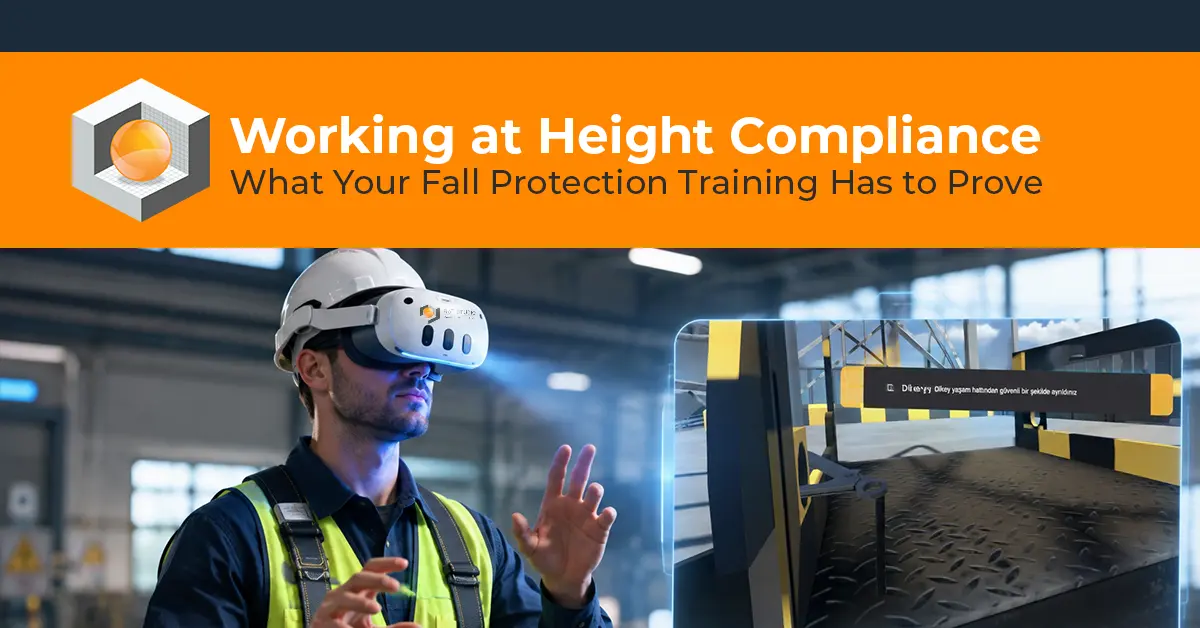
In a virtual environment a trainee can walk a scaffold, select an unsuitable anchor, misjudge clearance beneath a leading edge, and experience the outcome, then repeat the sequence until the correct response becomes automatic. The scenario reruns on demand at no marginal cost and with no exposure. Rescue procedures, which are rarely rehearsed anywhere, become a routine part of the module rather than a paragraph in a binder. The Working at Height module in the RoT STUDIO catalogue is built around exactly this pattern, and the broader case for VR-based working at height training covers the learning science underneath it.
Performance Data as Compliance Evidence
The second contribution matters more to the compliance file than to the trainee. Simulation platforms record attempt counts, success rates, error types, and completion levels for each individual. That turns a vague claim that the workforce is trained into a per-worker record of what was attempted, what was failed, and what was eventually performed correctly.
When an inspector, an insurer, or opposing counsel asks how competence was verified, that record is a substantively different answer from a signed sheet. It is also the same dataset that identifies which crews need intervention before an incident rather than after one, which is the part safety managers tend to value once they have it. Organisations already running LoTo Lock training or wider health and safety VR programmes are usually reading that data across modules rather than in isolation.
| TECHNICAL NOTE Simulation Supplements the Competent Person, It Does Not Replace Them Nothing in either regulatory framework allows a simulation to stand in for the competent person who must deliver and verify training, or for hands-on familiarity with the specific equipment a worker will actually wear on site. The defensible model is blended. Simulation carries the repetition, scenario exposure, and rescue rehearsal. Physical equipment checks and competent person sign-off stay exactly where they are. Deploying VR as a replacement rather than a supplement swaps one compliance gap for another. |
Building a Defensible Programme
A working at height programme that holds up under scrutiny tends to carry the same components regardless of sector. Start with a documented hazard assessment identifying every location and task where a fall is possible, then confirm the correct trigger height for each site’s regulatory classification. Map protection to the hierarchy, preferring elimination and collective systems over personal fall arrest wherever the work allows it.
From there the requirements turn administrative, which is precisely why they slip. Anchor points need certification. Inspection logs for harnesses, lanyards, and connectors need to be current, with compromised equipment withdrawn rather than repaired. Rescue procedures need to be written, assigned to named responders, and genuinely practised. Training certification needs to name the worker, the date, and the trainer, and it needs to be retrievable several years later rather than filed somewhere plausible.
The final component is the one most often missing altogether. The programme needs a mechanism for demonstrating competence rather than asserting it, plus a way to show that mechanism was applied to every individual on the register. Everything else on the list is easier to satisfy than that one, and easier to satisfy badly.
Frequently Asked Questions
Safety managers evaluating a change to their working at height programme tend to raise the same practical questions well before they raise budget. The ones below come up most consistently.
Does VR training satisfy OSHA or Work at Height Regulations requirements on its own?
No. Both frameworks require training delivered and verified by a competent person, and neither treats any single delivery format as automatically sufficient. Simulation is best positioned as the repetition and assessment layer inside a programme that retains competent person oversight, physical equipment familiarisation, and written certification records.
How often does working at height training need to be repeated?
The regulatory triggers are event based rather than annual. Retraining is required when the workplace changes, when new fall protection equipment is introduced, or when a worker demonstrates inadequate understanding. Consensus standards add a cadence on top, generally two years for fall protection competency and three to five for mobile elevating work platforms, and many organisations run an annual refresher above both.
What is the difference between a trained worker and a competent person?
Training describes instruction a worker receives. Competence in the regulatory sense means the ability to identify hazards and, under the American definition, the authority to take corrective action. A competent person delivers and verifies training. Every worker exposed to a fall hazard must be trained, but not every trained worker is a competent person, and the two are not interchangeable in documentation.
What records does an inspection actually ask for?
Written certification identifying each trained employee, the date training was delivered, and the trainer or employer signature. Inspectors also commonly request equipment inspection logs, anchor point certification, and the site rescue plan. Records that cannot be produced on request are generally treated as though the underlying activity never took place.
Do the European and American requirements conflict?
They differ in structure rather than intent. The American framework sets numeric trigger heights and demands specific documentation. The European framework applies wherever a fall could cause injury and puts heavier weight on the avoidance hierarchy and on competence across planners and supervisors. A programme designed to satisfy both is generally built to the stricter element of each rather than to an average of the two.
Can rescue procedures realistically be practised?
Not easily on live structures, which is exactly why they are so often documented and never rehearsed. Suspension trauma can become dangerous within minutes, so the gap between a written plan and a practised one is significant rather than academic. Simulation is one of the few settings where a suspended worker rescue can be run repeatedly without introducing the hazard it addresses.
What This Means for the Programme You Already Run
The regulatory direction across both frameworks points toward demonstrated capability and retrievable evidence. Enforcement data showing fall protection at the top of the citation list for fifteen consecutive years suggests that the prevailing model of delivery, taken in aggregate, is producing neither.
For a safety manager the practical question is not whether a training programme exists. It is whether that programme can answer three things on request: what each worker was asked to do, how they performed when they did it, and what changed for the ones who performed badly. A programme that can answer all three is defensible. One that can only produce an attendance register is exposed, and it usually stays exposed until something forces the issue.
How RoT STUDIO Approaches This
RoT STUDIO builds working at height training as a ready-made module inside its VR Training Catalogue, which means an organisation can deploy a scaffold, anchor selection, clearance, and rescue scenario without commissioning custom development first. The module sits alongside related HSE content including HSE Risk Hunt and LoTo Lock, so a safety function whose remit extends past fall protection is not rebuilding from zero with every new hazard.
Where an organisation’s structures, equipment, or procedures differ from the standard scenario, the RoT STUDIO License lets HSE teams author and modify content themselves without software development resources, and the Customized VR/XR Services team builds site-specific environments the standard module does not reach. Across all three routes the platform records per-trainee performance data, and that is the component turning training delivery into training evidence.