In 2026 the International Organization for Standardization added a new class of fire. Class L, created specifically for lithium-ion battery fires, exists because the existing classes did not describe what these fires actually do.
That is a remarkable admission. Fire classification has been stable for decades, and an entire new letter was added because grid-scale battery storage behaves in ways the old categories could not account for. A Class L fire can re-ignite hours or days after it appears to be out. Water, the reflex response of almost every trained worker, can be ineffective or actively dangerous on an energised system.
Which creates a training problem with no conventional solution. You cannot drive a battery container into thermal runaway so your team can practise. The one hazard in the energy sector that most needs rehearsal is the one that cannot be staged, and that is precisely where VR stops being a nice-to-have.
Why This Is a VR Problem Rather Than a Training Problem
Most energy sector safety training has a physical fallback. Confined space entry can be rehearsed in a clean tank. Working at height can be practised on a training rig. Even live-line work has de-energised mock-ups. Expensive, logistically painful, but possible.
Battery energy storage has none of that. A thermal runaway event destroys the asset, releases toxic and flammable gas, and cannot be initiated safely under any circumstances. There is no de-energised version of the scenario, because stranded energy is the hazard. The system holds charge inside damaged cells after every visible sign of the emergency has stopped.
So the industry has defaulted to classroom instruction and documentation for a hazard whose defining characteristic is that it behaves unlike anything the workforce has previously encountered. Reading about delayed re-ignition does not build the instinct to treat a quiet, blackened container as still lethal four hours later.
Four Things the Energy Workforce Already Knows That Are Wrong Here
The difficulty is not ignorance. It is that experienced people arrive with correct instincts from other hazards, and those instincts misfire.
Water puts fires out. On an energised battery system, standard suppression may be ineffective and may introduce additional risk. Cooling to prevent propagation is a different objective from extinguishing, and the tactical choice between them is not obvious to someone trained on conventional fire classes.
Shutdown means safe. Isolation is the foundation of energy safety, and in a lockout context it works. In a damaged battery system, emergency shutdown does not remove stranded energy from the cells. The system can remain energised and hazardous with every switch in the correct position.
Out means over. Across most of industry, once the flames stop the emergency is de-escalating. Here it may be pausing. Re-ignition driven by stranded energy can arrive hours or days later, which changes what the cordon means, when staff may re-enter, and how long the site stays an incident scene.
Overhaul is good practice. Breaking apart and inspecting fire-damaged material is standard in conventional response and is strongly contraindicated here, because disturbing damaged cells can restart the reaction. The correct response is frequently defensive and patient, which runs against the training and the temperament of most responders.
Investigation into a United States battery storage incident that injured responders concluded that standard hazardous materials curricula did not at that point cover basic energy storage hazards. The people who arrived had been trained; the training had not caught up with the asset.
Industry commentary since has been consistent that deployment has outpaced the development of training and standard operating procedures, leaving both site teams and responders working unfamiliar scenarios with limited preparation.
What a BESS Scenario Has to Contain
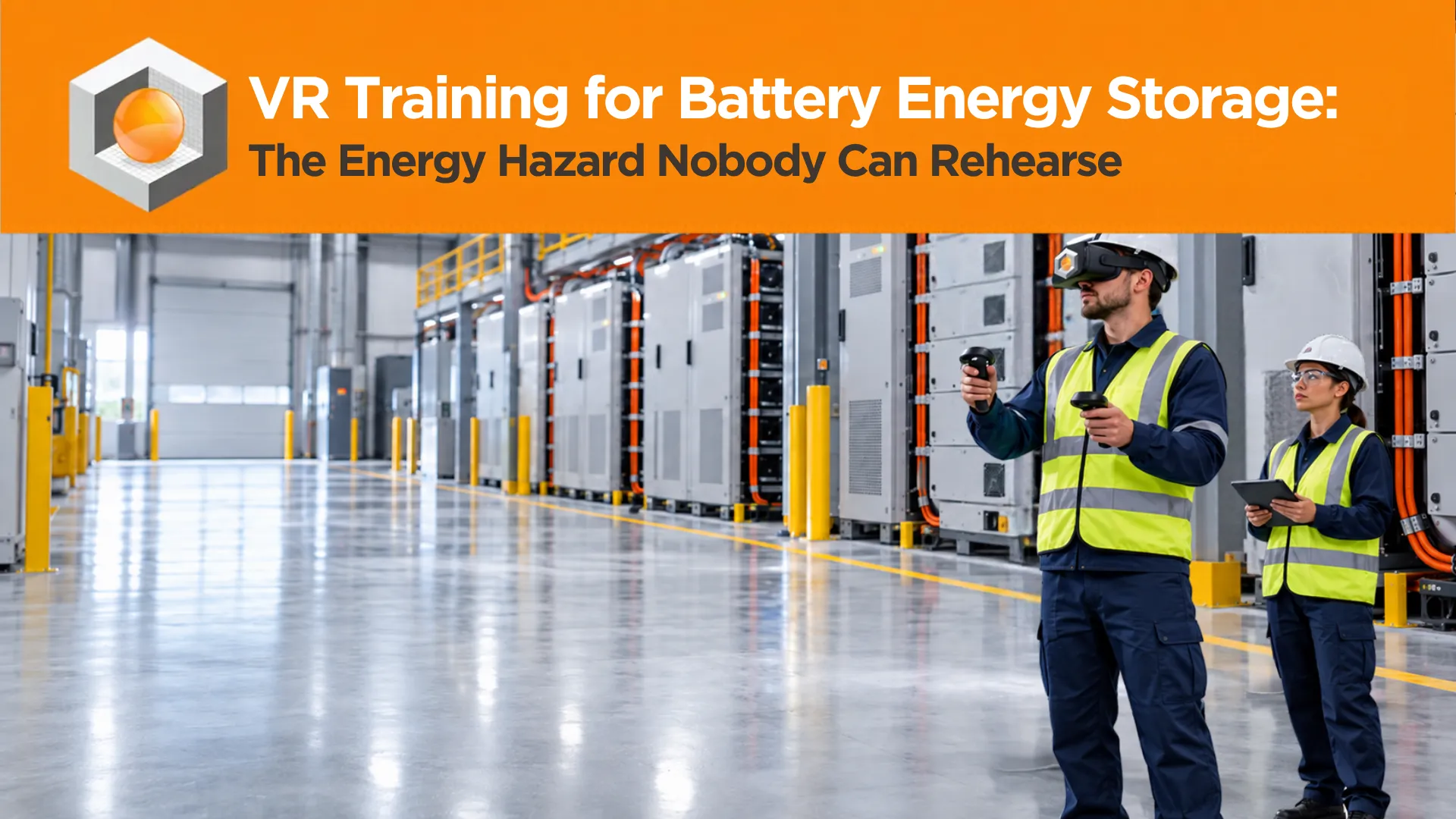
A credible battery storage simulation is not a fire scenario with different textures. The decisions it has to test are specific, and several of them have no equivalent in any other energy training module.
Early recognition comes first, because the window that matters opens before anything is visibly burning. Off-gassing often precedes flame, and a scenario should let a trainee encounter the signs of a cell venting and decide what to do while the container still looks normal. Gas monitoring and the decision to evacuate the exclusion zone belong in that same window.
Then the tactical fork. Defensive posture, cooling adjacent units to prevent propagation rather than attacking the fire, and the discipline not to open doors on a container that may contain an explosive gas mixture. Deflagration risk makes the decision to open an enclosure one of the highest-consequence choices on the site, and it is exactly the kind of choice that benefits from having been made wrongly once, in a headset.
The coordination layer follows. A responder arriving at a battery site frequently has no real-time information on state of charge, temperature or fault location, and getting that information requires talking to the operator. Rehearsing the handover between site staff and the fire service is a communication scenario as much as a technical one.
Finally the long tail, which is where most conventional training stops and most BESS incidents continue. Who decides the site is safe. What the re-entry criteria are. How stranded energy is managed over the following days. A scenario that ends when the flames do has taught the wrong lesson.
For almost every energy operator the answer is no, and the reason is physics rather than budget. Tell the RoT STUDIO team what your storage assets look like and we will map which parts of the response can be simulated.
Where It Connects to Training You Already Run
Battery storage does not arrive on a greenfield site. It is added to generation plants, substations, industrial facilities and wind and solar farms where an HSE programme already exists. The useful question is which existing modules transfer and which actively mislead.
Conventional extinguisher training is the one that needs handling carefully. The skill of selecting an extinguisher for a fire class remains valuable across the rest of the site, which is why Fire Extinguisher VR Training keeps its place in an energy programme. What has to be added is the explicit instruction that the battery enclosure is the exception, because a worker who generalises their extinguisher confidence to a storage container is in danger.
Facility-level fire behaviour carries across more cleanly. Industrial Facility Fire Awareness covers ignition sources, escalation and evacuation decisions, and the evacuation logic for a battery site is a stricter version of the same reasoning. HSE Risk Hunt Training builds the scanning habit that early recognition depends on.
Energy isolation is where the relationship is most interesting. LoTo Lock Training teaches a discipline that is correct everywhere else on site and incomplete here, since stranded energy survives a correctly executed isolation. Running both and naming the difference is stronger than running either alone.
The physical environment adds the rest. Container roofs, inverter platforms and transformer decks put people at height, which is Working at Height VR Training, and grid-connected storage is critical infrastructure where physical and behavioural security matter, which is Information Security Risk Hunt. The full set sits in the HSE Training Catalogue, and the wider methodology behind it in VR health and safety training.
Why This Has to Be Built Rather Than Bought
Most catalogue modules work because the hazard behaves identically everywhere. Battery storage does not. Chemistry changes the hazard profile, with lithium iron phosphate resisting runaway at higher temperatures than nickel manganese cobalt, and that difference alters what a scenario should teach. Container layout, spacing, ventilation and suppression design vary by integrator. Re-entry criteria vary by operator.
Standards reinforce the point. The current energy storage fire code expects site-specific hazard evaluation, which means a programme built around a generic battery container is answering a question nobody asked. That places this work with Customized VR/XR Services, building the environment from the operator's own layout and the integrator's own equipment.
There is a practical shortcut worth knowing. Storage assets are delivered with engineering data, so the container, inverter and switchgear models frequently already exist in CAD. Where that is true the environment can be built from the supplied geometry rather than modelled from photographs, which is what the Designer Module route is for.
Breathing apparatus, gas detector calibration, hose handling and anything requiring physical competence with equipment belong in hands-on training with a qualified instructor. A headset cannot certify any of it, and a programme presenting it as a replacement would fail inspection.
What simulation carries is the part the physical world cannot provide: the unstaged event, the decision under uncertainty, and the repetition needed for an unfamiliar hazard to stop feeling like a familiar one.
Who Needs the Scenario, Beyond the Fire Service
Energy operators tend to scope battery emergency training to responders and stop there, which leaves the people most likely to encounter the first sign of a problem untrained.
Site operations and maintenance staff are usually first on scene and often alone. Control room operators see the telemetry before anyone sees smoke, and their decision about when to escalate sets everything downstream. Contractors working on adjacent plant need to know what the exclusion zone means and why it is larger than it looks. Security staff control who enters and may be the only person present overnight.
Incident command deserves separate attention, because the defining difficulty is holding a defensive posture under pressure from people who want visible action. That is a leadership scenario rather than a technical one, which is where the behavioural work in Leadership VR Training and the wider HR and soft skills programme meets the technical side of an energy programme.
Frequently Asked Questions
These come up whenever an energy operator or an integrator starts scoping simulation for storage assets, usually once someone has realised the hazard cannot be drilled conventionally.
Can VR training satisfy energy storage code requirements?
It contributes rather than discharges. Current fire code for energy storage expects site-specific hazard evaluation, documented emergency response planning and training appropriate to the installed system, and simulation addresses the training component. Hands-on competence with breathing apparatus, detection equipment and suppression remains a separate physical requirement, and the two should be documented separately.
Why not use existing fire training for battery sites?
Because several of its core lessons are wrong in this context. Conventional training builds a reflex toward extinguishment, overhaul and a clear end to the incident. A lithium-ion event rewards cooling over extinguishment, prohibits overhaul, and may not be over when it appears to be. Generalising from conventional fire experience is itself a hazard, which is why the distinction has to be taught explicitly rather than assumed.
Does the scenario need our actual site?
For this hazard, usually yes. Container spacing, access routes, ventilation, suppression design and the position of isolation points determine what the correct action is, and those differ by integrator and by site. A generic battery container teaches the chemistry and the principle. Your own layout teaches the response.
How long does it take to build?
The dominant variable is whether engineering data exists. Storage systems are delivered with CAD, so where the integrator will share geometry the environment can be built from it directly rather than reconstructed. The longer part is usually agreeing the correct response with the operator, the integrator and the local fire service, because those three do not always start from the same answer.
What should the training record?
Decisions rather than completion. Whether the trainee recognised off-gassing before flame, whether they opened an enclosure, whether they chose cooling over attack, whether they held the exclusion zone, and whether they treated the site as hazardous after the visible event ended. The last of those is the figure worth tracking across a workforce, because it is the behaviour that gets people hurt during the recovery phase.
Does this only apply to grid-scale storage?
No. The same chemistry and the same response logic apply to commercial and industrial storage, to substation-attached systems, and in modified form to electric vehicle charging infrastructure and battery-powered plant on industrial sites. The scale changes the consequence rather than the hazard, which means an operator with modest storage still needs the recognition and decision training even if the response plan is simply to evacuate and call.
A New Asset Class Needs New Training
The energy transition has put an unfamiliar hazard onto thousands of sites staffed by people whose safety instincts were formed on fuel, pressure and voltage. Those instincts are good. They are also, in this one specific case, misleading in ways that have already injured responders.
Standards are catching up, with a new fire classification in 2026 and a fire code that now expects site-specific evaluation. Training is the part still lagging, and it is lagging for a reason that will not resolve on its own: the event cannot be staged. For energy operators that leaves one practical route to rehearsed competence, which is to simulate it.
How RoT STUDIO Approaches This
RoT STUDIO builds scenarios around events that cannot safely be staged, which is the category battery storage emergencies sit in. Scenarios are designed so that the hazard develops through its real stages rather than starting at flame, so that incorrect actions produce their actual consequence inside the scenario, and so that the incident continues past the point where conventional training would end.
Because response depends on the installed system, this work runs through Customized VR/XR Services, with the environment built from the operator's layout and the integrator's equipment data. Where a team wants to revise scenarios as sites and procedures change, the RoT STUDIO License and its Trainer Module move that in-house without a development cycle.
The approach is the same one applied across heavy industry, including the Carmeuse Turkey programme, and the method behind it is set out in industrial VR training and across the RoT STUDIO case studies.
RoT STUDIO will map your storage assets, your response plan and the roles around them, then show what a rehearsable version looks like for site teams and responders. Book a demo with the RoT STUDIO team.