Twenty minutes in a headset measurably changes how prepared a nurse feels to handle an aggressive patient. That is not a vendor claim. It comes from a controlled study of 221 nursing and midwifery students who completed a single VR de-escalation session, with the improvement in confidence reaching statistical significance and a moderate to large effect size.
Ninety-three per cent of those students said VR was a suitable medium for this kind of training. Eighty-nine per cent asked for more of it. For a training subject where the usual feedback is polite tolerance, that is an unusual response.
So the individual-level case for VR de-escalation training is in reasonable shape. What the research has never been asked to demonstrate is anything above the individual, and that is now the exact question hospitals are required to answer.
What a VR De-escalation Scenario Actually Is
The phrase covers several quite different things, and the differences matter more than the label. At the weak end sit 360-degree videos where the trainee watches an incident unfold and answers questions afterwards. At the strong end sit branching interactive scenarios where a virtual person reacts, in real time, to what the trainee does.
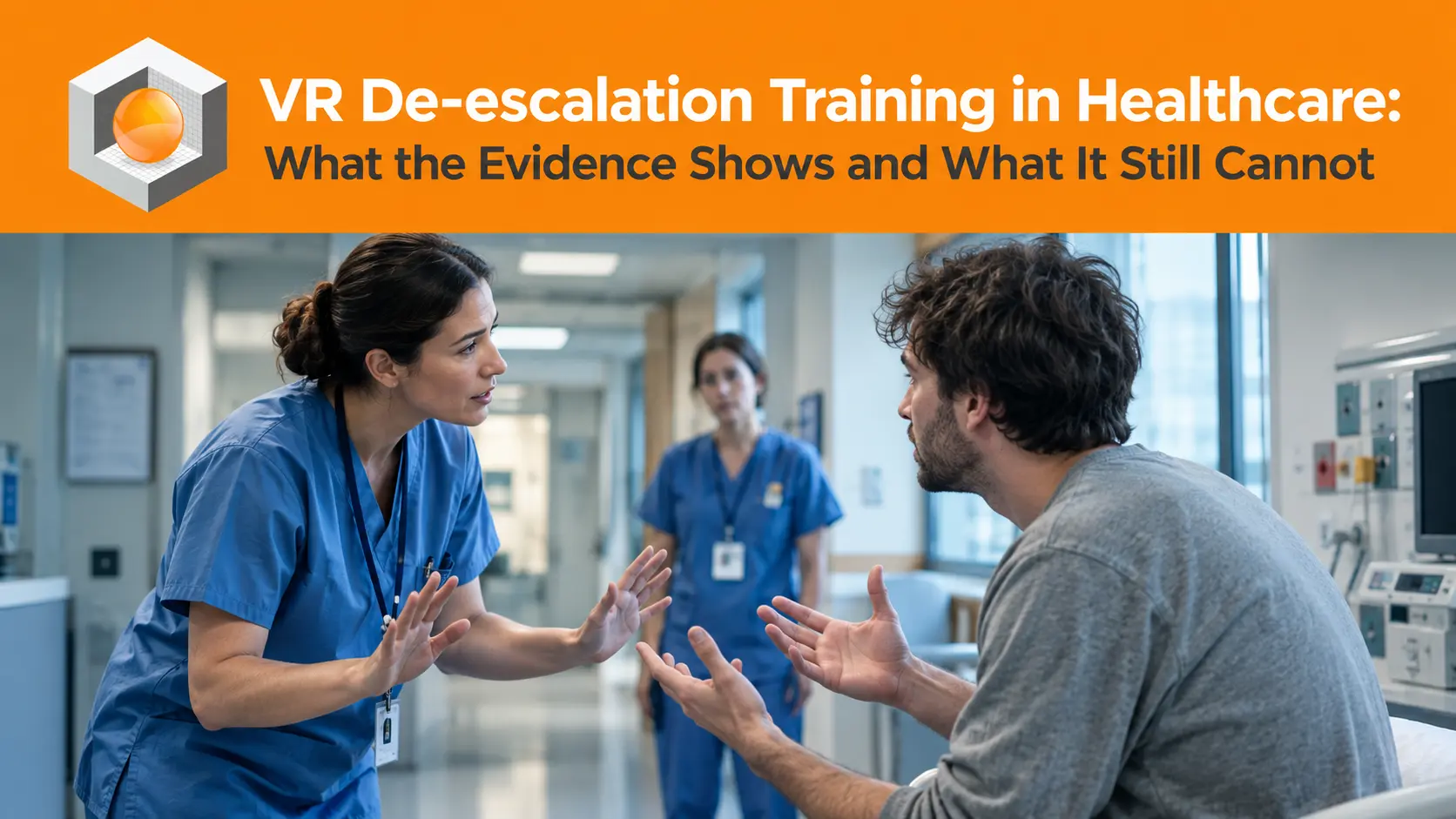
A well-built example works like this. The trainee stands in a simulated ward room with a patient who is already agitated. The patient speaks, using the register a real agitated patient uses rather than a sanitised version of it. The trainee chooses a response, verbal and non-verbal, and the patient's state shifts according to that choice. One published programme of this type branches to six distinct endings, ranging from the patient settling and engaging safely through to a confrontation involving threats and simulated physical aggression.
That branching structure is the whole point. A linear scenario teaches recognition, which a video can also do. A branching scenario teaches consequence, because the trainee sees the room change in response to a decision they made three seconds earlier. Research in this area has used approaches ranging from open verbal interaction with a conversational agent through to emotion-recognition tasks and multiple-choice response menus, and the design choice determines what the trainee can actually practise.
What the Evidence Shows, and Where It Stops
The published work on VR de-escalation in healthcare is more substantial than most VR training categories, and it is unusually consistent about one thing: it moves confidence.
The 221-student study found significant improvement from a single twenty-minute exposure, with participants reporting the system easy to use and motion sickness minimal. Qualitative work with hospital ward nurses points at the mechanism. Participants described the simulation as a prompt for reflective practice, improving relational communication, sharpening risk assessment, and making them conscious of their own body language during patient interactions. That last one is difficult to teach any other way, because most people cannot see what they do with their posture under stress.
Then there are two findings that a vendor would normally leave out, and that anyone evaluating this should know.
Work with staff in secure mental health units concluded that VR simulation enhances situational understanding but does not sufficiently prepare participants for action readiness, and that it cannot replace physical simulation. And a systematic review covering two decades of studies, screening over two thousand papers and including fifteen, reported that none of them evaluated whether VR training had any impact at the organisational level.
The research distinguishes between a trainee understanding what is happening in front of them and being ready to act on it. VR reliably improves the first. The evidence that it produces the second, on its own, is not there.
This is why every credible study in the field positions VR as a supplement to physical simulation rather than a replacement for it. A vendor telling you otherwise is either unfamiliar with the literature or hoping you are.
The Four Scenarios Healthcare Programmes Actually Need
Most available VR de-escalation content models one situation: an angry adult in a ward or emergency department. That is the most common case and it is not the only one, and the others require genuinely different scenario design.
The aggressive presentation is the familiar one. A patient or visitor escalating through frustration, intoxication or pain, where the skills are volume control, distance, posture and acknowledgement. This is where the existing research sits and where off-the-shelf content is strongest.
Confusion and distress is a different scenario entirely and is badly under-served. An older patient with dementia, disoriented at night, frightened rather than hostile. Responding to this as though it were aggression escalates it. The scenario has to reward a completely different set of moves: slower speech, orientation cues, reduced stimulus, and often stepping back rather than engaging.
Reaction to bad news sits in a third category. A relative who has just been told something devastating and whose distress turns outward. The clinical instinct is to keep explaining, and explaining is precisely what fails here. The scenario needs to make that failure visible, which a branching structure can do and a video cannot.
Lateral aggression between colleagues is the fourth and is almost never built, despite accreditation definitions of workplace violence now extending to intimidation, harassment and bullying between staff. A scenario where the escalating party is a senior colleague rather than a patient tests something different and more uncomfortable, and it is the category most likely to be missing from a programme audit.
Most programmes cover one. Tell the RoT STUDIO team which situations your incident reports keep describing and we will map them against what a branching scenario can rehearse.
What the Headset Records, and Why That Closes the Gap
Return to the finding that no study has evaluated organisational impact. That is not a gap in the technology. It is a gap in what anyone has bothered to measure, and it persists because most VR de-escalation research is designed around a pre-test and post-test confidence questionnaire.
A branching scenario generates considerably more than that, and it generates it per participant, automatically, every run. At which stage of escalation did the trainee first change their approach. Which branch did they take at each decision point. How many attempts before they reached a safe outcome. Did they disengage and summon support when the scenario passed the point where talking helps, or did they stay in the room.
That last figure is the one worth tracking across a workforce, because it corresponds directly to how staff get hurt. It is also the figure no completion register, feedback form or classroom session can produce.
Read alongside the operational indicators a hospital already collects, including incident reports, reporting rates and injury data, that per-participant record is the beginning of the organisational-level evaluation the literature is missing. The honest caveat is that a simulator score is not an outcome. Consensus work in healthcare simulation is consistent that what matters is transfer, meaning whether the behaviour appears on the ward, so scenario data belongs next to ward data rather than in place of it. The same principle applies across the wider RoT HEALTHCARE simulation programme.
Physical intervention and restraint require hands-on certification with a qualified instructor and cannot be delivered in a headset. Neither can a site walkthrough of alarms, exits and safe rooms, which has to happen in the building.
VR covers the verbal and behavioural layer: recognising escalation early, holding the response under pressure, and deciding when to disengage. That is a defined portion of a programme, not the programme itself, and scoping it honestly is what keeps it defensible at survey.
Why Hospitals Are Asking About This Now
The timing is not coincidental. From January 2026, accreditation elevated workplace violence prevention to a national performance goal, which raised the survey attention attached to it. The requirements include a named leader reporting to the governing body, violence data reaching board level, training delivered at hire, annually and whenever the programme changes, and an annual worksite analysis that evaluates risks, policies, procedures and training.
The phrase that matters is the last one. An analysis that evaluates training has to reach a conclusion about whether the training does anything, and a completion percentage is not a conclusion.
Worth knowing alongside this: in the United States there is still no enforceable federal occupational standard specific to workplace violence in healthcare. Guidance dates to 1996 and was revised in 2004 and 2016, and the proposed rule remains in long-term status. The pressure is coming from accreditors and from state legislation, with California requiring site-specific written prevention plans and a healthcare-specific state standard due by the end of 2026. For most hospitals the accreditor arrives well before any occupational regulator does.
Deploying It Without Disrupting the Ward
The practical objections to VR in a hospital are usually about logistics rather than content, and the published session lengths help. A twenty-minute scenario fits inside an existing induction slot or a handover-adjacent teaching session, which means it does not require a separate training day to be scheduled and defended.
Device count follows throughput rather than headcount. Sessions are short and sequential, so a small pool of headsets running through a training room covers a large intake. The constraint most organisations underestimate is not hardware cost but device management, meaning who provisions the headsets, locks them to the right application and pushes updates without collecting every unit by hand.
Attachment point matters too. Because the accreditation trigger includes point of hire, the natural home for this is alongside existing VR nursing onboarding, where a headset session is already part of the first week. Retrofitting it later as a standalone annual event is how it becomes the thing everyone reschedules.
Frequently Asked Questions
These come up whenever a nursing education or safety lead starts scoping VR for this subject, usually in the first conversation and usually in this order.
Does VR de-escalation training actually work?
For confidence in managing patient aggression, the evidence is reasonably strong: a single twenty-minute session produced a statistically significant improvement across 221 nursing students, and qualitative work reports gains in relational communication, risk assessment and awareness of body language. For action readiness in a real incident, the evidence is weaker and the research says so. Treat it as a supplement to physical simulation rather than a substitute.
How long does a session take?
Published programmes run around twenty minutes, which is short enough to sit inside an induction or teaching slot without requiring a dedicated training day. First-time headset users need a few extra minutes of orientation so that controller handling does not become the thing being assessed.
Will staff feel motion sick?
For this content type it is a smaller problem than people expect. The 221-student study reported minimal motion sickness and high usability. De-escalation scenarios are largely stationary conversations rather than fast movement through an environment, which is the main trigger. A seated or standing stationary option should be standard, and anyone who feels unwell should be able to stop without explanation.
Is this distressing for staff who have been assaulted at work?
It can be, and it needs designing for rather than assuming away. Participation should be voluntary where someone has recent experience of an assault, scenarios should build intensity gradually instead of opening at the extreme, and the post-incident support route should be visible before the session rather than mentioned afterwards. A provider who has not raised this unprompted has not thought carefully about who they are training.
Can the scenario be set in our own department?
Yes, and whether it is worth it depends on the scenario. For verbal response training a representative ward teaches the skill adequately. Site-specific builds earn their cost where the layout is part of the answer, such as an emergency department where sightlines, exit routes and alarm positions differ meaningfully from a generic room, or a behavioural health unit with its own protocols.
What do we ask a vendor to prove?
Ask to see the failure branches rather than the success path, since a scenario with one obviously correct route teaches recognition rather than judgement. Ask which specific actions are recorded per participant and how that data reaches your reporting. Ask whether disengaging is modelled as a correct outcome or as a failure state. And ask what the product does not cover, because a vendor who claims it replaces physical intervention training has told you something useful about the rest of their answers.
A Category With Evidence and an Unclosed Question
VR de-escalation training is in a better evidential position than most immersive training categories. Twenty minutes demonstrably shifts how prepared a nurse feels, students ask for more of it, and the mechanism reported by participants is specific rather than vague.
What nobody has shown is the organisational half, and that is now the half accreditation asks about. The route to closing it is not more confidence questionnaires. It is treating the per-participant record a branching scenario already produces as evidence, and reading it against the incident and reporting data the hospital already holds. That is an ordinary piece of programme design, and it is available to any organisation willing to specify it at the start rather than discover it at survey.
How RoT STUDIO Approaches This
RoT STUDIO builds de-escalation as branching scenario work rather than as observational content. The escalation develops through recognisable stages instead of arriving fully formed, the virtual counterpart responds to both what the trainee says and how they carry themselves, and disengaging is modelled as a correct outcome rather than a failure state.
The method comes from the behavioural scenario work in challenging customer management and the wider HR and soft skills programme, applied to clinical environments. Per-participant performance is recorded across attempts, including the stage at which escalation was recognised and whether the trainee disengaged when the scenario passed the threshold.
Where a specific emergency department or behavioural health unit needs to be recognisable, Customized VR/XR Services builds the environment from the client's own plans. Where a training team wants to revise scenarios as protocols change, the RoT STUDIO License supports that without a development cycle.
RoT STUDIO will walk your team through a de-escalation scenario including the routes where it goes wrong, and show exactly what the session records per participant. Arrange a walkthrough with the RoT STUDIO healthcare team.
References
- Johnson, Mills, Hopper et al., The effectiveness of virtual reality aggression and violence de-escalation training for nursing and midwifery students: a quasi-experimental study, Clinical Simulation in Nursing, 2025
- Systematic review of virtual reality in de-escalation of aggression training for providers and users of public and healthcare services, 2000 to 2022, PRISMA protocol
- Lockertsen and Kj\u00e6rvik, Staff experiences with VR simulation in patients with challenging behaviour, International Medical Education, 2025
- Nurses' perceptions about the use of virtual reality simulation to develop competencies in managing violent and threatening behaviours: a qualitative study, BMC Nursing, 2026
- Designing virtual reality-based conversational agents to train clinicians in verbal de-escalation skills: exploratory usability study, JMIR
- The Joint Commission, National Performance Goal 2a, workplace violence prevention, effective January 2026
- Occupational Safety and Health Administration guidance on preventing workplace violence for healthcare and social service workers, 1996, revised 2004 and 2016, and current regulatory agenda status
- Immersive Healthcare Collaboration, Three Principles for Progress, University of Leeds, 2021