
Episode 02
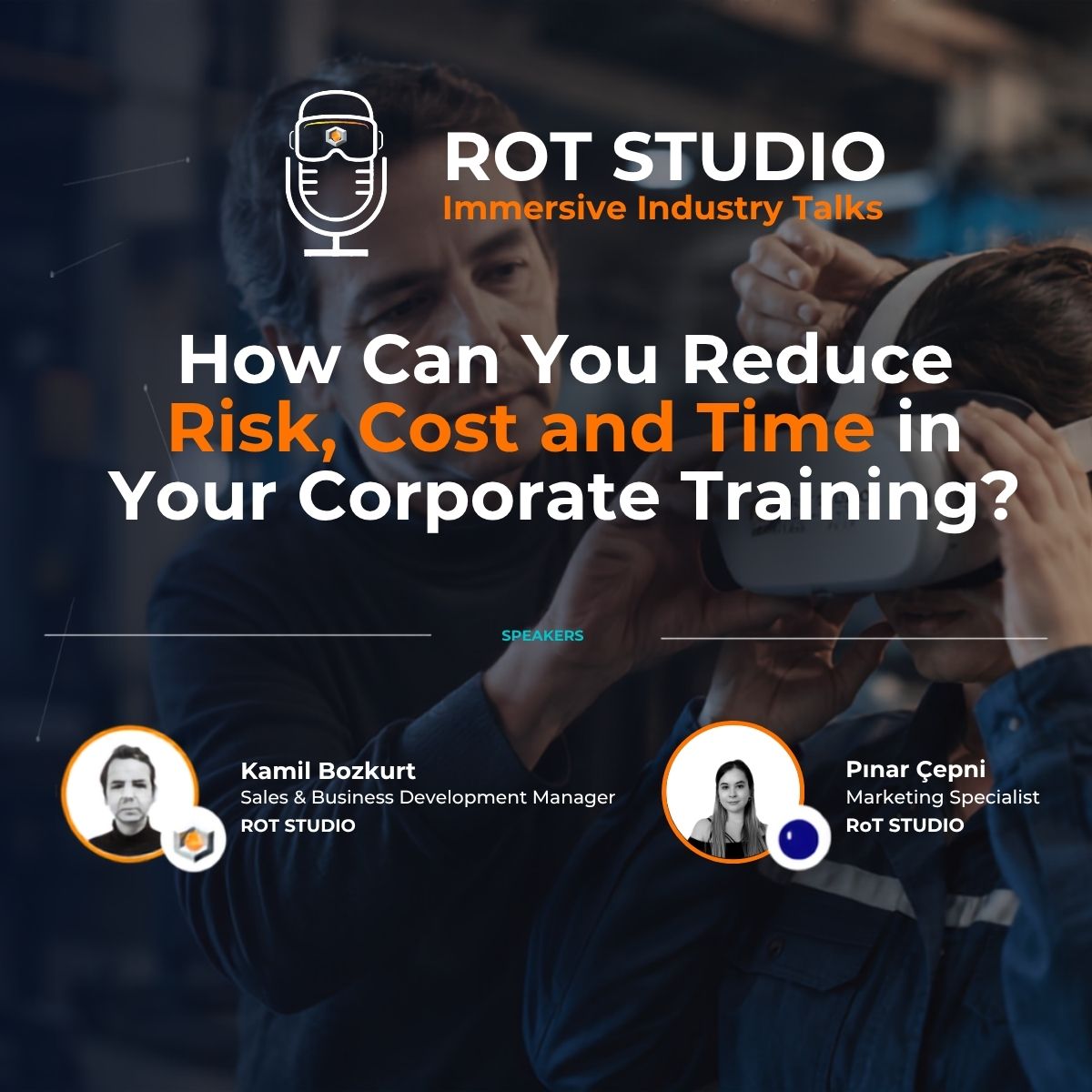
How Can You Reduce Risk, Cost and Time in Your Corporate Training?
With Pınar Çepni and Kamil Bozkurt from RoT STUDIO
Why do corporate training programs still create risks, time loss and high costs? In this episode, we explore how RoT STUDIO’s VR and XR solutions can make corporate training safer, repeatable and measurable across occupational health and safety, technical training, onboarding and soft skills development, supported by real-world project examples.
LISTEN AND SUBSCRIBE ON YOUR FAVORITE PLATFORM
Episode Summary
Not every corporate training challenge is the same. Some training scenarios are dangerous to conduct in real environments, some are nearly impossible to recreate, some require costly operational downtime, and others struggle to maintain employee attention and knowledge retention. In this episode, we examine these challenges through the DICE framework.
Through examples including Tosçelik’s crane maintenance training, Tüpraş’s fire training, Ford Otosan’s VR assembly scenarios and Gazi University’s immersive anatomy education, we explore how virtual reality can address a wide range of learning needs. We also introduce RoT STUDIO’s no-code VR platform, ready-to-use HSE Training Catalog, Earthquake Awareness Training and soft skills solutions.
In the final part of the episode, we look at the Kimtaş / Carmeuse Turkey case to discuss measurable VR training performance, Training and Test modes, LMS and Power BI integrations, device management and how organizations can identify the right VR use case before starting a project.
“Delivering training alone is not enough. Organizations also need to measure how much employees have learned and how effectively they can apply that knowledge.”
Key Topics
- 01 The DICE Framework in Corporate Training
- 02 Moving High-Risk Training into Safe VR Environments
- 03 Reducing Training Costs and Operational Downtime
- 04 No-Code VR Content Development
- 05 Ready-to-Use HSE, Earthquake and Soft Skills Training
- 06 Measuring Performance with Training and Test Modes
- 07 LMS, Power BI and Device Management Integration
- 08 Choosing the Right VR Training Use Case
Watch the Episode
Meet the Speakers

Pınar Çepni
Marketing Specialist, RoT STUDIO

Kamil Bozkurt
Business Development & Sales Manager, RoT STUDIO
Never Miss an Episode
Get notified by email whenever a new episode of RoT STUDIO Immersive Industry Talks is released.

Cem Pekcan
Business Development Europe Representative
Hello, I am Cem! I work as the Business Development Europe Representative at RoT STUDIO. You can contact me using the information below if you have any questions or want to work with us!
Frequently Asked Questions (FAQ)
What is VR and XR-based corporate training?
VR and XR-based corporate training allows employees to experience real workplace processes and high-risk scenarios inside immersive virtual environments rather than relying only on physical training. It can provide repeatable and measurable practice across HSE, maintenance, assembly, onboarding, technical training and soft skills development.
What is the DICE framework?
DICE stands for Dangerous, Impossible, Counterproductive and Expensive. It describes training scenarios that are risky to conduct, difficult or impossible to recreate physically, inefficient or costly. VR can provide an alternative environment for delivering these types of training scenarios.
What types of training can be delivered in VR?
VR can be used for occupational health and safety, fire safety, Working at Height, LoTo, maintenance, assembly, manufacturing, onboarding, earthquake awareness, leadership, time management and customer management training. Solutions can be delivered as ready-to-use catalog products or developed specifically for an organization’s needs.
Can employee performance be measured in VR training?
Yes. RoT STUDIO projects can include separate Training and Test modes to track whether users complete the training, how long they take, where errors occur and how effectively they apply what they learned. The resulting performance data can also be transferred to reporting systems.
Can VR training be integrated with an LMS or Power BI?
Yes. Performance data generated during VR training can be integrated with an organization’s existing LMS infrastructure or reporting tools such as Power BI. This makes it possible to centrally monitor training completion and performance across different users, facilities and locations.
How is a custom VR training project developed?
The process begins with a needs analysis and identification of the right use case. A detailed training scenario is then created together with the organization’s subject-matter experts. The required 3D environments and models are developed, followed by software development, testing and final delivery. LMS integration and VR device management can also be included when required.
How are the cost and timeline of a VR training project determined?
The cost and timeline depend on the scope of the scenario. Factors such as the size and detail level of the environment to be modeled, user interactions, tasks, animations and software requirements determine the amount of 3D modeling and software development effort required.
How can our organization get started with VR training?
The first step is to identify the training area where VR can create the most value. RoT STUDIO can evaluate potential use cases through a needs analysis and help define a roadmap from an initial pilot project to a broader deployment.