The 2026 NSI National Health Care Retention and RN Staffing Report puts the average cost of losing a single bedside registered nurse at $60,090. The national RN turnover rate climbed to 17.6% in 2025, with 22.3% of newly hired nurses leaving within their first year. The average hospital carries 43 unfilled RN full-time-equivalent positions and loses between $4.2 million and $6.2 million annually to nurse churn, averaging approximately $5.19 million. Every one-percentage-point movement in RN turnover translates to roughly $295,000 in annual cost or savings for the average hospital. These are the headline figures for chief nursing officers, hospital CFOs, and health system COOs going into fiscal 2027 planning.
The figures make the recruitment shortfall visible. The 158,600 unfilled RN positions nationally and the 78-day RN Recruitment Difficulty Index also make it visible. What the figures do not fully expose is the deeper structural constraint underneath both: even when hospitals fill the positions, the new hires require ninety to one hundred eighty days to reach productive competency, and that productivity ramp is bottlenecked by the availability of experienced nurses to serve as preceptors. Every dollar of new-hire compensation is being spent against a workforce whose most valuable members are already stretched to capacity supporting the last cohort of new hires.
The fiscal pressure amplifier arrived in July 2025 with the One Big Beautiful Bill Act, which the Congressional Budget Office scores as $940 billion to $1 trillion in Medicaid cuts over ten years. Premier analysis estimates $68.5 billion in hospital revenue at risk over 2026 and 2027 alone, with operating margins in Medicaid expansion states projected to shrink by 19 to 30 percent. In this environment, the internal cost of nursing onboarding inefficiency is no longer a workforce operations line item. It is a material component of health system financial performance.
This piece is a strategic framework for chief nursing officers, hospital CFOs and COOs, nursing school program directors, health system CIOs, and health system talent leaders. The thesis is direct: the nursing workforce crisis is not primarily a recruitment crisis, it is a preceptor bottleneck, and the emerging structural response across US health systems in 2026 is virtual reality-based procedural training, deployed to decouple new-hire skill acquisition from experienced-nurse time. The top three US medical VR platforms serving this market (Osso VR, SimX, and the UbiSim platform now under Labster) have converged on this positioning, and their 2025-26 deployments reveal a clear operational pattern that health systems can build against.
The Real Numbers Behind the 2026 Nursing Crisis
The nursing workforce data reported through 2025 and into 2026 tells three interlocking stories, and understanding all three is prerequisite to seeing why VR-based onboarding has become the structural response rather than a supplemental training tool.
The Workforce Shortage Figures
The American Hospital Association estimates a deficit of more than 250,000 registered nurses by 2028. The 2026 NSI report identifies 158,600 currently unfilled RN positions nationwide, with a national vacancy rate of 8.6% and one in three hospitals reporting vacancy rates of 10% or higher. The RN Recruitment Difficulty Index sits at 78 days, meaning the average open RN position takes roughly two and a half months to fill. Behind these figures, the demographic pipeline is unfavorable: nearly one million RNs are over the age of 50, signaling a retirement wave that will not resolve through the current graduation pipeline. Nursing schools in 2021 rejected approximately 91,938 qualified applicants due to faculty, space, and funding constraints, which means the workforce inflow is throttled by academic capacity, not by candidate interest.
The Hidden Cost: Turnover Economics
The $60,090 average per-RN turnover cost captures direct expense: recruitment spending, agency and travel nursing coverage during vacancy, sign-on bonuses, and human resources administrative time. What it does not fully capture is the productivity gap. New nurses, including experienced nurses transferring in from other facilities, require ninety to one hundred eighty days to reach the procedural and relational fluency of a tenured team member. During that period, the unit operates below full clinical output while carrying the full compensation cost. This gap compounds when 22.3% of first-year hires exit before reaching that productive threshold, meaning the health system pays for onboarding without capturing the return.
The Medicaid Cut Pressure
The July 2025 One Big Beautiful Bill Act contains the largest federal Medicaid cuts since the program began. CBO scoring places the cuts at approximately $940 billion to $1 trillion over ten years. Premier analysis puts $68.5 billion in hospital revenue at risk over the 2026-2027 window. Health systems where Medicaid represents 20 to 40 percent of patient revenue are projecting operating margin contractions of 19 to 30 percent. In fiscal environments this constrained, every avoidable internal cost carries operational weight it did not carry three years ago, and nursing turnover is now the single largest addressable workforce cost line for most acute care systems.
| Expert Note: Why the $295,000 Per-Percentage-Point Number Matters Most for Executive Planning The NSI 2026 report calculates that every one-percentage-point change in RN turnover translates to approximately $295,000 in annual cost or savings for the average hospital. This is the number that should anchor the executive conversation on nursing onboarding investment. A health system running 20% RN turnover that reduces churn to 15% recovers approximately $1.5 million annually per hospital in the network. For a five-hospital system, that is $7.5 million in recovered operating margin against fixed compensation costs already committed. The math frames why nursing onboarding infrastructure investment now competes favorably with almost any other operational efficiency spend most CFOs have on the fiscal 2027 agenda. |
Why Traditional Nursing Onboarding Has Hit Its Structural Limits
Understanding the response requires understanding the specific limits the standard nursing onboarding model has reached. The problem is not that health systems are underinvesting in onboarding. It is that the underlying model does not scale to the pace of workforce turnover the current environment produces.
The Preceptor Bottleneck
The dominant nursing onboarding model relies on the preceptor: an experienced staff nurse assigned one-to-one or near-one-to-one with a new hire during the transition period, providing supervision, clinical judgment coaching, and procedural feedback in real clinical work. This model produces excellent outcomes when it functions. The problem in 2026 is that it functions less often. The most experienced nurses (the ones who make effective preceptors) are also the most valued clinical staff, the most stretched by the workforce shortage, and the most at risk for burnout-driven exit. Assigning a senior nurse to precept a new hire removes that nurse from direct patient care for a meaningful portion of the shift. In units already operating below target staffing, this is an option many nurse managers cannot exercise. The consequence is that new hires are assigned to preceptors who are themselves early in their careers, or to preceptor rotations that spread the same experienced nurse across multiple new hires simultaneously, or to unit environments where preceptor time is nominal rather than substantive. The training outcomes decline accordingly.
The 90-to-180-Day Productivity Ramp
The productivity ramp for new nursing hires is not a training design choice. It reflects the actual time required to build procedural fluency across the many discrete skills a functional bedside nurse deploys daily: intravenous line insertion, central line maintenance, urinary catheter care, medication administration and reconciliation, wound care, sterile technique across multiple procedure categories, patient assessment, documentation workflow within specific electronic health record configurations, and the coordination workflows specific to each unit and specialty. Each skill requires repetition to reach fluency. In the traditional model, that repetition comes from live clinical encounters, which are unevenly distributed by unit acuity, patient census, and shift assignment. A new hire on a low-census week may see only two or three IV starts, delaying skill consolidation. This unevenness is the primary reason productivity ramps span three to six months rather than being compressible into structured weeks.
Nurse Residency Programs and Their Scaling Constraints
Nurse Residency programs earned a 3.9 out of 5 effectiveness rating from health system respondents in the 2026 NSI survey, making them among the most valued retention interventions. The Vizient 2026 nurse leader survey identifies burnout management (61%), adequate staffing amid shortages (41%), and nurse recruitment and retention (40%) as the top priorities shaping the year. Residency programs address these directly, and 80.8% of hospitals now maintain a specific strategy for newly hired nurses. The scaling limitation is that residency programs still depend on experienced staff time for cohort education, mentorship, and clinical supervision, so they do not resolve the preceptor bottleneck; they redistribute it. Well-designed residency programs also require dedicated educator staffing, which competes with the same clinical staffing budget the residency exists to protect.
How Virtual Reality Compresses the Nursing Onboarding Curve
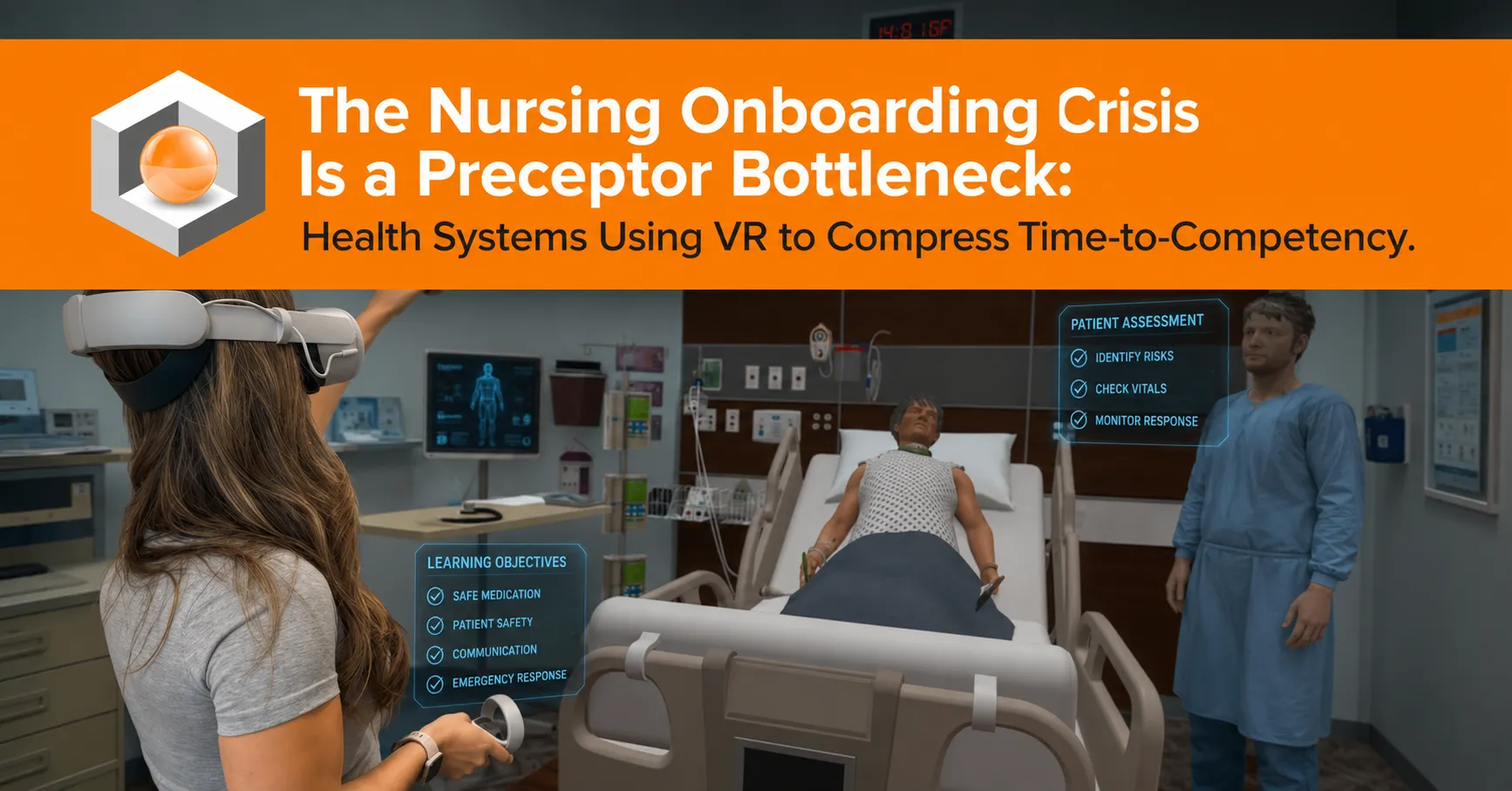
The structural argument for VR-based nursing onboarding is that it decouples procedural skill acquisition from experienced-nurse time. The trainee builds procedural fluency in the simulation environment, at a pace determined by the trainee rather than by the unit’s clinical census, without consuming preceptor capacity. This is the specific mechanism by which VR compresses the onboarding curve, and it is what health systems and the top US VR platforms have converged on across 2025 and 2026.
Repetition Density for Procedural Skill
Procedural nursing skill is built through repetition, not through information delivery. A new nurse who has performed forty IV starts in a simulated environment has substantively different motor competency than a new nurse who has watched the procedure demonstrated three times and executed it twice during clinical rotations. VR-based scenarios allow the trainee to complete these repetitions on their own schedule, with corrective feedback embedded in the scenario logic, without consuming preceptor time or waiting for the appropriate live clinical encounter. This is the same principle that underlies VR nursing training adoption across US health systems in 2025-26, but the operational framing has evolved from “supplement to clinical rotations” to “structural replacement for the classroom and demonstration components of onboarding.”
Safe Practice for High-Stakes Low-Frequency Events
A material portion of nursing competency involves scenarios that occur too rarely during routine clinical work to build fluency through exposure: rapid response activations, code blue coordination, patient deterioration recognition, medication error interception, sepsis identification, and the specific communication workflows for handoff during clinical crisis. These are exactly the scenarios where competency gaps produce the highest patient safety consequences, and they are also the scenarios most difficult to practice under traditional models. VR simulation allows structured, repeatable practice of these events, with performance data captured for competency assessment. For chief nursing officers building programs against safety and quality outcomes, this is the highest-value application of the technology.
Session-Level Competency Documentation
VR-based training systems automatically capture session-level performance data: which decisions were made, how long the trainee took at each step, where errors occurred, how many repetitions were required before correct execution, which scenario variations were completed. This documentation exceeds the depth of traditional attendance-based training records, and it supports two operational uses: residency program competency milestones that satisfy accreditation body expectations, and organizational retention analytics that identify which trainees are at risk of first-year exit before the exit occurs. The 22.3% first-year attrition rate is not evenly distributed across new hires. Session-level competency data allows nurse educators to identify high-risk trainees earlier and intervene, which is a lever traditional onboarding methods do not provide.
Why Traditional Nursing Onboarding Has Hit Its Structural Limits
Understanding the response requires understanding the specific limits the standard nursing onboarding model has reached. The problem is not that health systems are underinvesting in onboarding. It is that the underlying model does not scale to the pace of workforce turnover the current environment produces.
The Preceptor Bottleneck
The dominant nursing onboarding model relies on the preceptor: an experienced staff nurse assigned one-to-one or near-one-to-one with a new hire during the transition period, providing supervision, clinical judgment coaching, and procedural feedback in real clinical work. This model produces excellent outcomes when it functions. The problem in 2026 is that it functions less often. The most experienced nurses (the ones who make effective preceptors) are also the most valued clinical staff, the most stretched by the workforce shortage, and the most at risk for burnout-driven exit. Assigning a senior nurse to precept a new hire removes that nurse from direct patient care for a meaningful portion of the shift. In units already operating below target staffing, this is an option many nurse managers cannot exercise. The consequence is that new hires are assigned to preceptors who are themselves early in their careers, or to preceptor rotations that spread the same experienced nurse across multiple new hires simultaneously, or to unit environments where preceptor time is nominal rather than substantive. The training outcomes decline accordingly.
The 90-to-180-Day Productivity Ramp
The productivity ramp for new nursing hires is not a training design choice. It reflects the actual time required to build procedural fluency across the many discrete skills a functional bedside nurse deploys daily: intravenous line insertion, central line maintenance, urinary catheter care, medication administration and reconciliation, wound care, sterile technique across multiple procedure categories, patient assessment, documentation workflow within specific electronic health record configurations, and the coordination workflows specific to each unit and specialty. Each skill requires repetition to reach fluency. In the traditional model, that repetition comes from live clinical encounters, which are unevenly distributed by unit acuity, patient census, and shift assignment. A new hire on a low-census week may see only two or three IV starts, delaying skill consolidation. This unevenness is the primary reason productivity ramps span three to six months rather than being compressible into structured weeks.
Nurse Residency Programs and Their Scaling Constraints
Nurse Residency programs earned a 3.9 out of 5 effectiveness rating from health system respondents in the 2026 NSI survey, making them among the most valued retention interventions. The Vizient 2026 nurse leader survey identifies burnout management (61%), adequate staffing amid shortages (41%), and nurse recruitment and retention (40%) as the top priorities shaping the year. Residency programs address these directly, and 80.8% of hospitals now maintain a specific strategy for newly hired nurses. The scaling limitation is that residency programs still depend on experienced staff time for cohort education, mentorship, and clinical supervision, so they do not resolve the preceptor bottleneck; they redistribute it. Well-designed residency programs also require dedicated educator staffing, which competes with the same clinical staffing budget the residency exists to protect.
How Virtual Reality Compresses the Nursing Onboarding Curve
The structural argument for VR-based nursing onboarding is that it decouples procedural skill acquisition from experienced-nurse time. The trainee builds procedural fluency in the simulation environment, at a pace determined by the trainee rather than by the unit’s clinical census, without consuming preceptor capacity. This is the specific mechanism by which VR compresses the onboarding curve, and it is what health systems and the top US VR platforms have converged on across 2025 and 2026.
Repetition Density for Procedural Skill
Procedural nursing skill is built through repetition, not through information delivery. A new nurse who has performed forty IV starts in a simulated environment has substantively different motor competency than a new nurse who has watched the procedure demonstrated three times and executed it twice during clinical rotations. VR-based scenarios allow the trainee to complete these repetitions on their own schedule, with corrective feedback embedded in the scenario logic, without consuming preceptor time or waiting for the appropriate live clinical encounter. This is the same principle that underlies VR nursing training adoption across US health systems in 2025-26, but the operational framing has evolved from “supplement to clinical rotations” to “structural replacement for the classroom and demonstration components of onboarding.”
Safe Practice for High-Stakes Low-Frequency Events
A material portion of nursing competency involves scenarios that occur too rarely during routine clinical work to build fluency through exposure: rapid response activations, code blue coordination, patient deterioration recognition, medication error interception, sepsis identification, and the specific communication workflows for handoff during clinical crisis. These are exactly the scenarios where competency gaps produce the highest patient safety consequences, and they are also the scenarios most difficult to practice under traditional models. VR simulation allows structured, repeatable practice of these events, with performance data captured for competency assessment. For chief nursing officers building programs against safety and quality outcomes, this is the highest-value application of the technology.
Session-Level Competency Documentation
VR-based training systems automatically capture session-level performance data: which decisions were made, how long the trainee took at each step, where errors occurred, how many repetitions were required before correct execution, which scenario variations were completed. This documentation exceeds the depth of traditional attendance-based training records, and it supports two operational uses: residency program competency milestones that satisfy accreditation body expectations, and organizational retention analytics that identify which trainees are at risk of first-year exit before the exit occurs. The 22.3% first-year attrition rate is not evenly distributed across new hires. Session-level competency data allows nurse educators to identify high-risk trainees earlier and intervene, which is a lever traditional onboarding methods do not provide.
What the Top Medical VR Platforms Are Actually Doing in Nursing
Three platforms have positioned themselves aggressively into US nursing onboarding across 2025 and 2026, and their approaches illustrate the operational patterns health systems can build programs against.
Osso VR: Procedural Skills Library with Evidence-Based Content Alignment
Osso VR launched its Nursing Series and the Osso Loop learning platform in September 2025, with a Founders Circle model open to health systems through early 2026. In October 2025 the company announced a partnership with EBSCO to align its nursing training content with Dynamic Health’s evidence-based skills and procedures libraries. The strategic pattern here is instructive: rather than building nursing training as a separate product category, Osso VR has extended its surgical training platform architecture into nursing procedural skills, with the same performance analytics engine, and has anchored the clinical content to an established evidence-based reference library. CEO Heather Gervais has been explicit in public commentary that hospital executives are prioritizing nurse onboarding acceleration as the single most consequential workforce operations question, and Osso’s positioning reflects that assessment.
SimX: Multi-Specialty Patient Simulation and Team Scenarios
SimX, headquartered in Mountain View California, operates the most institutionally validated multi-specialty VR medical simulation platform, with deployments at Mayo Clinic, Stanford, NYU Langone, and the US Air Force. SimX’s approach centers on high-fidelity simulated patients across clinical categories, with multiplayer scenarios that allow multiple trainees to practice team coordination under conditions that mirror emergency medicine, ICU workflow, and mass casualty response. For nursing onboarding programs that need coverage across acute care, emergency, and ICU specialties, SimX’s breadth is a differentiating factor. The multiplayer architecture also addresses a training component that single-trainee VR does not: interprofessional team communication, which is a documented failure mode in clinical incidents.
UbiSim (Labster): Nursing-Specific Curriculum Integration
UbiSim, now under Labster following acquisition, has focused specifically on nursing simulation for both academic and health system settings. The platform is oriented toward scenario-based practice mapped to nursing curriculum competencies, with strong penetration in nursing schools and academic medical center residency programs. For health systems that partner with academic institutions for nurse residency pipeline development, UbiSim’s curriculum-integrated positioning offers a bridge between pre-license education and post-hire onboarding that the surgical-training-anchored platforms address less directly.
The Common Pattern and Where Platforms Diverge
Across the three platforms, the common pattern is procedural repetition with automated performance analytics, delivered on standalone VR hardware (Meta Quest 3, PICO 4, and equivalents) that has become economically viable at scale. Where the platforms diverge is in content architecture (procedural-skills-library versus patient-scenario-library versus curriculum-mapped-scenario), team-training capability (SimX’s multiplayer versus single-trainee models), and reference-content anchoring (Osso VR’s EBSCO partnership versus curriculum-body alignment versus internally-developed content). Health system procurement teams evaluating platforms in 2026 are increasingly asking these architectural questions during vendor selection, rather than treating VR nursing training as a single feature category.
Implementation Framework for Health Systems
Health systems that have moved past pilot into operational deployment of VR nursing onboarding across 2025 and 2026 have converged on a set of implementation patterns worth noting for organizations approaching the procurement decision.
Which Nursing Categories Benefit Most
The highest-value deployments have concentrated on new-graduate med-surg onboarding, where the volume of new hires and the breadth of procedural skills produce the strongest cost-benefit profile. Second-highest value has clustered around ICU and specialty transitions (med-surg to critical care, floor to procedural, general to specialty step-up), where the additional procedural competency required exceeds what live clinical exposure builds efficiently. Third-tier deployments address specialty-specific procedural competency: OR nursing, procedural areas, wound care, ostomy, oncology-specific medication administration. Programs that attempt to cover all nursing training with VR at once typically underperform programs that sequence deployment by workforce category.
Integrating VR Into Existing Nurse Residency Programs
The residency-integrated deployment model has produced the strongest outcomes to date. VR handles procedural skill acquisition during the classroom-and-simulation portion of residency, freeing preceptor time on the units for clinical judgment coaching and workflow integration. Session-level performance data from the VR component feeds residency competency milestone tracking, which supports accreditation body documentation requirements. This approach parallels the framework used in how healthcare institutions use VR/XR simulations to improve surgery success rates for surgical residency, adapted for nursing residency structure.
Measuring ROI
The ROI calculation for VR nursing onboarding investment centers on turnover reduction, productivity ramp compression, and preceptor time recovery. For each percentage point of first-year attrition reduction, the health system recovers approximately $295,000 per hospital annually against the NSI benchmark. Productivity ramp compression from ninety-to-one-hundred-eighty days toward the shorter end of that range recovers substantive compensation-to-output value that is often underreported in workforce financial modeling. Preceptor time recovery, redirected to direct patient care, addresses the underlying staffing shortage without additional hire. Across US deployments to date, the aggregate ROI thesis parallels the broader argument in the VR training workforce shortage response analysis, adapted for clinical workforce specifics.
Frequently Asked Questions
Does VR training satisfy nurse residency program accreditation requirements?
Increasingly yes, depending on the accrediting body and residency structure. The American Nurses Credentialing Center Practice Transition Accreditation Program and similar residency accreditation frameworks accept simulation-based training hours, with VR now recognized as legitimate simulation modality. Health systems building VR into residency should document the specific competency milestones addressed and retain session-level performance records as evidence during accreditation review. Individual state boards of nursing continue to vary on specific rules, so program design should align with the state where the residency operates.
What hardware do we need to deploy VR nursing training across a multi-hospital system?
Current-generation standalone VR headsets (Meta Quest 3, Quest 3S, PICO 4, and equivalents) have made enterprise deployment economically viable at scale. A typical multi-hospital rollout commits to a small fleet of headsets per facility (often ten to twenty per site) rotated across training sessions. Cloud-deployed VR platforms minimize on-premise IT infrastructure requirements. Per-headset cost has fallen to the point where hardware is rarely the constraining budget line; content licensing, integration engineering, and internal change management are typically larger cost centers.
How does VR nursing training integrate with our existing learning management system?
Modern VR nursing training platforms integrate with enterprise LMS infrastructure through xAPI, and less commonly SCORM. Session-level performance data (scenarios completed, competency assessments, error patterns) flows into the LMS as structured records that support residency milestone tracking and organizational reporting. Integration typically requires configuration engineering during initial deployment, but does not require full LMS replacement. Health systems should include LMS integration requirements in vendor RFP scope explicitly, rather than treating it as an after-deployment consideration.
How do CFOs model the ROI on VR nursing onboarding investment?
The core calculation combines four financial impacts. First, turnover reduction: each one percentage point of first-year attrition reduction recovers approximately $295,000 per hospital annually against the NSI benchmark. Second, productivity ramp compression: bringing new hires to fuller productivity earlier recovers the compensation-versus-output gap during the initial ninety to one hundred eighty days. Third, preceptor time recovery: hours redirected from procedural instruction to direct patient care reduce reliance on travel and agency staffing during vacancy periods. Fourth, quality and safety outcomes: reduced patient safety incidents associated with new-hire error patterns produce meaningful indirect savings. Most health systems that have modeled the full picture report ROI positive within twelve to twenty-four months of full deployment.
What is the difference between VR nursing training and general medical VR simulation?
VR nursing training focuses on the specific procedural skills, clinical judgment scenarios, and workflow competencies that define nursing practice: IV insertion, medication administration, patient assessment, catheter care, wound care, code and rapid-response participation, and unit workflow integration. General medical VR simulation covers a broader clinical scope, including physician-oriented scenarios (surgical procedures, diagnostic reasoning, physician-specific procedural skills) that map to different training audiences. Some platforms (SimX, for example) cover both categories under a unified content architecture; others specialize in one or the other. Health systems building comprehensive clinical training programs typically combine multiple content sources rather than expecting a single platform to cover all clinical roles.
How do we handle VR training for specialty-specific nursing skills our health system requires but the standard platform catalogues do not cover?
Custom scenario development is available from most major platforms, either through the vendor’s professional services team or through specialized custom VR development studios. The economics vary substantially: custom scenario development for a specific procedural skill typically ranges from $25,000 to $150,000 per scenario depending on complexity, clinical review requirements, and asset creation depth. Health systems with unusual specialty scope, proprietary protocols, or unique equipment configurations should include custom development scope in vendor evaluation. Standard platform catalogue content plus targeted custom scenarios is typically more cost-effective than requiring the standard platform to cover every specialty.
The Strategic Conclusion: Nursing Onboarding Is Now a Financial Performance Metric
The nursing workforce crisis has moved from a workforce operations concern to a financial performance metric that health system boards are tracking directly. The convergence of the $60,090 per-turnover cost, the 22.3% first-year attrition rate, the $295,000 per-percentage-point sensitivity, the Medicaid revenue pressure, and the preceptor time constraint has produced a decision environment where nursing onboarding infrastructure investment competes favorably with almost any other operational efficiency initiative on the fiscal 2027 agenda.
VR-based nursing training has emerged as the structural response because it addresses the underlying constraint (preceptor bottleneck) rather than trying to work around it with more classroom hours, more residency cohort investment, or more hiring against a workforce that does not exist. The top three US medical VR platforms have positioned aggressively into this market across 2025 and 2026, and their deployment patterns give health systems clear templates to build against.
For chief nursing officers, hospital CFOs and COOs, health system CIOs, and nursing school program directors approaching the procurement and program design conversation, the operational conclusion is direct: sequencing VR into the onboarding architecture is no longer an early-adopter decision. It is a mainstream operational move with a defined evidence base, established vendor options, and a financial model that reads defensibly at the executive level. The question in 2026 is not whether to invest but how quickly the deployment can be made operational before the fiscal pressure environment tightens further.
How RoT STUDIO Approaches This
RoT STUDIO’s healthcare training portfolio addresses nursing procedural competency through the VR Training Catalogue and Customized VR/XR Services scope. The Colorectal Surgery Nursing Training module in the standard catalogue demonstrates the platform’s readiness for procedural nursing content, with the same session-level performance analytics that support residency documentation and organizational retention analytics.
For health systems requiring specialty-specific or protocol-specific nursing scenarios that fall outside standard catalogue coverage, the Customized VR/XR Services model supports scenario development anchored to the health system’s specific procedures, equipment configurations, and clinical workflows. The no-code RoT STUDIO License platform additionally allows in-house clinical education teams to author and update scenarios as protocols evolve, which is particularly relevant for organizations where clinical practice standards change frequently or where local jurisdictional requirements differ from national templates.
For chief nursing officers, hospital finance leaders, and nursing education program directors evaluating VR-based onboarding architecture against the workforce and financial pressures outlined above, the healthcare training portfolio from RoT STUDIO and the broader VR/XR Training Solutions scope are the starting point. Get in touch with the team to walk through what a nursing onboarding deployment looks like for your specific health system, specialty mix, and residency program structure.
References
- NSI Nursing Solutions Inc. — 2026 National Health Care Retention and RN Staffing Report: nsinursingsolutions.com
- Becker’s Hospital Review — The Cost of Nurse Turnover in 10 Points (April 2026)
- American Hospital Association — 2026 Health Care Workforce Scan
- Vizient — 2026 Nurse Leader Survey: Top Priorities Report
- Congressional Budget Office — One Big Beautiful Bill Act Medicaid Impact Scoring (July 2025)
- Premier Inc. — Hospital Revenue Impact Analysis: 2026-2027 Medicaid Cut Projection
- American Association of Colleges of Nursing (AACN) — Nursing Shortage Fact Sheet
- U.S. Bureau of Labor Statistics — Occupational Outlook: Registered Nurses
- Nurse.org — 2026 Nurse Turnover Cost Analysis
- Osso VR — Nursing Series Launch Announcement (September 2025) + EBSCO Dynamic Health Partnership (October 2025): ossovr.com
- SimX — Multi-Specialty VR Medical Simulation Platform: simxvr.com
- Labster / UbiSim — Nursing Simulation Platform: ubisimvr.com
- Li LZ et al. — Nurse Burnout and Patient Safety, Satisfaction, and Quality of Care: A Systematic Review and Meta-Analysis. JAMA Network Open (November 2023)