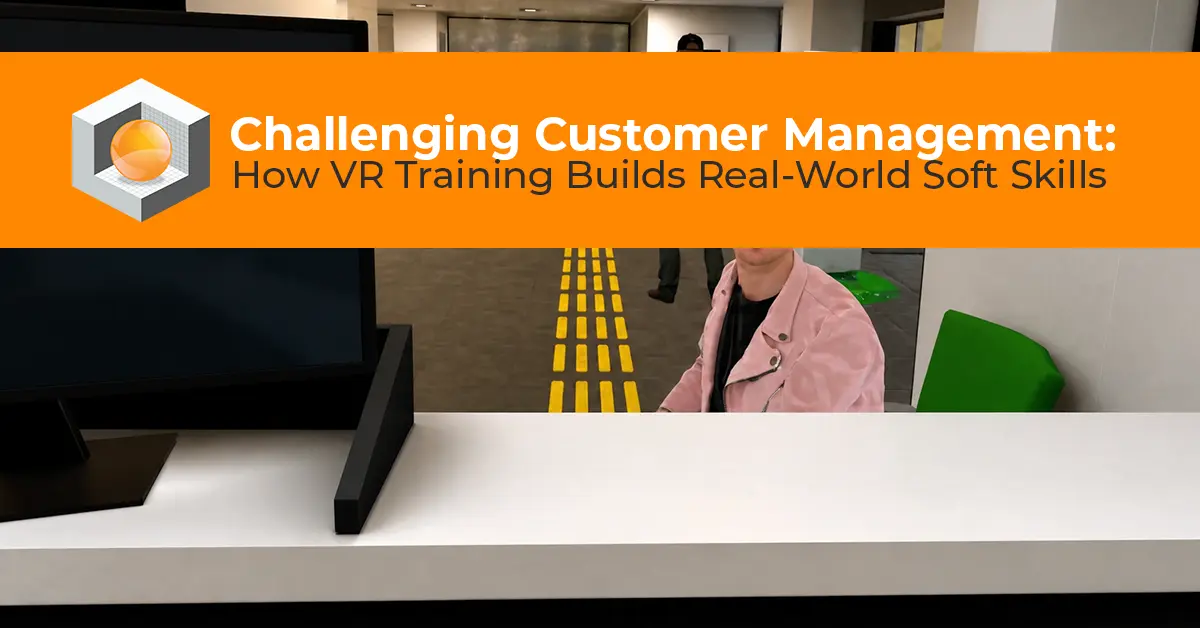
Most organizations know their weakest moment of customer interaction isn’t a policy failure — it’s a human one. An employee who freezes under pressure, responds defensively to an irate caller, or fails to read the emotional temperature of a tense conversation. The knowledge gap here is rarely about product information or company procedures. It’s behavioral. And behavioral gaps are notoriously resistant to the training methods that fill most L&D calendars.
Soft skills have always been difficult to teach at scale. The challenge isn’t understanding them in the abstract, every new hire leaves orientation knowing they should “stay calm,” “show empathy,” and “listen actively.” The gap opens between that understanding and what actually happens when a customer is raising their voice at a service counter, demanding a refund that policy doesn’t allow, or describing a problem the employee has never encountered before. What happens in that moment is shaped by experience and until recently, there was no reliable way to manufacture that experience before the real thing arrived.
VR-based challenging customer management training changes that calculus fundamentally.
Why Conventional Customer Service Training Produces Inconsistent Results
The standard training stack for customer-facing roles — induction sessions, e-learning modules, scripted roleplay with colleagues — has a structural problem: the environments it creates are too safe to produce genuine behavioral learning.
Classroom roleplay depends on a peer to play the difficult customer. That peer, regardless of instruction, tends toward kindness. The emotional stakes are low, the consequences are zero, and the trainee knows it. The result is a rehearsal that confirms existing habits rather than challenging them. Research on traditional training methods shows that employees forget roughly 70% of what they learned within 24 hours and nearly 90% within a month. That figure isn’t a criticism of trainers — it reflects the fundamental limitations of passive and low-stakes learning.
The problem compounds when organizations scale. A single L&D team running consistent, high-quality roleplay sessions for hundreds of employees across multiple sites is logistically impractical. What gets deployed instead is a version that varies in quality, depth, and emotional realism depending on who delivers it on any given day. The training exists on paper; the behavioral outcome does not follow reliably.
These are some of the most persistent challenges in corporate training programs that organizations encounter when trying to develop customer-facing competencies at scale.
The Specific Skills That Break Down Under Pressure
Understanding what actually fails in a challenging customer interaction helps clarify the design requirements for any training solution that aims to address it.
Emotional regulation is the first casualty. Employees trained in theory on de-escalation techniques often find those techniques unavailable under pressure. The stress response is physiological, not intellectual, and knowing the right steps does not automatically mean the body and mind will execute them in the heat of an interaction.
Tone management is the second. Volume, cadence, word choice, and facial expression all shift under stress, often in ways that escalate rather than resolve the situation. Employees frequently have no awareness of how their communication style changes when they feel threatened or overwhelmed.
Empathy under pressure is the third — and perhaps the hardest to train through traditional methods. Genuine empathy requires being able to hold the customer’s perspective even when their behavior is unreasonable. That capacity requires practice, not instruction.
Problem-solving under emotional load completes the picture. When emotional pressure is high, working memory contracts. Employees who know their product catalog and escalation procedures perfectly may find themselves unable to access that knowledge when a difficult customer is standing in front of them.
Each of these skills requires practiced exposure to realistic stress — not reading about stress, but moving through it repeatedly in a context where mistakes are permitted and learning is structured.
What VR Simulation Offers That No Other Method Can Match
The core advantage of virtual reality in soft skills training is its ability to generate emotional reality without real-world consequence. That distinction matters enormously.
A PwC study examining VR for enterprise soft skills training found that employees who trained in virtual environments reported feeling 3.75 times more emotionally connected to the training content than those in traditional classroom settings. That emotional connection is not a secondary benefit — it is the mechanism through which behavioral change occurs. Skills rehearsed in emotionally engaged states transfer to emotionally charged real-world situations in ways that cognitively processed knowledge does not.
The same study found that VR-trained employees completed training up to four times faster than classroom counterparts, and reported 275% greater confidence in applying what they had learned on the job. VirtualSpeech’s research corroborates this: 95% of employees who practiced customer-facing scenarios in VR reported feeling better prepared for real-world situations than before training.
These outcomes emerge from what simulation design gets right that scripted roleplay does not. The learner cannot override the virtual customer’s emotional state. They cannot rely on a peer’s subconscious wish to be helpful. The scenario runs according to its own logic, and the response options available to the trainee have consequences — scored, measured, fed back in structured form — that make the learning register in the way that emotionally consequential experiences register.
For industries where VR business training has been deployed at enterprise scale, the behavioral outcome data is consistent: repetition in realistic, emotionally engaged environments produces durable behavior change in ways that classroom instruction does not.
How VR Customer Management Scenarios Are Built
Effective VR training for challenging customer interactions is not a single experience. It is a structured library of branching scenarios, each calibrated to specific interaction types and the behavioral competencies those interactions demand.
Branching Narratives and Adaptive Customer Behavior
The architecture of a well-designed scenario uses branching logic to make every trainee decision consequential. If the employee responds with an invalidating phrase, the virtual customer’s emotional state escalates — their tone sharpens, their demands increase, or they threaten to leave. If the trainee chooses a de-escalation phrase and mirrors the customer’s concern, the scenario shifts accordingly.
This is not simply rule-following practice. The branching structure forces the trainee to read the interaction, not execute a script. It develops the pattern recognition that experienced customer-facing employees develop over years of real interactions — but compresses that learning into structured, repeatable sessions.
Empathy Development Through Perspective Shift
Some of the most effective deployments of VR in soft skills training place the learner not only in the employee role but in the customer role as well. Experiencing the interaction from the other side — hearing one’s own typical response delivered by a virtual employee, feeling the emotional impact of being dismissed or talked over — produces a qualitative shift in empathy that instruction cannot replicate.
This perspective-shift mechanic is particularly valuable for roles that deal with complaint resolution, where the emotional logic of customer frustration is often invisible to the employee until they experience its equivalent firsthand.
Measurable Feedback on Communication Quality
Unlike traditional roleplay, VR training environments can capture and score the trainee’s behavioral outputs, response timing, tone of voice, compliance with de-escalation frameworks, choice of words — and return that data as structured feedback immediately after each session. This transforms what was previously a subjective coaching conversation into a data-driven development map.
Managers can see which scenarios each employee struggles with, which behavioral competencies are improving over time, and where the team as a whole has consistent gaps. That visibility makes coaching targeted rather than generic.
The Scenario Library That Maps to Real-World Pressure
The value of any VR training system for customer management depends entirely on how well the scenarios reflect the actual pressure employees face. Generic simulations featuring an arbitrarily angry character produce generic responses. The scenarios that produce durable behavioral change are the ones that map precisely to the interaction types employees encounter in their specific roles.
Common scenario categories that appear in enterprise deployments include:
The complaint has no satisfactory resolution. The customer wants something outside policy. The employee must manage disappointment without capitulating inappropriately or becoming defensive.
The emotional spiral. The customer begins mildly frustrated and escalates rapidly. The employee must recognize the escalation pattern early and apply de-escalation techniques before the interaction passes a threshold where resolution becomes unlikely.
The accusation of dishonesty. The customer believes they have been misled. The employee must navigate the accusation without becoming defensive, while maintaining the relationship and resolving the underlying issue.
The multilayered grievance. What begins as a single complaint opens into a series of complaints. The employee must prioritize, manage expectation, and sequence resolution without losing the customer’s trust in the process.
The observer effect scenario. The difficult interaction is happening in a public setting where other customers are watching. The employee must manage both the individual interaction and the impression made on the broader room.
Each of these scenarios produces a different emotional profile in the trainee. Each requires a different primary competency. A well-structured VR training program cycles employees through the full range, identifies individual weak points, and routes additional repetitions toward those specific gaps.
Expert Note One frequently underestimated element of scenario design is the post-session debrief structure. The immersive learning experience itself generates high emotional engagement, but the behavioral change is consolidated in the structured reflection that follows — review of performance metrics, replay of key decision points, comparison against best-practice response paths. Organizations that deploy VR scenarios without a disciplined debrief protocol see significantly lower transfer of learning to live interactions than those that treat the debrief as an integral part of the session, not an optional add-on.
What the Performance Data Actually Shows
The behavioral outcomes of VR-based customer management training are measurable in ways that traditional training outcomes typically are not.
Knowledge retention is one dimension. While traditional training methods produce retention rates of 10–30% within days of the session, VR training consistently produces retention rates above 75%, with some studies showing durable knowledge retention of up to 80% after a year. The mechanism is the same as any memory research: experiences with emotional and sensory engagement encode more deeply than information passively received.
Confidence is another. The same PwC research that documented the emotional connection advantage also found that VR-trained employees demonstrated a 275% greater confidence increase than control groups. Presenting a 40% improvement over classroom learners and 35% over e-learning counterparts. In customer management, confidence is not a soft metric. An employee who approaches a difficult interaction with composure and self-assurance manages that interaction differently than one who enters it anxious and uncertain.
Speed of behavior change is the third dimension worth tracking. VR training scenarios can be deployed, completed, and debriefed in a fraction of the time required for equivalent classroom instruction. Research suggests training time reductions of up to 75% across skill categories. For organizations with large customer-facing workforces, that compression translates directly into measurable gains in employee productivity and reduced time-to-competency for new hires.
At scale, the economics shift further. PwC’s analysis found that VR training reaches cost parity with classroom learning at 375 learners. With 3,000 learners, the cost advantage reaches 52%. For organizations operating contact centers, retail networks, or distributed service teams, those figures are significant inputs to the business case.
Which Organizations and Roles Benefit Most
VR challenging customer management training is applicable across any sector where employees regularly navigate complex, emotionally charged interactions with external parties. In practice, the greatest deployment concentration has been in:
Retail and hospitality, where frontline staff face the full spectrum of customer behavior daily and where inconsistent quality of service interactions has a direct impact on customer lifetime value and brand perception.
Financial services and insurance, where advisors and service representatives must manage emotionally loaded conversations about money, claims, and outcomes that have significant impact on customers’ lives. The St. James’s Place deployment in UK financial services is a documented case where VR roleplay with branching narratives produced consistent improvements in active listening, rapport building, and empathy scores across a large advisor cohort.
Healthcare administration and patient-facing services, where staff navigate conversations involving anxiety, pain, uncertainty, and sometimes grief, and where poor interaction quality has immediate patient experience consequences.
B2B sales and account management, where difficult conversations about pricing, scope, missed deliverables, or contract disputes require the same de-escalation and empathy competencies as consumer service interactions, but in a higher-stakes relationship context.
HR and internal communications teams, including leaders and managers who must handle performance conversations, redundancy discussions, and team conflict — all forms of challenging interpersonal interaction that follow the same behavioral logic as external customer management.
The target audience for this training spans organizational levels: HR teams designing development programs, operations leads managing customer-facing workforces, and senior executives who want behavioral consistency across distributed teams. Entrepreneurs running high-touch client businesses and team leaders preparing potential leaders for customer escalation responsibility are equally relevant beneficiaries.
Frequently Asked Questions
What is challenging customer management VR training?
Challenging customer management VR training places employees inside simulated, realistic customer interaction scenarios — including complaints, conflicts, and emotionally charged conversations — and develops their communication, empathy, and de-escalation competencies through repeated, consequence-driven practice. Unlike classroom instruction or scripted roleplay, the virtual environment responds dynamically to the employee’s decisions, generating an emotionally realistic training context that drives genuine behavioral change.
How does VR training improve empathy in customer service?
VR creates the conditions for empathy development by making the customer experience emotionally real. When a virtual customer displays distress, frustration, or escalating anger, the trainee’s stress response activates in a manner that passive learning methods cannot produce. Some deployments include perspective-shift scenarios, placing the learner in the customer role, which consistently produces stronger empathy outcomes than instruction alone. Research from PwC found that VR learners reported an emotional connection to training content 3.75 times stronger than that of classroom learners.
Can VR training measure soft skills performance objectively?
Yes — and this is one of the most significant advantages VR brings to soft skills development. VR training environments can capture response timing, de-escalation technique compliance, word choice, and tone indicators, returning structured performance data after each session. This allows managers to track individual employee progress over time, identify specific behavioral gaps across a team, and make coaching targeted rather than intuitive. Traditional roleplay produces qualitative impressions; VR produces quantifiable performance profiles.
How long does a VR customer management training session take?
Session length varies by scenario complexity and organizational design, but most enterprise deployments structure individual scenarios to run between 10 and 30 minutes, including the post-session debrief. Full program completion — covering a library of scenario types — typically fits within a timeframe significantly shorter than equivalent classroom instruction. Research indicates VR training can reduce total training time by up to 75% compared to traditional methods.
Is VR soft skills training cost-effective for large organizations?
At scale, yes. The initial investment in hardware, software, and scenario development is offset by reduced time-to-competency, lower per-session delivery cost, and the elimination of travel and trainer fees for distributed teams. PwC’s cost analysis found that VR training achieves cost parity with classroom delivery at 375 learners, and becomes 52% more cost-effective than traditional training at 3,000 learners. For organizations with large customer-facing workforces, the per-employee cost comparison favors VR significantly once the program reaches deployment scale.
What types of customer scenarios are most commonly simulated in VR training?
The most commonly deployed scenario types cover: customers making demands outside policy scope, emotionally escalating interactions that require de-escalation technique, accusation or complaint situations where the employee must navigate defensiveness, and multi-issue grievances requiring prioritization and expectation management. The most effective programs build scenarios from an organization’s own real interaction data — complaint logs, call center recordings, and service feedback — rather than from generalized assumptions about difficult customer behavior.
Turning Difficult Encounters Into Training Assets
The organizations that benefit most from VR challenging customer management training are not the ones that treat it as a one-time onboarding supplement. They are the ones that integrate it as an ongoing development mechanism — building scenario libraries from real interaction data, routing employees back through updated scenarios when new interaction patterns emerge, and using the performance data generated by each session to inform coaching and team development decisions.
The forward direction of this field points toward increasingly adaptive simulation. AI-driven virtual characters that respond not just to scripted decision trees but to the full conversational context of the interaction, delivering an experience closer to the unpredictability of a real difficult customer. Multimodal performance capture that tracks not only language choices but physiological stress indicators, giving trainers visibility into the emotional state of the trainee throughout the session. These developments will deepen what is already a measurably superior approach to building the behavioral competencies that customer-facing roles demand.
For L&D directors and operations leads, the practical takeaway is straightforward: if the behavioral gap between what employees know and how they perform under pressure is showing up in customer satisfaction data, escalation rates, or staff confidence metrics, the training mechanism needs to change. Adding more instruction to a model that has already reached its ceiling does not close a behavioral gap. Structured, measurable, emotionally realistic practice does.
How RoT STUDIO Approaches This
At RoT STUDIO, challenging customer management training is one component of a broader soft skills and behavioral development offering built on the same simulation infrastructure that the company has deployed across manufacturing, healthcare, energy, and aerospace environments. The approach to scenario design draws on real interaction data where available, and the training architecture is built to produce measurable behavioral output — not just completion rates.
The RoT STUDIO License gives organizations a no-code environment to build, update, and deploy their own VR training scenarios without reliance on custom development cycles. For organizations that need ready-made deployments, the VR Training Catalogue provides immediately deployable scenario sets covering a range of customer management interaction types, calibrated to enterprise quality standards. Customized VR training engages design scenarios from the ground up based on an organization’s specific industry context, customer profile, and behavioral development priorities.
Operating from European headquarters at High Tech Campus Eindhoven — one of the most concentrated technology innovation environments in Europe — and with offices in Istanbul and Ankara, RoT STUDIO brings the engineering depth of infoTRON’s 3D and simulation legacy to every deployment. The company’s multi-industry track record means that the scenario architecture and performance measurement frameworks applied to customer management training are built on the same technical foundation that has produced measurable outcomes in the most demanding training environments.