Ask an HR director which capability their organisation most needs and the answer is rarely a technical one. It is some version of the same thing: people who can work out what to do when the situation in front of them does not match anything in the handbook.
The labour market data agrees. Analytical thinking and creative thinking now sit among the fastest growing workplace skills in global workforce forecasting, and both are downstream of the same underlying capability. Survey work on managerial confidence points the same way, with roughly two thirds of managers reporting that recent hires are not fully prepared for the roles they have stepped into. Around a quarter of employers now expect behavioural skills to matter more than technical ones, against a much smaller share who still rank technical skills higher.
So the investment case is settled. What is not settled is the delivery model. Organisations are spending real money on problem-solving and soft skills programmes, and a substantial share of that spend never reaches the job it was bought for. The reason is structural, and it has very little to do with the quality of the content.
What Problem Solving Actually Is as a Workplace Skill
Problem solving in an organisational context is the ability to recognise that something is wrong, work out why rather than treating the symptom, choose between imperfect options, and act before the situation resolves itself badly. It draws on critical thinking, judgement under incomplete information, and the communication needed to bring other people along with a decision.
A project slipping by two weeks illustrates the distinction. The reactive response is to push the team harder. The problem-solving response is to establish whether the delay came from unclear briefs, a dependency nobody owned, or capacity that was never realistically available, and then to change whichever of those is actually causing it. Same delay, entirely different intervention, and only one of them stops it recurring next quarter.
Knowing a Framework and Using One Are Different Capabilities
Most organisations already teach a structured method. Define the problem, gather context, find root causes, generate options, evaluate them, act, monitor, refine. The frameworks are sound and largely interchangeable, and employees can usually recite them accurately at the end of a session.
Reciting a method is not the same competence as applying it while a frustrated stakeholder is talking over you and the decision is due in ten minutes. A high score on an end-of-course assessment says something about comprehension and almost nothing about performance under pressure. Worse, it produces a confident learner, because understanding a method feels a great deal like being able to use it. That gap between comprehension and reflex is where most programmes quietly fail.
Why Soft Skills Programmes Do Not Reach the Job
Training researchers have a name for this. The soft skills transfer problem describes the well documented pattern in which behavioural training produces engaged sessions, positive feedback forms, and no observable change in how people act at work three months later.
The causes are consistent across the literature. Retention decays sharply without reinforcement, so a single event loses most of its content within days. Learners return to an environment that does not support the new behaviour, or that offers no opportunity to practise it while it is still fresh. And the measurement layer compounds the problem: most learning functions are held to training hours, attendance, and completion rates, none of which describe whether anyone does anything differently.
The consequences show up somewhere other than the learning dashboard. They surface as projects delayed by misaligned communication between departments, as turnover driven by friction between employees and their direct managers, and as customer satisfaction scores that soften because frontline staff resolve problems poorly. Those costs are almost never attributed back to a training programme that technically achieved full completion.
Content-First and Problem-First Programs Compared
The two models produce different learner behaviour, and the difference is visible well before you get to outcome measurement.
| Dimension | Content-first program | Problem-first programme |
| Learner role | Listener | Decision maker |
| First encounter with the skill | Explained, then practised | Attempted, then explained |
| Role of failure | Avoided, marked as error | Deliberate, the point of the exercise |
| What gets measured | Attendance, completion, quiz score | Decisions taken, attempts, behaviour change |
| Typical output | Awareness of a method | Reflex under pressure |
The constraint on the right-hand column has always been practical rather than philosophical. Running problem-first training at scale means producing difficult, repeatable, consequence-bearing situations for every participant, which is expensive with facilitators and role-play actors and effectively impossible to standardise across sites.
The Situations Where Problem Solving Is Actually Tested
Abstract problem-solving exercises transfer poorly because real workplace problems arrive attached to people, politics, and time pressure. The scenarios that genuinely stress the skill tend to fall into a few recognisable categories.
There is the underperformance conversation, where a manager has to raise a difficult issue without damaging the relationship or triggering defensiveness. There is the escalated customer, where the commercial problem and the emotional one have to be solved simultaneously and in the right order. There is the negotiation with incomplete information, where the other party knows things you do not and the resources are genuinely constrained.
Then there is cross-functional conflict, where two departments each hold a locally rational position and the problem is not technical at all. And there is decision making against the clock, where a defensible answer now beats an optimal answer later. Each of these is a problem-solving task wearing a soft skills label, which is precisely why treating the two as separate training categories tends to weaken both. RoT STUDIO’s HR and soft skills VR programmes are built around this scenario set rather than around skill labels.
What Simulation Changes About Practising These Skills
Immersive simulation is not a better way to deliver soft skills content. It is a way to deliver the part that content cannot carry, which is repeated exposure to consequence.
Consequence Without Cost
In a simulated performance conversation the employee reacts to how the manager opens. Lead with the accusation and the conversation closes down. Restate the other person’s position before responding and it stays open. The manager sees the branch their choice created, then runs the scenario again and takes the other path.
That loop is difficult to reproduce any other way. A role-play with a colleague is constrained by the colleague’s acting range and by both parties knowing it is not real. A live attempt with an actual underperforming employee is real, but it happens once and the cost of getting it wrong is borne by a person. Simulation sits in between: consequential enough to engage, repeatable enough to build a reflex, and identical for every participant across every site.
Turning Behaviour Into Something Observable
The second contribution matters more to the HR function than to the learner. Behavioural competence has always been hard to evidence, which is why learning teams end up reporting completion rates they know are weak proxies. A simulation records what each participant actually did: which option they took at each decision point, how many attempts a scenario needed, where the same error recurred across a cohort.
That moves reporting up a level. Instead of confirming that a workforce attended communication training, the function can show which behaviours changed, for whom, and where a cohort is still failing consistently enough to warrant a targeted intervention. Evaluation frameworks have separated reaction, learning, behaviour, and results for decades. Most programmes report at the first two levels because the third has been impractical to capture at scale.
The same data answers the question finance actually asks. A pattern showing that escalation handling improved across a service team is a materially different conversation with a board than a completion percentage, and it is the kind of evidence that survives a budget review. The broader argument for where VR resolves long-standing corporate training constraints covers the operational side of this in more detail.
Building a Programme That Reaches the Job
Delivery format alone does not solve transfer. Programmes that change behaviour tend to share a set of design decisions regardless of the technology underneath them.
Start from real organisational problems rather than generic case studies, because relevance is one of the stronger predictors of whether a skill survives the walk back to someone’s desk. Sequence practice so the first encounter with a skill is an attempt rather than an explanation. Then build in repetition over time instead of a single event, since the decay curve is steep and one exposure loses to it.
The organisational half matters at least as much as the design half. Managers need to reinforce the behaviour afterwards through coaching and the questions they ask, because the post-training environment often predicts transfer more strongly than anything inside the session. Give people an opportunity to apply the skill soon after training, while it is still available to them. And define success as observable behaviour before the programme launches rather than after, because a metric chosen retrospectively will almost always be the one that is easy to collect.
None of this requires simulation. What simulation contributes is the practical means to do the second and third of these at scale, which is where most organisations run out of facilitator capacity and quietly revert to a content-first model.
Frequently Asked Questions
HR and learning teams weighing a change to how they deliver behavioural training raise a fairly consistent set of questions, usually before the conversation turns to budget or headsets. These come up most often.
Can problem solving genuinely be taught, or is it a personality trait?
It can be taught, and the framing matters. Described as a quality someone either has or lacks, it becomes untrainable by definition. Described as a set of observable moves, such as establishing the root cause before proposing a fix or restating an objection before answering it, each component can be practised, observed, and assessed. Competency frameworks generally take the second view for exactly this reason.
Why do soft skills programmes score well on feedback but change nothing?
Feedback forms measure reaction, which is a poor predictor of behaviour change. A session can be engaging, well facilitated, and enjoyable while still failing to produce transfer, because transfer depends on reinforcement, opportunity to apply, and a supportive environment afterwards. High satisfaction scores and zero behavioural change routinely coexist.
How is VR different from e-learning with branching scenarios?
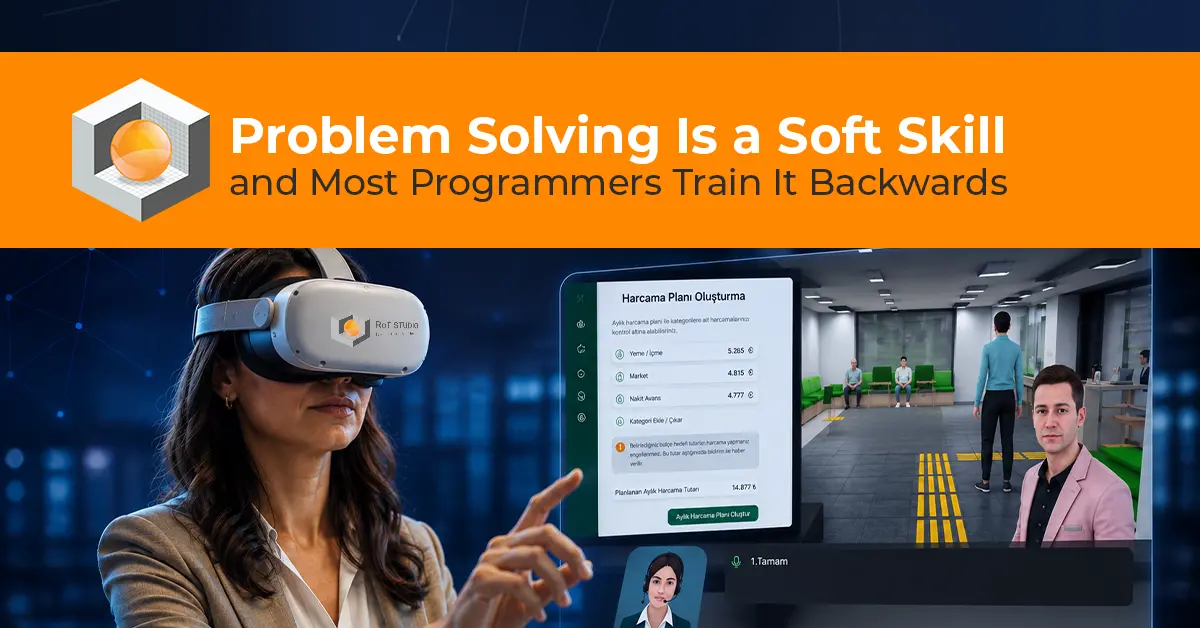
The mechanism is presence. A branching e-learning module asks the learner to select what they would say from a list, which is a comprehension task. An immersive scenario places them in the situation with a person reacting to them in real time, which recruits the stress response the real conversation will involve. Practising a skill under something resembling the conditions of use is a large part of why it later transfers.
What should HR measure instead of completion rates?
Observable behaviour and downstream operational indicators. Whether managers now open difficult conversations differently, whether escalations resolve at first contact more often, whether recurring problems decline, whether issues get resolved without escalation. Completion data is worth keeping for administrative purposes but should not be reported as an outcome.
Does this replace coaching and manager reinforcement?
No, and treating it as a replacement is a common way to waste the investment. Simulation handles repeated practice and generates behavioural data. Managers convert that into sustained change through coaching, the questions they ask in reviews, and whether they create room for the new behaviour. The evidence on transfer consistently points to the post-training environment as decisive.
How long does it take to deploy a programme like this?
It depends on whether the scenarios are ready-made or bespoke. Standard modules covering leadership, communication, negotiation, and time management can be deployed on a timescale of weeks. Custom scenarios built around an organisation’s own situations, role profiles, and cultural context take longer, and most organisations sensibly begin with ready-made content and add bespoke scenarios once the delivery model has proved itself internally.
Where This Leaves HR and Learning Teams
The demand signal for behavioural capability is not in dispute, and neither is the shortfall. What remains unresolved in most organisations is a delivery model built for information transfer being asked to produce reflexes, and a measurement layer reporting attendance because behaviour was impractical to capture.
The useful question for a learning function is not whether it runs soft skills training. Nearly all of them do. It is whether the programme can put someone into a situation hard enough to fail at, more than once, and produce a record of what changed between the first attempt and the last. A programme that can do that is defensible in a budget review. One reporting completion rates is not, and it tends to find that out at the worst possible moment.
How RoT STUDIO Approaches Leadership Training
RoT STUDIO builds HR and soft skills training as immersive scenario work rather than as content delivery. Participants are placed in leadership conversations, customer interactions, negotiations involving information asymmetry and constrained resources, and decisions taken against the clock. The design intent is that people meet these situations in a simulation before they meet them at work, and that they are allowed to handle them badly the first time.
Ready-made modules covering leadership, HR and soft skills, and time management are available through the VR Training Catalogue, which lets an organisation start without commissioning development first. Where an organisation’s role profiles, sector context, or cultural setting need scenarios that do not exist off the shelf, the Customized VR/XR Services team builds them, and the RoT STUDIO License lets learning teams author and revise scenarios themselves without software development resources.
Across all three routes the platform tracks confidence scores, decision-making patterns, and scenario completion for each participant, and the same standardised programme can run in Amsterdam, London, Berlin, or Istanbul without drifting between sites. The wider VR and XR training solutions range applies the same methodology to operational and technical training, which matters for organisations wanting one delivery model across both.