Across industrial sites in North America and Europe, HSE managers running their Q1 2026 incident reports are noticing a pattern that is becoming hard to ignore. Recordable incidents track upward in close correlation with workforce turnover. Near-miss frequency rises in the months following retirements of senior operators. New-hire incident involvement appears earlier in tenure than it used to. The aggregate picture is not yet a crisis at the industry level, but at the site level it is increasingly the most operationally significant item in the safety report.
The underlying cause is no longer hypothetical. U.S. manufacturing alone faces a projected 2.1 million unfilled jobs by 2030, with the cost potentially reaching $1 trillion in that single year. Approximately 26% of the existing manufacturing workforce is expected to retire by 2030. HVAC has 110,000 unfilled positions nationally. Emergency medical services are running short across multiple states. Trucking, mining, energy, and construction are absorbing the same pressure. The mismatch between experienced workers leaving and new workers being brought to competency is becoming the defining workforce reality of the decade.
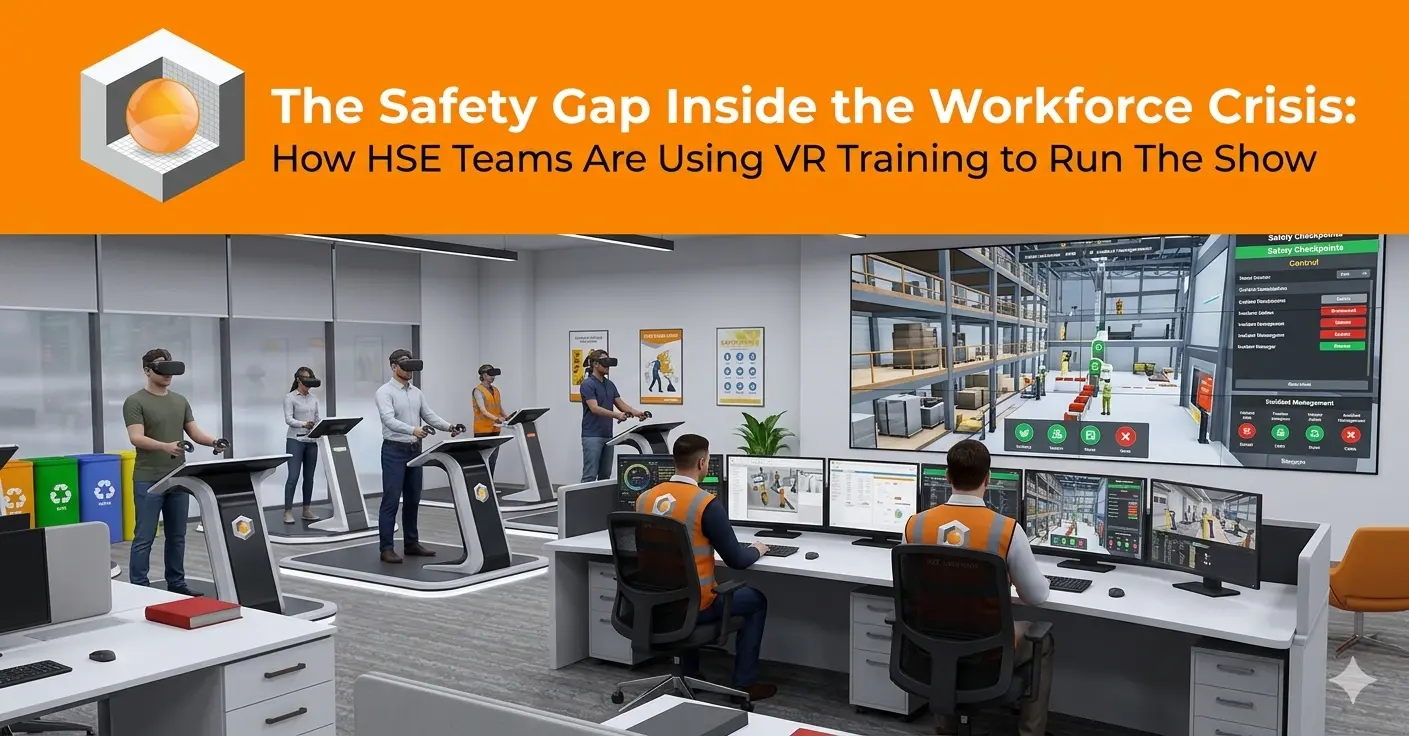
For HSE managers, this reality is not an HR problem to monitor from a distance. It is the central operational risk multiplier of 2026 and beyond. A workforce in which experienced operators retire faster than new hires can be brought to safe competency is structurally more exposed to incidents, and the response cannot be more PowerPoint slides, more classroom hours, or more supervised field time, because those approaches do not scale at the pace the workforce churn demands. The response that is producing measurable results across multiple sectors is VR-based training, deployed at the frequency and scale that procedural competency actually requires.
This is the operational logic behind why 2026 has produced more high-profile VR training adoption announcements and industry awards than any prior year. It is also the logic that puts HSE managers at the center of a procurement conversation that traditionally lived in L&D.
The Workforce Crisis Is Also a Safety Crisis
The data points have been published widely, but their full implication for HSE is often understated in workforce reporting.
The Demographic Pipeline Problem
The U.S. Bureau of Labor Statistics tracked manufacturing employment dropping by more than 70,000 jobs in the second half of 2025, with factory employment at 12.69 million as of December, the lowest reading since March 2022. NAM survey data for Q1 2026 shows manufacturers reporting an average 4.1% of roles unfilled, with roughly one in four manufacturers facing vacancy rates above 5%. JOLTS data shows manufacturing job openings ranging between 440,000 and 510,000 through the first quarter of 2026, a level meaningfully higher than the year-earlier period and structurally higher than pre-pandemic norms.
The skilled trades pipeline shows the same pattern with greater intensity in specific verticals. The HVAC industry has 110,000 nationally unfilled positions according to current industry analyses. Connecticut EMS agencies have begun adopting unconventional recruitment and training approaches to address the EMT shortage. JPMorgan Chase’s recent workforce report identifies semiconductor manufacturing, defense, energy, and AI as the most acutely affected sectors, with the bank explicitly framing the gap as a national security risk.
The Compounding Effect on Incident Risk
For HSE managers, the operational concern is not the headcount math but the experience-distribution math. A site with 200 production workers and a 4% vacancy rate has eight open roles, but the more consequential statistic is that the workers filling those roles, plus the workers replacing the next wave of retirements, will collectively represent a workforce with a measurably lower median tenure than the workforce of three years ago. Lower median tenure correlates with higher incident involvement across virtually every industrial vertical that publishes the data. The broader pattern is described in detail in our analysis of why manufacturers are switching to VR-based workforce training.
The compounding problem is that the workers retiring are the workers who held the tacit safety knowledge that does not exist in SOPs. A thirty-year operator’s intuition about why a particular machine sounds different on a humid day, or why a particular procedure step has historically caused near-misses when performed in a specific sequence, is not documented anywhere. It exits the building with the operator.
Why Traditional Training Methods Have Hit Their Scale Limit
The standard response to a green workforce is more training. The structural problem is that traditional training methods, classroom instruction, demonstration-based safety briefings, and supervised field hours, do not scale to the pace that workforce turnover now demands. Classroom hours require trainer availability, which is itself a function of the same workforce shortage. Supervised field hours require an experienced operator’s time, which is the scarcest resource on the floor. Demonstration-based briefings produce knowledge transfer but not procedural skill, and procedural skill is what determines whether a green operator executes a correct lockout sequence on day 90 of their tenure rather than the incorrect sequence they were briefed on once during onboarding.
This is the structural reason VR-based safety training has moved from pilot status to scaled deployment across multiple sectors in 2026.
What Award-Winning VR Programs Are Actually Solving For
A pattern that became visible across 2026 industry announcements: VR safety training programs are winning a disproportionate share of national recognition compared to their share of total training spend. Schneider, the bulk shipping carrier, was recognized with a national safety award for its VR training and advanced simulator program targeting accident prevention, spill reduction, and new driver readiness. J.J. Keller’s VR training solution was named to Heavy Duty Trucking’s 2026 Top 20 Products list for advancing trucking safety and compliance. VRSim’s leadership received Hartford Business Journal’s 2025 Innovator recognition for its work in skilled trades VR training. The Schneider, J.J. Keller, and broader cluster of award-recognized programs are operating at industrial scale in environments where workforce turnover and incident risk are both high.
The Common Pattern Across These Programs
What these recognized programs share is not technology novelty. VR training has been operationally viable for nearly a decade. What they share is the specific problem set they are deployed against:
High-turnover, high-incident-cost workforces where green operators reach production faster than experienced trainers can be made available. Procedural skills that cannot be reliably built through classroom or demonstration formats, including emergency response, complex equipment operation, and multi-step safety procedures. Multi-site or distributed deployment requirements where training consistency is impossible to maintain through trainer-led delivery. Compliance documentation pressure that paper-based records cannot satisfy.
The Schneider Case as a Template for Industrial HSE
The Schneider bulk shipping case is structurally informative for industrial HSE managers even though it sits in a transportation vertical. The training problem Schneider faced is the same training problem a 12-site manufacturing organization faces: a workforce that turns over faster than trainer-led safety programs can keep pace with, against a regulatory environment that requires auditable competency documentation, in an operational environment where incidents carry both immediate human cost and long-tail insurance and reputational cost.
The pattern that makes these programs award-eligible is not their use of VR. It is that they have solved an HSE problem at a scale that traditional training methods could not reach.
How HSE Teams Are Actually Deploying VR Training in 2026
The operational mechanics of VR safety training have matured to the point where HSE managers can build programs that compress competency time without compromising the rigor of the training standard.
Compressing Competency Time Without Compromising Standards
The training science behind this is now well-established. Research summarized across industry sources indicates that VR-based training delivers approximately 75% higher knowledge retention compared with traditional methods (PwC), approximately 4x faster training completion times compared with equivalent classroom programs, and approximately 40% average cost reduction compared with in-person training of equivalent depth. The peer-reviewed evidence base is also expanding. A 2025 study published in Nature evaluating VR-based training effectiveness for sustainable health and occupational safety in Industry 4.0 environments confirms the magnitude of the retention and behavioral-change advantages reported in industry data.
For HSE managers, the operationally relevant version of these statistics is that a green operator can complete a VR-based LoTo, fire extinguisher, working-at-height, or HSE risk-hunt training scenario multiple times in a single session, building procedural memory that classroom instruction cannot produce regardless of how many hours it consumes. The repetition density is the mechanism. A trainee who has executed the PASS extinguisher sequence forty times in VR scenarios has substantively different motor competency than a trainee who watched the procedure demonstrated once and signed an attendance sheet. RoT STUDIO’s VR safety training programs are structured around this principle: every module is built for repetition density rather than briefing-style coverage.
Documentation That Survives Workforce Turnover
The second operational advantage that has become decisive for HSE adoption is session-level performance documentation. Paper-based and even most LMS-based safety training records confirm that a session occurred. They do not confirm that any specific individual can execute the procedure under simulated stress. VR-based training systems automatically capture session-level performance data: which decisions were made, how long the trainee took at each step, where errors occurred, how many repetitions were required before correct execution. This data is exportable, audit-ready, and persists in the record regardless of staff turnover.
For OSHA-regulated facilities, NHS-compliant healthcare environments, and EU-jurisdiction industrial sites, this documentation depth is increasingly the difference between defensible and undefensible training programs under audit conditions.
Sites and Shifts as Independent Variables
The third operational shift that has driven 2026 HSE adoption is the elimination of geography and scheduling as training constraints. Cloud-deployed VR training programs run identically at every site, on every shift, without requiring trainer travel or facility downtime. A multi-site organization can complete a fire safety refresher across all locations in the same week without coordinating external vendors or pausing operations. For HSE managers operating distributed industrial portfolios, this removes the single largest scaling constraint that paper-and-classroom training imposed.
The Specific HSE Use Cases Where VR Is Producing Measurable Results
VR safety training is now deployed against a defined set of HSE use cases where the procedural-skill requirement, the regulatory documentation burden, and the difficulty of physical training delivery converge.
Fire Response and Extinguisher Operation
Live fire extinguisher training discharges physical agent, consumes replacement charges, requires vendor coordination, and produces one or two repetitions per worker per training cycle. VR-based fire response training removes the physical consumables entirely and converts a once-a-year procedural briefing into an ongoing program of distributed scenarios across multiple extinguisher types, fire classes, and environmental contexts. The Schneider case for transportation safety shares the same operational architecture as enterprise fire training: replacing a low-frequency, high-cost live training event with a high-frequency, low-cost simulation program.
Working at Height
Working-at-height training in physical environments requires risk acceptance even during the training itself. VR-based working at height training places trainees in elevated environments without the underlying fall risk, allowing repetition that field-based training cannot match. The procedural elements (PPE selection, anchor inspection, ascent technique, rooftop transitions) are encoded through physical interaction in VR rather than through demonstration.
Lockout/Tagout (LoTo) Procedures
LoTo procedure errors are among the highest-consequence procedural failures in industrial environments. The challenge for HSE managers is that LoTo training delivered through briefing format produces awareness but not reliable execution. VR-based LoTo training places trainees in the full procedure sequence across multiple equipment types and tag-out scenarios, with corrective feedback at each decision point.
Risk Hunt and Hazard Recognition
The HSE Risk Hunt training format, in which trainees are placed in an operational environment and asked to identify hazards, is one of the strongest matches for VR delivery. The format requires environmental complexity that cannot be staged physically without cost and downtime, and it requires immediate corrective feedback that is difficult to provide in classroom format. RoT STUDIO’s HSE Risk Hunt, Underground Mining Risk Hunt, Earthquake Risk Hunt, and Information Security Risk Hunt modules are built specifically around this format. For the broader category of industrial VR training, the risk-hunt format has emerged as one of the highest-engagement scenario types.
Emergency Evacuation and Disaster Response
Earthquake response, fire evacuation, chemical spill response, and similar emergency procedures are characterized by low-frequency, high-consequence execution requirements. Traditional drills cannot be run frequently enough to build procedural memory across a workforce, and the drills that do run are too scripted to replicate the cognitive load of real emergencies. VR and mixed reality (MR) training environments can deliver high-fidelity emergency simulation that scales across sites and training frequencies.
Industrial Manufacturing and Equipment-Specific Training
Equipment operation training, hazard recognition specific to manufacturing environments, and process-specific safety procedures benefit from VR’s ability to replicate site-specific conditions. RoT STUDIO’s Customized VR/XR Services extend the standard catalogue into client-specific environments where standard scenarios cannot capture the operational specifics of a particular facility or equipment configuration.
The Procurement and ROI Logic HSE Managers Need to Make
The business case for VR safety training has evolved past the early-adoption framing that compared it primarily to classroom training costs. The 2026 procurement conversation operates against a different denominator.
The Incident-Avoidance ROI
Industrial incidents carry direct costs (medical, equipment damage, production downtime), indirect costs (investigation, regulatory follow-up, insurance premium impact), and reputational costs (community standing, customer relationships, recruitment damage). Across industries, organizations that have published VR training ROI data consistently report that incident reduction alone produces a positive return that meaningfully exceeds the platform investment within 12 to 24 months of deployment. The case for how VR training reduces workplace accidents is now supported by a substantial body of operational data across multiple sectors. For Carmeuse Turkey, deployment of customized VR training across six factories in the lime and mining sector contributed to recognition through the Carmeuse Group Innovation Award and the ILA Health and Safety Award, against a backdrop of measurable workplace incident reduction.
The Documentation and Audit Defense Logic
A secondary but increasingly significant component of the procurement case is audit defense. Regulatory and insurance auditors have become more sophisticated about distinguishing between attendance documentation and competency documentation. Training programs that produce session-level competency records, rather than attendance sheets, are increasingly viewed as evidence of a defensible safety program. For organizations operating under OSHA scrutiny, EU industrial safety frameworks, or NHS clinical compliance requirements, this documentation depth is now a procurement decision factor in its own right.
The Sustainability and ESG Procurement Add-On
A third procurement dimension that has emerged in 2026 is ESG alignment. VR-based training eliminates the consumables, travel, and physical waste streams associated with traditional HSE training, contributing directly to organizational sustainability reporting. For organizations with formal ESG mandates, this contribution is increasingly captured in training program procurement evaluations.
Frequently Asked Questions
Does VR safety training fully replace physical drills?
For procedural skill components (PASS extinguisher technique, LoTo sequences, anchor inspection, hazard recognition), VR can fully replace classroom and demonstration formats with stronger competency outcomes. For site-level coordination drills (full-building evacuation, fire warden coordination, mutual aid response), physical drills remain appropriate and required in most jurisdictions. VR-based training is most effective when used as the primary modality for individual procedural competency, with physical drills focused on site-level coordination.
How does VR safety training documentation hold up under OSHA or EU regulatory audit?
VR-based training systems produce session-level performance records that exceed the documentation standard of traditional attendance sheets. Records typically include scenario completion confirmation, error logs, time-on-task per decision point, and repeat attempt history per trainee. This documentation depth is exportable, audit-ready, and persists in organizational records regardless of staff turnover. For organizations under OSHA 29 CFR 1910 or equivalent EU industrial safety regulation, this depth is the documentation standard auditors increasingly expect.
What hardware investment does a multi-site VR safety training program require?
Current-generation standalone VR headsets (Meta Quest 3, PICO 4, and equivalent) have made enterprise deployment economically viable at scale. A typical multi-site rollout commits to a small fleet of headsets per facility (often six to twelve units), rotated across training sessions. Cloud-deployed VR platforms minimize on-premise IT infrastructure requirements, and per-headset cost has fallen to the point where the hardware is rarely the limiting factor in procurement decisions.
How long does it take to deploy a VR safety training program across multiple sites?
For organizations using a no-code VR authoring platform with a ready-made catalogue of modules, multi-site deployment can be operational within weeks rather than months. Custom-developed scenarios (site-specific equipment, process-specific safety procedures) add development time. The RoT STUDIO License platform is designed to allow HSE managers to author and update training scenarios without dedicated development resources, which removes the dependency on external development cycles that has historically slowed VR training rollouts.
Can VR safety training cover regulated workforce categories beyond manufacturing?
VR safety training has been deployed across manufacturing, mining, healthcare, construction, transportation, and utility sectors. Specific module availability depends on the platform provider. Healthcare-specific VR safety training, including surgical workflow safety, infection control protocols, and clinical equipment operation, sits within RoT Healthcare’s clinical training scope. Industrial safety training is the core of RoT STUDIO’s standard catalogue.
How is VR safety training different from VR EMS training or VR EMT training?
VR EMS training and VR EMT training apply the same procedural-repetition and scenario-based methodology to emergency medical services and pre-hospital care, where workforce shortages have become acutely visible across the U.S. The underlying training architecture is identical to industrial HSE: procedural skill built through immersive repetition, with session-level performance documentation. RoT STUDIO’s healthcare division (RoT Healthcare) extends its VR/XR capabilities into the clinical training scope adjacent to EMS and emergency response workflows.
From Workforce Crisis to HSE Response: The Operational Conclusion
The 2026 workforce crisis is not slowing. The retirement curve, the new-hire pipeline gap, and the structural labor shortage in skilled trades and industrial roles are sustained trends, not cyclical anomalies. For HSE managers operating across industrial portfolios, the operational consequence is that the workforce filling production roles over the next decade will be measurably less experienced than the workforce of the past decade. The safety competency that workforce achieves will determine the incident profile of those operations.
The traditional training methods that built safety competency in prior workforce generations were designed for slower workforce turnover, more available trainer capacity, and longer onboarding windows than the 2026 operating reality provides. Those methods have hit their structural limit. The training architecture that scales to the new reality is built around procedural repetition delivered through simulation, session-level competency documentation, and consistent deployment across distributed sites without dependency on trainer availability.
This is the operational shift that VR safety training has made possible at industrial scale, and it is the reason 2026 has produced more visible enterprise adoption and industry recognition than any prior year. For HSE managers, the procurement conversation has moved from “is VR effective” to “how fast can we deploy it before the workforce competency gap becomes our incident report.”
How RoT STUDIO Approaches This
RoT STUDIO’s VR training platform is built around the principle that procedural safety competency cannot be transferred through information delivery, regardless of format. It must be built through repetition under realistic conditions, with corrective feedback embedded in the training environment. The platform addresses the workforce-driven HSE challenge through three operational layers.
The VR Training Catalogue includes ready-made modules covering Fire Extinguisher Operation, Working at Height, LoTo Lock procedures, HSE Risk Hunt, Underground Mining Risk Hunt, Earthquake Risk Hunt, Information Security Risk Hunt, and Disaster and Emergency Response. Each module is structured for the repetition density required to build procedural competency, with session-level performance tracking embedded in the platform architecture.
The no-code RoT STUDIO License allows HSE teams to author and update scenarios as site conditions, equipment, or procedures change, without dependency on software development resources. This is particularly relevant for organizations operating across multiple sites with site-specific equipment or process configurations. Customized VR/XR Services extend the standard catalogue into client-specific scenarios where standard modules cannot capture the operational specifics of a particular facility. For HSE programs operating at scale across distributed industrial portfolios, this combination of standardized catalogue depth and bespoke customization capacity has supported deployments at Ford Otosan Romania, Tosyalı Holding, Carmeuse Turkey, and other industrial clients facing the same workforce and safety competency pressures that define the broader 2026 industrial environment.
For HSE managers evaluating the VR training procurement decision against the workforce-driven incident risk now visible in their operational data, the VR/XR Training Solutions from RoT STUDIO are the starting point. Get in touch with the team to walk through what a multi-site deployment looks like for your specific operational portfolio.