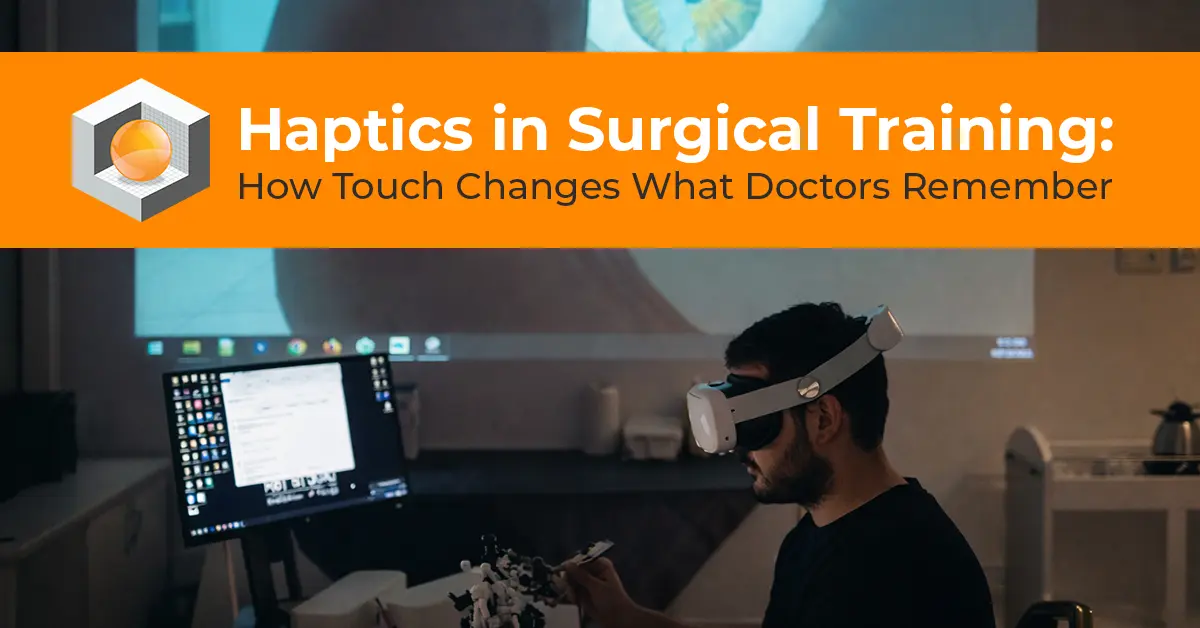
Ask any attending surgeon to describe the moment they first felt correct tissue resistance through a laparoscopic instrument and they will pause before answering. The sensation is specific: a subtle give when the trocar passes through the abdominal fascia, a change in compliance as a needle bites through a vessel wall, the way living tissue pushes back differently from a cadaveric specimen. These are not incidental details. They are the perceptual anchors around which surgical memory is organized. Residents who have never experienced them in training are, in a measurable and consequential sense, less prepared to operate safely.
This is the core problem that haptic feedback technology addresses in surgical simulation. Visual fidelity in VR has advanced rapidly, and the visual accuracy of modern surgical simulators can be remarkable. But surgery is not a visual-only discipline. The procedural knowledge that experienced surgeons carry in their hands: the calibrated sense of pressure, resistance, and tissue behavior that guides every incision and suture is formed through years of tactile experience. Training systems that omit that channel produce a different kind of learner: one who can describe what they are supposed to feel without actually having felt it.
The volume of research into haptic feedback in medical education has grown from roughly 250 published studies in 1995 to more than 640,000 by 2025. That trajectory reflects not academic enthusiasm but clinical urgency. Surgical programs are under pressure to produce competent, independent operators faster and with fewer opportunities for supervised patient exposure. Haptic-enabled simulation is one of the few tools available that can close the gap between what trainees know and what their hands remember.
Why Surgery Is a Tactile Discipline
The surgical environment demands that practitioners perform precise motor actions based on information they cannot always see directly. In minimally invasive procedures, surgeons operate through ports and channels, relying on instrument feedback to compensate for the absence of direct tissue palpation. In open procedures, the feel of tissue under a finger or instrument communicates information about depth, pathology, and structural integrity that visual inspection alone cannot provide. In microsurgical contexts — retinal surgery, neurosurgery, microvascular anastomosis — the margin for error is measured in micrometers, and tremor that would be negligible elsewhere becomes clinically significant.
This tactile dimension of surgical work is not supplementary. It is load-bearing. Studies of expert surgeons show that haptic cues drive real-time correction of surgical movements at a speed that conscious cognition cannot match. When an instrument encounters unexpected resistance, the adjustment happens before the surgeon has consciously registered that something was wrong. That form of reactive motor control depends entirely on a trained somatosensory reference — a stored map of what different tissues are supposed to feel like under different conditions. Building that map requires exposure to realistic tactile feedback during training, not just exposure to simulated visuals.
The shift toward robotic and minimally invasive surgical platforms has in some ways intensified the problem. These systems attenuate or eliminate direct haptic feedback by design, placing even greater cognitive load on force estimation and visual inference. Surgeons transitioning to these platforms without prior haptic training face a steeper learning curve because they must simultaneously learn the procedural sequence and recalibrate their entire tactile reference system. Simulation environments that incorporate haptics from the beginning of training allow that recalibration to happen before the trainee enters an operating room.
The Neuroscience Behind Touch and Procedural Memory
How the Somatosensory System Encodes Motor Skills
Procedural memory, the kind that governs skilled physical performance — is stored and retrieved differently from declarative knowledge. A surgeon who can articulate the steps of a laparoscopic cholecystectomy is not necessarily competent to perform one. The procedural component of surgical skill is encoded in motor pathways that require physical, repeated practice to develop. This is why surgical education has always relied on apprenticeship models: the knowledge that matters most cannot be transferred verbally.
Haptic feedback plays a direct role in this encoding process. Tactile and kinesthetic signals are processed across several specialized regions of the parietal lobe, with different sub-regions handling texture and pressure, macroscopic shape and size, and spatial location of contact. As Science Advances has documented, the brain uses tactile, kinesthetic, and proprioceptive feedback together to deduce the physical characteristics of objects through specific actions — the stiffness of tissue under pressure, for example, or the force required to pass a needle through a particular structure. When this tactile channel is active during training, the resulting motor memory is more complete and more transferable.
The practical implication for simulator design is significant. Training environments that provide only visual feedback produce motor memories that are encoded without their tactile component. When the trainee then encounters real tissue with real resistance, the memory is partially mismatched. The visual cues may be familiar; the haptic cues are not. Performance degrades precisely at the moment when it matters most — during live patient procedures.
What Haptic Feedback Adds to Simulation Fidelity
In surgical simulation, haptic fidelity refers to the degree to which the system replicates the force, pressure, compliance, and texture cues that a surgeon would encounter in live tissue. A simulator without haptics requires the trainee to mentally fill in all tactile information from visual and procedural cues alone. A simulator with calibrated haptic feedback allows the trainee to develop genuine tactile references — to feel when a drill is about to breach cortical bone, or when the tension on a suture approaches the tissue’s tensile limit.
The distinction matters most not for task completion during training, but for retention and transfer. Research on haptic memory shows that the brain’s short-term tactile buffer, processed through the parietal lobe, functions as a gateway for integrating tactile input into the broader cognitive framework. Repeated activation of this pathway through realistic haptic training progressively consolidates motor memory — building the kind of ingrained procedural knowledge that experienced surgeons describe as muscle memory, and that residents need before they can safely operate independently.
What the Research Shows
A Systematic Look at 51 Studies
The most comprehensive analysis of haptic feedback in surgical virtual simulation to date was published in Surgical Innovation in June 2024. Researchers at McGill University’s SAILS Lab reviewed 51 studies drawn from an initial pool of 2,782, covering randomized controlled trials, crossover studies, and observational designs involving medical residents, students, and attending physicians across multiple specialties. Of the 34 performance outcomes that could be directly compared between haptic and non-haptic conditions, 34 favored haptics. Only three favored non-haptic conditions, and the remainder showed mixed or equivalent results.
The review concluded that haptic feedback generally enhances performance, complements traditional teaching methods, and offers a pathway toward personalized skill development when combined with validated simulator feedback. Importantly, the authors found that the benefit of haptics was most pronounced in procedural training — the type of skill development that surgical simulation is specifically designed to support.
A separate randomized controlled trial conducted at St George’s University Hospitals NHS Foundation Trust directly compared haptic and non-haptic immersive VR training for bone drilling — a procedure where force calibration is critical to avoiding catastrophic error. The trial used a double-blinded design with junior surgeons, and results favored the haptic group across performance metrics. The study’s significance lies in its methodological rigor: blinded RCT conditions with a clinically relevant outcome measure, not a proxy task.
| EXPERT NOTE In specialties where tactile cues are central to operative safety. Such as: Orthopedics, laparoscopy, neurosurgery, microsurgery. The benefit of haptic simulation is most clearly demonstrated in early-stage training. For residents who have limited supervised operating room time, haptic simulation effectively front-loads the tactile learning that would otherwise only occur on patients. One pattern observed across deployment contexts: residents who train on haptic simulators tend to show better instrument handling under time pressure. The tactile reference is more accessible under cognitive load than procedural knowledge acquired through visual study alone. |
Specific Procedures Where Haptics Makes a Difference
The evidence base is not evenly distributed across specialties. Surgical simulation accounts for 79% of the clinical training applications in which haptic technology has been studied, with dental training (7%), anesthesiology (7%), and gynecology and obstetrics (7%) making up most of the remainder. Within surgical simulation, the strongest evidence for haptic benefit comes from minimally invasive procedures, where the absence of direct tissue contact makes tactile feedback from instruments especially important.
In orthopedic surgical training, the impact is measurable at the level of procedural accuracy. Studies of VR-based pedicle screw insertion training using systems with force feedback and haptics have demonstrated striking performance differences: in one randomized controlled trial, residents who trained on haptic VR simulators achieved a perfect screw placement rate of 100%, compared to 50% in the control group who received standard training, a result that would have direct consequences in the operating room if it held at scale.
Haptic training has also been studied in the context of laparoscopic skill development. A systematic review and meta-analysis conducted at Queen Mary University’s Barts Cancer Institute, covering randomized controlled trials through April 2024, compared VR simulators with haptic feedback to box trainers — physical training devices that provide realistic tactile feedback but no automated performance assessment. The comparison is instructive because it places haptic VR against the most tactile-rich alternative training method currently in widespread use.
For microvascular and microsurgical training — subspecialties where precision motor control is the central clinical requirement — research by Azher and colleagues highlighted the effectiveness of haptic VR simulators in improving residents’ proficiency in procedures that demand the highest levels of manual dexterity. This population of trainees has the most to gain from simulation-based haptic exposure precisely because live supervised practice opportunities in these subspecialties are severely limited.
| RoT Healthcare combines immersive VR simulation with purpose-built haptic hardware to support surgical programs that need training solutions grounded in both clinical realism and measurable outcomes. |
Building Haptic Systems That Actually Teach
Force Feedback vs. Vibrotactile Feedback
Not all haptic feedback is equivalent in its training value, and the distinction matters when evaluating or specifying a simulation system. The two dominant categories are force feedback (kinesthetic haptics) and vibrotactile feedback (tactile haptics). Force feedback systems use actuated linkages or motors to apply resistance to the user’s hand or instrument, replicating the push-back that tissue or bone would provide. Vibrotactile systems deliver high-frequency vibration patterns to the skin surface, communicating information about contact, texture, and threshold events without replicating force magnitude.
For surgical training specifically, force feedback is generally more clinically relevant — particularly in procedures where the trainee needs to develop calibrated responses to resistance. The feel of drilling through cortical bone, of a needle passing through different tissue layers, or of correct tension on a vascular anastomosis requires kinesthetic feedback that vibrotactile systems cannot fully replicate. Vibrotactile feedback is valuable for signaling discrete events — a threshold crossed, an error made, a contact detected — but does not build the same kind of continuous tactile reference.
The field is evolving toward multi-modal haptic systems that combine force feedback with vibrotactile and thermal components, and emerging hardware research is exploring liquid metal actuators, air pressure systems, and transcutaneous nerve stimulation as mechanisms for delivering richer sensory information. Current generation deployed systems in healthcare simulation use primarily force feedback and vibrotactile combinations, with the balance depending on the specific procedure being trained.
Latency as a Learning Variable
One of the less-discussed but critically important parameters of haptic training systems is latency — the delay between a trainee’s movement and the corresponding haptic response from the simulator. Research published in Scientific Reports in 2025, examining the interaction between visual and haptic feedback latency in a fine motor surgical task, found that a visual delay of just 200 milliseconds significantly worsened performance and increased perceived task difficulty. Real-time haptic feedback was rated as substantially more useful, particularly for participants with prior laparoscopic experience.
The cognitive mechanism here is well-established: the brain uses the temporal alignment between intended movement and received sensory feedback to assess whether motor commands are being executed correctly. When feedback is delayed, this predictive alignment breaks down, and the cognitive load of motor correction increases. In training contexts, high-latency haptic feedback may actually impair the formation of accurate motor memories — teaching the nervous system to compensate for the delay rather than to build genuine procedural competency. Well-engineered haptic training systems address this by minimizing end-to-end latency in the feedback loop, typically targeting sub-50ms response times for clinical simulation applications.
| TECHNICAL NOTE Most deployed surgical simulators do not publish their haptic latency specifications publicly, making it difficult for program directors to compare systems on this dimension. When evaluating haptic simulation platforms, it is worth requesting specific latency data alongside construct validity evidence. A system with excellent visual fidelity and validated task metrics but high haptic latency may produce misleading training outcomes — particularly for procedures where force calibration is the primary skill being developed. The relationship between haptic latency and training outcome is not linear. There appears to be a threshold effect: below approximately 50ms, most users adapt without significant performance impact. Above that threshold, the adaptive burden increases rapidly and begins to compete with skill formation. |
Implications for Surgical Program Directors
Integrating haptic simulation into a residency or fellowship curriculum requires decisions that go well beyond hardware procurement. The evidence, while generally favorable to haptics, also contains important nuances. Haptic feedback appears to accelerate early-stage skill acquisition more reliably than it supports late-stage skill refinement. For attending-level surgeons maintaining competency or learning new platform systems, the benefit profile is different from that seen in novice residents. Program directors should calibrate their expectations — and their curriculum design — accordingly. For more context on how VR environments are currently being used in surgical healthcare training, the full breakdown in RoT STUDIO’s discussion of VR in ophthalmology training illustrates how specialty-specific simulation requirements shape deployment choices.
Transferability of haptic simulator skills to real procedures is another area where the evidence requires careful reading. One study in the McGill review showed that haptic training produced accelerated learning but that the advantage was specific to haptic environments — the trainees performed better on haptic tasks but did not show the same benefit on non-haptic assessments. The authors note, reasonably, that since real surgery is itself a haptic environment, this finding is not necessarily an argument against haptic training. But it does suggest that haptic simulation works best when paired with structured progression toward live operative experience, rather than used as a standalone curriculum endpoint.
The most practically effective model appears to be one in which haptic simulation serves as a structured prerequisite gate; residents must demonstrate measurable proficiency on the simulator before accessing supervised patient procedures. Global survey data published in Scientific Reports in 2025 found that across 25 training centers in 12 countries, this competency-gated approach to VR simulation has become normalized in some specialties. The benefit of this model is that it shifts the early part of the learning curve — the period of highest error risk — out of the operating room entirely. RoT STUDIO’s dedicated page on haptic technology in VR training outlines how this integration works across different training hardware configurations.
For program directors assessing which haptic platforms to implement, the practical checklist is relatively straightforward: validated construct validity for the specific procedures being trained, documented latency performance, a modular curriculum that maps to training level and clinical progression, and objective performance metrics that can be reviewed and used to make promotion decisions. The last point is important. One of the most durable advantages of simulation-based training is the generation of objective performance data that traditional apprenticeship models cannot produce.
Frequently Asked Questions
Does haptic feedback actually improve surgical skill retention, or just performance during training?
The most rigorous systematic reviews indicate that haptic feedback improves performance during training and, in most studied procedures, produces better performance outcomes on post-training assessment tasks than non-haptic conditions. Long-term retention data are more limited, as most studies use post-intervention metrics rather than longitudinal follow-up. The evidence is strongest for early-stage procedural skill acquisition in specialties where tactile cues are central to operative safety, such as orthopedics, laparoscopy, and microvascular surgery.
What is the difference between force feedback and vibrotactile haptics in surgical simulators?
Force feedback systems physically resist the user’s movements using motors or actuated linkages, replicating the pressure and compliance of biological tissue. Vibrotactile systems deliver surface vibration patterns that signal discrete events such as contact or procedural errors. For surgical training, force feedback is generally more clinically relevant because it builds the calibrated tissue-resistance reference that surgeons rely on during live procedures. Vibrotactile feedback is useful for event notification but does not replicate continuous force experience.
At what stage of training does haptic simulation provide the most benefit?
Current evidence suggests that haptic simulation provides its clearest benefit during the early stages of skill acquisition — when residents are developing their foundational tactile reference for a given procedure. Novice trainees who lack any prior tactile exposure show the largest performance gaps between haptic and non-haptic training conditions. For experienced surgeons, haptic simulation is still valuable for learning new platforms or maintaining competency in low-volume procedures, though the effect size tends to be smaller.
How does latency affect haptic training quality in surgical simulators?
Latency — the delay between a trainee’s movement and the haptic system’s response — has a measurable negative effect on both performance and learning quality above approximately 50 milliseconds. High-latency haptic feedback can interfere with motor memory formation by creating a mismatch between intended movement and sensory response. Well-engineered surgical simulation systems target sub-50ms latency for haptic feedback loops. Program directors evaluating platforms should request specific latency data alongside clinical validity studies.
Can haptic simulation replace supervised live surgical practice?
No. The current evidence positions haptic simulation as a prerequisite and complement to supervised patient exposure, not a replacement for it. The optimal curriculum model uses simulation to shift the earliest and highest-risk portion of the learning curve out of the operating room, and then sequences structured live experience afterward. Haptic simulation produces transferable skills that accelerate performance on real procedures, but the translation to live tissue — with its variability, patient-specific anatomy, and time pressure — still requires supervised clinical exposure.
Which surgical specialties have the strongest evidence for haptic simulation?
The strongest evidence base for haptic surgical simulation currently exists in orthopedics, laparoscopic surgery, and microsurgery/microvascular surgery. Ophthalmology, neurosurgery, and gynecology also have meaningful literature. Dental training and anesthesiology have smaller but growing evidence bases. Across specialties, the benefit is most consistently demonstrated in procedures where tactile cues are primary drivers of operative decision-making — bone drilling, tissue dissection, needle handling, and instrument navigation through confined spaces.
Touch Is Not a Peripheral Feature of Surgical Training
Three conclusions from the current evidence deserve particular weight. First, haptic feedback changes what trainees remember at the level of the nervous system, not just what they can describe. Motor memory formed through multisensory training — visual, auditory, and tactile together — is more complete, more accessible under pressure, and more transferable to real clinical environments than memory formed through visual simulation alone. Surgical programs that deploy non-haptic simulators are not providing a slightly inferior version of haptic training; they are providing a qualitatively different kind of training.
Second, the design details of haptic systems matter as much as their presence. Latency, force-feedback accuracy, and the mapping of simulated tissue properties to real tissue behavior determine whether a haptic training experience builds accurate motor references or teaches trainees to compensate for the simulation’s limitations. Program directors should evaluate haptic platforms with the same rigor applied to any clinical training technology — requesting construct validity data, latency specifications, and evidence of skills transfer.
Third, the trajectory of this field points toward increasing integration of haptic feedback as a standard component of surgical simulation, not an optional upgrade. As the shift toward minimally invasive and robotic surgical platforms continues — platforms that already attenuate natural haptic feedback — the training systems that precede live patient exposure will need to compensate by providing richer tactile environments, not poorer ones. Institutions that establish haptic simulation infrastructure now will be better positioned as this shift accelerates. For a broader look at how immersive VR is transforming healthcare education beyond the surgical context, the discussion of healthcare institutions using VR and XR simulations covers the institutional adoption patterns shaping this field.
How RoT STUDIO Approaches This
At RoT STUDIO, haptics is not treated as an add-on to our healthcare simulation portfolio. The haptic hardware development program at our High Tech Campus Eindhoven facility — operating within the 3EALITY innovation hub — has produced purpose-built devices designed specifically for clinical training contexts. These are not adapted gaming peripherals or repurposed industrial tools. They are designed from the ground up to meet the latency, force range, and durability requirements of medical simulation, and they undergo validation against clinical performance benchmarks alongside the VR content they support.
The RoT Healthcare product line integrates these haptic devices with our VR Training Catalogue across surgical and clinical specialties, including the Ophthalmic Surgery VR Training Simulator, Surgical Catheterization Procedure, and other modalities where tactile feedback is clinically significant. Our no-code RoT STUDIO License also supports institutions that want to build or customize their own haptic-enabled training scenarios — backed by infoTRON’s engineering and 3D legacy and our team’s direct experience in multi-industry simulation deployment.
What we find in practice is that surgical program directors who are most effective at integrating haptic simulation into their curricula are those who treat it as a curriculum design challenge, not a technology procurement exercise. The question is not only which haptic system to acquire, but how it fits into a competency progression, how its performance data connects to promotion and credentialing decisions, and how it complements rather than simply precedes supervised clinical exposure.
To assess how haptic-enabled VR training could support your institution’s surgical curriculum, contact the RoT STUDIO team. We work with program directors from initial needs assessment through scenario development and ongoing outcome monitoring — and we build our recommendations around the clinical and operational realities of your specific training environment. You can also review how our haptic technology platform fits within the broader RoT STUDIO ecosystem.
| If your surgical training program is evaluating haptic simulation solutions, the RoT STUDIO team can provide a technical and curriculum-focused assessment tailored to your specialty and institution. |
References
Azher S, Mills A, He J, Hyjazie T, Tokuno J, Quaiattini A, Harley JM. Findings Favor Haptics Feedback in Virtual Simulation Surgical Education: An Updated Systematic and Scoping Review. Surgical Innovation. 2024 Jun;31(3):331-341. doi: 10.1177/15533506241238263.
Gani A, Pickering O, Ellis C, Sabri O, Puchner P. Impact of haptic feedback on surgical training outcomes: A Randomised Controlled Trial of haptic versus non-haptic immersive virtual reality training. Annals of Medicine and Surgery. 2022 Sep 23;83:104734. doi: 10.1016/j.amsu.2022.104734.
Shahrezaei A, Sohani M, Taherkhani S, Zarghami SY. The impact of surgical simulation and training technologies on general surgery education. BMC Medical Education. 2024 Nov 13;24(1):1297. doi: 10.1186/s12909-024-06299-w.
Boutin J, Kamoonpuri J, Faieghi R, Chung J, de Ribaupierre S, Eagleson R. Smart haptic gloves for virtual reality surgery simulation: a pilot study on external ventricular drain training. Frontiers in Robotics and AI. 2024;10:1273631. doi: 10.3389/frobt.2023.1273631.
Ortega-Morán JF, Sánchez-Peralta LF, Pagador JB, et al. Impact of laparoscopic training, haptic feedback and visual haptic latency on virtual fine motor performance. Scientific Reports. 2025. doi: 10.1038/s41598-025-18862-6.
Gualtieri M, Bertoncelli CM, et al. Haptic Technology: Exploring Its Underexplored Clinical Applications — A Systematic Review. Biomedicines. 2024 Dec;12(12):2802. doi: 10.3390/biomedicines12122802.
Vargas C, et al. (2021). Virtual Simulation in Orthopedic Surgery Education. PMC12325134.
Parisi D, et al. Haptic Research Publication Growth (1995–2025). Society for Simulation in Healthcare (SSH) State of Haptics Report. October 2025. https://www.ssih.org/news/current-state-and-future-haptics-healthcare-simulation
Metzger JC, et al. A Neurocognitive Pathway for Engineering Artificial Touch. Science Advances. doi: 10.1126/sciadv.adq6290.
Ovur SE, Cobanaj M, Vantadori L, De Momi E, Ferrigno G. Surgeon Training with Haptic Devices for Computer and Robot Assisted Surgery: An Experimental Study. In: Human Haptic Sensing and Active Touch. Springer, 2020.