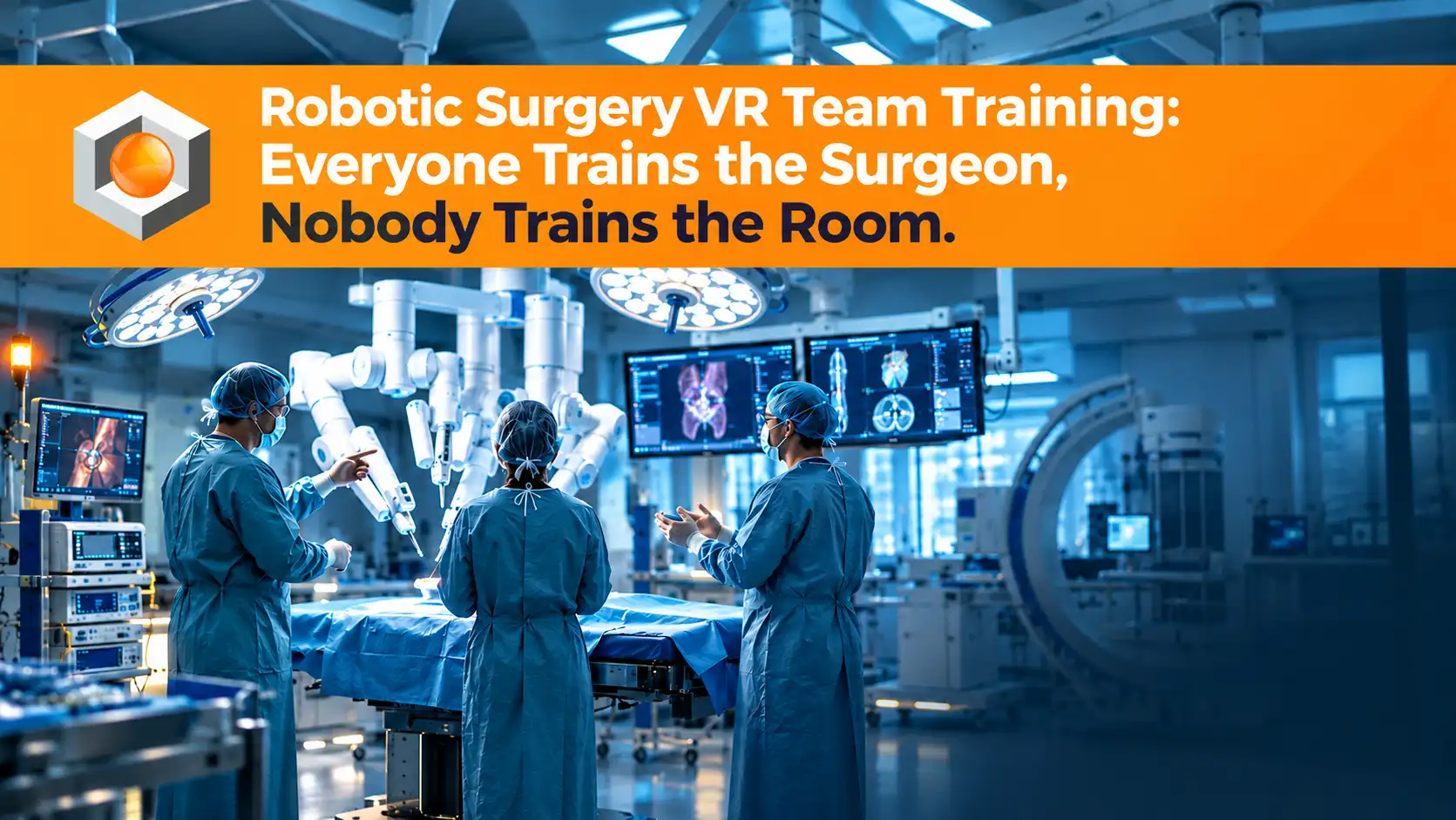
A hospital buys a surgical robot. The surgeon completes the manufacturer’s training pathway and is credentialed. Six months later the programme is running below the case volume it was bought for, and the reason has almost nothing to do with the surgeon’s skill at the console.
It is the docking that takes too long. It is the scrub nurse who has seen the instrument exchange four times. It is the table position that has to be corrected after the arms are already attached. It is the turnover between cases, and the biomedical technician who is the only person on site who can resolve a fault, and who is not on nights.
Surgical equipment training has a structural blind spot. Nearly all of it is aimed at the person holding the instruments, and nearly all of the friction that limits a programme sits with everyone else in the room.
What Console Simulators Cover, and What They Leave Out
Most robotic platforms ship with simulation software, and it is generally good software. It builds instrument control, camera handling, wrist articulation and the fine motor coordination that operating from a console requires. Two structural limits are worth naming, because neither is a criticism of the software itself.
The simulator lives inside the machine the hospital needs for patients
Because the training software is installed on the console, practising on it means occupying the console. Hospitals under pressure to justify a large capital purchase schedule that console for cases, which pushes training into evenings and weekends.
The consequence is a competition for slots that falls unevenly. Senior surgeons secure time, junior trainees and staff at smaller or remote centres get less, and the literature on robotic training access has described the resulting pattern as undemocratic. A training resource that is only available when the asset is idle is not really a training resource for the whole team.
It trains one seat in a room of eight
A console simulator trains the console operator. A robotic case involves a bedside assistant, a scrub nurse, a circulating nurse, an anaesthetic team, sterile processing before and after, and biomedical engineering behind all of it. Professional consensus in the field is explicit that everyone handling this equipment needs appropriate training, and equally explicit that no standard criteria exist setting out what that training should be for nurses or operating room technicians.
That absence is the gap. There is a defined, credentialed pathway for the surgeon and, for everyone else, whatever the manufacturer’s clinical specialist covered during installation week and whatever has been passed on since.
Equipment training is usually budgeted as part of the acquisition and delivered in a concentrated block at installation. Staff turnover, rotation and secondment then erode it continuously, and the people who received the original training are frequently not the people in the room a year later.
A capital system with a working life measured in years needs a training method that can be repeated cheaply for each new starter. Anything depending on the device itself, or on a visiting specialist, cannot meet that requirement.
The Parts of a Case Nobody Simulates
Ask an experienced robotic team where time is actually lost and the answers are consistent, and none of them concern intracorporeal technique.
Port placement and cannula docking come first. Getting port geometry wrong for the target anatomy produces arm collisions and restricted range, and correcting it once the arms are attached costs far more time than planning it correctly. Table positioning is closely related and often underestimated, since the table, the patient and the arms form one geometry, and a table adjusted after docking is a different and more difficult problem than a table set correctly beforehand.
Then there is imaging coordination. In hybrid rooms and cathlabs, a C-arm has to move around a patient, a table and equipment without collision and without breaking the sterile field, which is a spatial choreography rehearsed almost nowhere. Emergency conversion is the scenario that matters most and is practised least: when a case has to become open surgery quickly, undocking speed and role clarity determine how fast the team gets there.
Finally there is everything either side of the case. Set-up and tear-down of mobile equipment consumes a substantial share of room time, and instrument reprocessing has its own handling requirements where errors shorten instrument life and cost real money. Each of these is procedural, repeatable and largely independent of the patient, which is precisely what makes them suitable for simulation.
Who Needs Equipment Training, and What Goes Wrong Without It
Mapping the roles clarifies why surgeon-only training leaves a programme exposed.
| Role | What they own | What goes wrong untrained |
|---|---|---|
| Bedside assistant | Docking, instrument exchange, troubleshooting arms | Slow docking, arm collisions, delays the console cannot resolve |
| Scrub nurse | Instrument preparation, sterile field, exchanges | Hesitation at exchange points, field breaches during repositioning |
| Circulating nurse | Room layout, table position, cabling, equipment movement | Geometry that has to be corrected after docking |
| Anaesthetic team | Airway and line access with arms in position | Restricted access discovered mid-case rather than during setup |
| Radiographer or imaging tech | C-arm positioning and movement | Collision risk, repeated repositioning, longer screening times |
| Sterile processing | Reprocessing and instrument handling | Handling damage, shortened instrument life, avoidable cost |
| Biomedical engineering | Fault response, servicing, uptime | Escalation to the vendor for faults resolvable on site |
A capital system is used by a team, not by a procurement department, and a technically excellent platform underperforms if it adds friction at every handoff. Most of the handoffs listed above have no simulation available to them at all.
Why Equipment Training Is a Different Problem From Procedural Training
Treating these as one category is why equipment training keeps getting bundled into surgical education and then quietly dropped. They have different content, different learners and different constraints.
It is spatial and coordinated rather than anatomical
Procedural training is about tissue, judgement and technique, and it varies with every patient. Equipment training is about where objects and people are in a room, in what order they move, and who does what while they move. It is closer to a rehearsed drill than to clinical decision making, and it involves several people acting together rather than one person performing well.
It is consistent, which is what makes it simulable
Because a docking sequence, a table configuration and a C-arm path are broadly the same each time, they can be modelled accurately and rehearsed to a defined standard. Anatomy varies and is hard to simulate convincingly. A surgical table, a robotic arm and an imaging gantry are engineered objects with known geometry, and reproducing them faithfully is a solved problem.
This is the practical argument for putting equipment training in a headset rather than on the device. The content is stable, the fidelity required is achievable, the same rehearsal can run for every role, and none of it occupies an asset the hospital needs for patients. The wider case for virtual reality medical simulation applies here with fewer of the fidelity objections that clinical simulation attracts, precisely because the subject is hardware.
For most robotic and hybrid programmes the answer is no. Talk to RoT HEALTHCARE about simulating your equipment and room so training no longer competes with your case list.
The Manufacturer’s Side of the Same Problem
Hospitals are not the only buyers of equipment simulation. Device manufacturers face a mirrored version of the same constraint, and often a harder one.
A clinical specialist supporting a launch cannot be in eleven hospitals at once, and demonstration units are expensive, heavy and frequently unavailable when a surgeon has twenty minutes free. Sales teams are expected to explain a complex system credibly to clinicians who will spot uncertainty immediately, and internal training on a device that exists in limited quantities is the bottleneck.
A simulated version of the device solves several of these at once. It ships as a file rather than a crate, it can be rehearsed repeatedly by field staff and biomedical teams before a single unit is installed, and it can show a surgeon the workflow in their own office. Where two systems perform comparably, the one whose team can be brought to competence faster tends to win the account, which makes training support a commercial differentiator rather than a post-sale cost.
Frequently Asked Questions
These come up whenever a hospital or a manufacturer starts scoping equipment simulation, usually in the first conversation.
Does this replace the manufacturer’s training programme?
No, and it should not be presented that way. Manufacturer pathways and credentialing remain the route to authorisation for the surgeon. Simulated equipment training addresses the layer beneath, covering setup, docking, positioning, coordination and the roles for which no formal pathway exists, so that time on the real system is used for what only the real system can teach.
How accurate does the virtual equipment need to be?
Accurate enough that spatial relationships and sequences transfer, which means correct proportions, correct range of movement and correct interaction order. Photorealism matters less than geometry. Where a manufacturer supplies engineering data the model can be built directly from it, and where it cannot be supplied the equipment is reconstructed from measurement and reference, which is standard practice for this kind of work.
Can several team members rehearse together?
Yes, and for this subject it is the more valuable configuration. Docking, conversion and imaging coordination are failures of sequence between people rather than failures of individual skill, so a multi-user session where each participant holds their real role tests the handoffs that single-user training cannot reach.
Is this only relevant to robotic surgery?
No. The same reasoning applies to any complex capital equipment used by a team under time pressure, including hybrid theatre and cathlab imaging, C-arm coordination, intensive care equipment, surgical tables and specialist positioning systems. Robotic surgery is simply where the training gap is most visible, because the capital cost makes underuse impossible to ignore.
What should a programme measure?
Operationally meaningful things rather than completion. Time from patient positioned to arms docked, number of repositioning events per case, room turnover time, undocking time in a conversion drill, and how quickly a new starter reaches the team’s standard. These are the figures that connect training to theatre utilisation, which is the language a capital business case is written in.
How long does it take to build?
It depends almost entirely on whether the equipment model already exists and whether the room is generic or a specific theatre. A standard configuration is considerably faster than replicating a named hospital’s hybrid suite with its own layout and constraints. Most programmes sensibly begin with the highest-friction sequence, usually docking or conversion, and extend once the approach has proved itself internally.
The Case for Training the Room
Robotic and hybrid programmes are judged on utilisation, and utilisation is determined by how quickly a room can be turned over, set up, docked and, when necessary, converted. Those are team activities involving equipment, and they are the activities with the least structured training behind them.
The uncomfortable arithmetic is that an organisation will spend a very large sum on a system, train one person on it formally, and then rely on informal transmission for everyone whose speed determines whether the investment pays back. That is not a clinical problem or a technology problem. It is a training design problem, and it is solvable.
How RoT STUDIO Approaches This
RoT HEALTHCARE builds simulation around the equipment and the room rather than around anatomy alone. That includes robotic arms and table positioning, surgical tables, intensive care equipment and cathlab environments including C-arm imaging systems, with scenarios written for surgeons, interventional cardiologists, radiologists and nursing teams rather than for the console operator on their own.
For manufacturers the same models support demonstration and internal enablement, letting field teams, biomedical staff and customers work with a device without a physical unit or a specific location. Where a project calls for patient-specific rehearsal, geometry derived from CT and MRI data can be brought into the environment so a team can prepare against the anatomy they will actually meet.
Delivery follows the usual two routes. Customized VR/XR Services covers equipment and environments that have to match a specific device or theatre, which is most of this category, and the RoT HEALTHCARE programme sets out the wider surgical and clinical simulation work this sits alongside.