Smart glasses are now outselling VR headsets at a ratio of approximately 3 to 1 in 2026, according to IDC market data. Augmented World Expo USA opened June 15 under the explicit theme of “Spatial AI,” and the hardware reveals across the spring and early summer have moved the AR-glasses category from technology promise to procurement reality. XREAL opened reservations for AURA at a $1,500 ceiling. Snap Specs are shipping this fall at approximately $2,500. Samsung Galaxy Glasses leaked at $379 to $499 entry-level pricing, with a premium variant arriving in 2027. Meta’s Ray-Ban Display line is already in market. Google’s Android XR partnership with Warby Parker, Gentle Monster, Gucci, and Kering is driving fashion-channel distribution. The smart glasses category is no longer the subject of skeptical 2024 industry analyses. It is the operational reality of 2026.
For Heads of Learning and L&D Directors, the procurement story is the secondary consideration. The primary question is how the architecture of enterprise training programs should evolve when the device mix in the workforce begins to diversify. Workers across field service, manufacturing, healthcare, logistics, and frontline retail will begin wearing AR glasses for reasons that have nothing to do with the L&D program: navigation, communication, productivity, accessibility. The training value the organization extracts from that device proliferation is an L&D design question, and it is being shaped now by a small group of programs across multiple sectors that have already made the design moves.
This piece is the framework for L&D Directors and Heads of Learning thinking about how training programs need to evolve. Not a hardware comparison, not a procurement guide. A learning architecture framework for the AR-glasses-and-VR-headsets era that is now operational, with the conceptual distinction at its center: VR headsets are immersion devices designed for skill acquisition, AR glasses are augmentation devices designed for skill execution, and the strongest 2026 enterprise training programs are designing for both rather than choosing between them.
The 2026 Smart Glasses Reality and Why It Matters for L&D
Understanding the L&D implications requires a brief grounding in the hardware reality, because the device mix in the next two to three years will materially change the canvas L&D programs design on.
The Hardware Landscape Is No Longer Speculative
Across the spring of 2026, the smart glasses category has consolidated around five major product lines. Meta Ray-Ban Display glasses are in active distribution through the Ray-Ban retail channel. Samsung Galaxy Glasses, running Android XR with Knox enterprise security and a five-year update commitment, position the device explicitly as an enterprise IT asset rather than a consumer gadget. Google’s Android XR partnership with Warby Parker is targeting a $799 retail price point through the eyewear channel; Gucci, Gentle Monster, and Kering brands extend the same platform into premium fashion distribution. Snap Specs ship this fall at approximately $2,500. XREAL AURA, announced for Fall 2026 at a $1,500 ceiling, positions display AR as the value-tier option.
On the headset side, the consolidation pattern is equally pronounced but moving in a different direction. Apple Vision Pro raised pricing to $3,699 on June 25, with no consumer successor on the publicly disclosed roadmap, repositioning the product explicitly as an enterprise spatial computing device. Meta Quest 3 and Quest 3S remain the dominant enterprise VR training platform at much lower price points. Samsung Galaxy XR sits adjacent to the Galaxy Glasses ecosystem with Android Enterprise support. The Pico, Vuzix, and RealWear vendor lineup, all built for enterprise from inception, has accelerated as Apple, Meta, and Microsoft have stepped back from direct enterprise hardware focus.
Snapdragon Reality Elite Sets the 2027 Spec Ceiling
Qualcomm’s Snapdragon Reality Elite chip, announced earlier this spring, sits underneath nearly every announced 2026-27 XR device. The chip delivers approximately 60% faster graphics performance than its predecessor, runs roughly 12 degrees cooler in thermal load, and supports on-device AI inference. The L&D implication is operational: training experiences that require real-time AI interaction (LLM-driven NPCs in soft skills scenarios, AI-generated assistance in field service workflows, adaptive scenario generation) can now run directly on the glasses or headset rather than requiring cloud round-trips. The latency and privacy implications matter for any training program operating under data residency constraints.
Why This Hardware Shift Matters for L&D Design
The L&D framing of this hardware reality is not “which device should we standardize on.” The framing is “what training scenarios fit which device, and how do we design programs that use the right device for the right learning objective.” Standardizing on a single XR device class in 2026 is the same procurement mistake organizations made in 2015 when they tried to standardize on a single mobile platform. The diversity is now the reality; L&D design needs to operate on top of it rather than fight it.
The Conceptual Shift: From Immersion to Augmentation
The single most important conceptual move L&D leaders need to make for the AR-glasses era is recognizing that VR headsets and AR glasses solve fundamentally different learning problems. They are complementary categories, not competitive ones, and program architectures that confuse them produce poor outcomes regardless of how impressive either device is in isolation.
VR Headsets Are Immersion Devices
VR headsets block out the real world by design. The opacity is the feature: it creates a controlled environment in which a trainee can practice procedures, make consequence-free errors, and build motor competency through repetition density. This makes VR the correct device for skill acquisition. Procedural training (fire response, working at height, LoTo, surgical workflows), high-stakes scenarios where the real environment carries risk (hazardous chemicals, energized electrical equipment, height work), soft skills scenarios that require focused emotional attention (customer service practice, leadership conversations, conflict resolution), and onboarding sequences for complex equipment all map to VR’s strengths. The fundamentals of the difference between AR and VR are operational design considerations in 2026, not abstract category distinctions.
AR Glasses Are Augmentation Devices
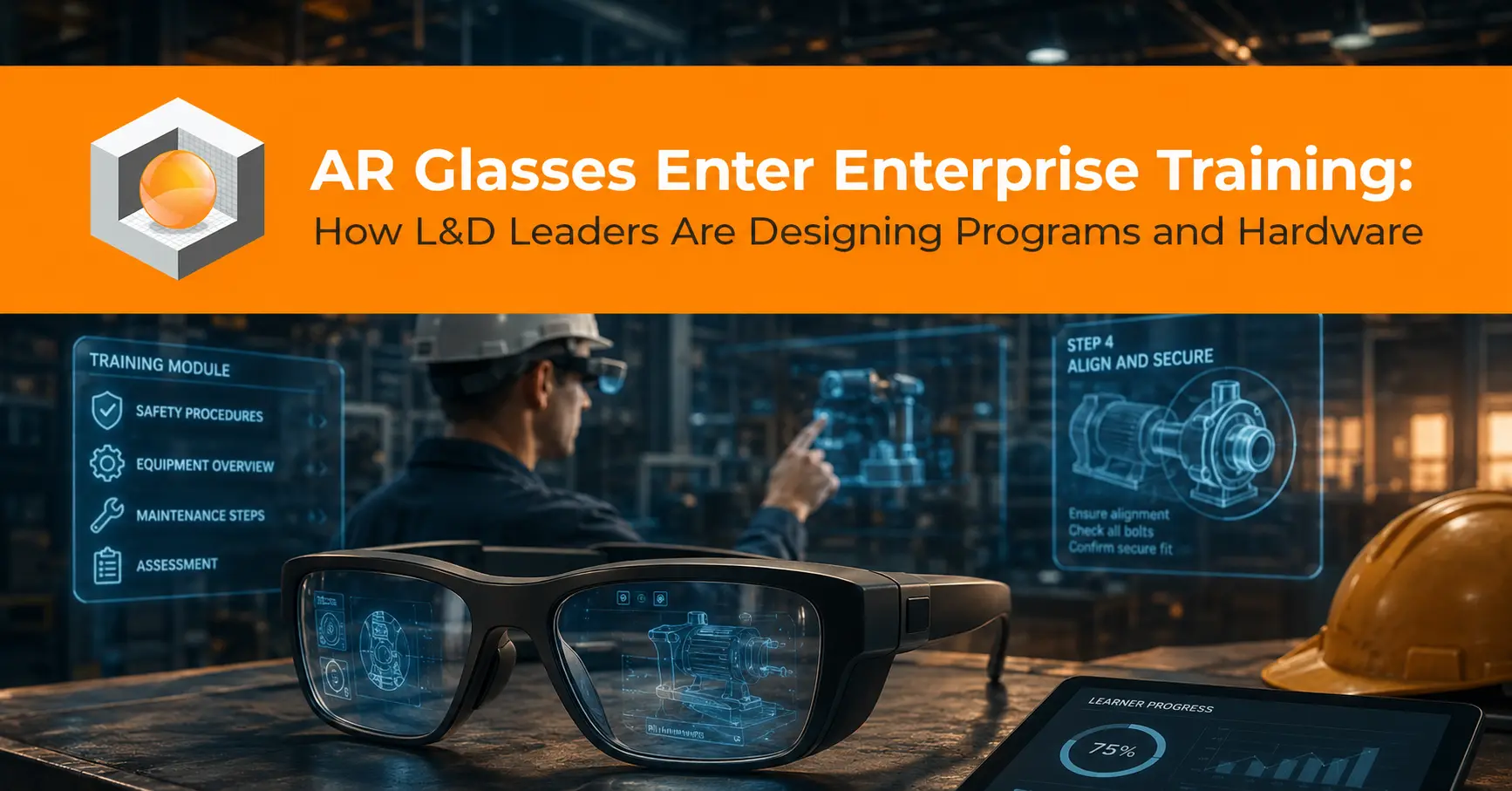
AR glasses overlay information on the real world while leaving the worker’s attention partially in the physical environment. The transparency is the feature. This makes AR glasses the correct device for skill execution, not skill acquisition. A worker with hands on actual equipment, receiving overlaid step-by-step guidance, captured photo or video evidence of their work, or remote expert assistance, is operating in a fundamentally different learning mode than a trainee in a VR scenario. The L&D term for this mode is performance support, sometimes called electronic performance support systems (EPSS). The category has existed since the 1990s in screen-based form. AR glasses are the first delivery technology that brings it into the worker’s natural line of sight without requiring them to consult a separate device.
The Layered Learning Architecture
The synthesis is the operational answer for 2026 L&D programs. VR headsets handle skill acquisition before the worker reaches the floor. AR glasses handle skill execution while the worker is on the floor. Classroom and instructor-led training continues to handle the human-judgment scenarios where neither device adds value. Documentation, compliance, and analytics layer across all three. This is a layered learning architecture, and the strongest 2026 enterprise training programs are designing around it rather than trying to force one device class to do everything.
| Expert Note: Why the Immersion-vs-Augmentation Distinction Matters Operationally In conversations with L&D leaders evaluating XR procurement in 2026, the single most common framing error is treating AR glasses as a cheaper or lighter VR headset. They are not. The transparency that makes glasses comfortable for all-day wear is the same property that makes them unsuitable for the focused immersion that procedural skill building requires. Conversely, the opacity that makes VR headsets effective for training makes them unsuitable for the hands-on-equipment performance support that AR glasses excel at. The two devices solve different problems; choosing one in a procurement decision means deciding which problem you are not solving. |
Use Cases Where AR Glasses Are Already Winning in Enterprise
The 2026 AR-glasses enterprise deployments have clustered around a specific set of use cases where the augmentation model produces measurable operational value. The AWE 2026 Auggie Award winners across the enterprise categories map to exactly this pattern, with steel fabrication, surgical guidance, and field maintenance among the recognized programs.
Field Service and Assisted Maintenance
The category where AR glasses have achieved clearest enterprise validation. A field technician arriving at a remote site, equipment failure mode unfamiliar, can now receive overlaid step-by-step instructions, schematic visualizations registered to the physical equipment, and live remote expert assistance through the “see what I see” pattern. The technician’s hands remain on the work. The remote expert can annotate the technician’s field of view in real time. The training implication for L&D is that the depth and currency of the underlying technical knowledge base now matters more than the depth of any individual technician’s pre-deployed skill, because the AR layer extends expert reach to less-experienced workers in the field.
Manufacturing Line Guidance and Assembly Workflows
Just-in-time work instructions overlaid at the assembly station have replaced printed work instructions across multiple 2026 deployments. Quality assurance checklists appear in the line of sight at the moment they are required. Quality issues can be photographed and tagged without leaving the workflow. The AWE 2026 Auggie Award for industrial XR included a steel fabrication deployment that operationalizes exactly this pattern. The L&D implication is that traditional shift-start briefings and end-of-shift reporting can be partially absorbed into the AR layer, freeing instructional design capacity for the higher-value training scenarios that VR handles.
Surgical Guidance and Clinical Performance Support
Apple Vision Pro has been adopted at SightMD in Long Island, with a surgeon disclosing in spring 2026 that he has performed hundreds of cataract operations wearing the device. The pattern is not VR training; it is intraoperative augmentation, with surgical planning overlays, instrument tracking, and procedural reference materials available in the surgeon’s field of view. The implication for healthcare L&D is that surgical training programs (which RoT STUDIO has covered extensively in adjacent contexts such as how healthcare institutions use VR/XR simulations to improve surgery success rates) now extend into the intraoperative augmentation phase, with a coherent training architecture spanning pre-procedure VR rehearsal and intraoperative AR support.
Warehouse, Logistics, and Pick-and-Pack Workflows
Pick-and-pack instructions overlaid on the inventory bin, voice and gesture-driven picking confirmation, inventory accuracy verification through computer vision, and seamless integration with WMS infrastructure have moved AR glasses from pilot to operational deployment across multiple large logistics operations. The L&D implication is that new-hire onboarding for warehouse roles has compressed substantially; workers can be brought to productive picking velocity in days rather than weeks when AR glasses are guiding the workflow.
Compliance Walkdowns, Inspections, and Audit Documentation
HSE inspectors, safety officers, and audit teams conducting physical walkthroughs now use AR glasses to display checklist overlays, automatically capture photographic evidence tied to inspection items, and produce structured audit documentation without leaving the workflow. The L&D implication is that compliance training programs increasingly integrate AR-based field execution as the practical complement to the VR-based scenario training that builds the inspector’s underlying competency.
Use Cases Where VR Headsets Stay Dominant for Training
Equally important for L&D design is recognizing where AR glasses are not the right substitution. Several training scenarios that the 2026 hardware-shift conversation has touched on are actually areas where VR headsets remain dominant, and where shifting investment to AR glasses would degrade training outcomes rather than improve them.
Procedural Training in Hazardous Environments
Fire response, working at height, electrical safety, LoTo, confined space entry, hazmat handling, and equivalent high-stakes procedural training are the exact scenarios where VR’s blocked-out environment is the feature. A trainee learning to operate a fire extinguisher under simulated stress should not have the real environment competing for attention; the cognitive load required to internalize the procedure benefits from immersion, not augmentation. The same applies to the broader category of VR safety training scenarios that RoT STUDIO’s catalogue addresses, including HSE Risk Hunt, Underground Mining Risk Hunt, Earthquake Risk Hunt, and equivalent procedural skill scenarios. AR glasses are not a substitute for these; they are a complement in the field-execution phase that comes after procedural skill is built.
Soft Skills and Conversational Training
LLM-driven NPCs for customer service practice, leadership scenario rehearsal, conflict resolution, and equivalent soft skills training require the trainee’s focused emotional attention. The realism of the practice scenario depends on the trainee accepting the simulated counterpart as a coherent emotional and conversational presence, which requires the immersion that VR provides. AR glasses are designed to share attention with the real environment, which is the opposite of what soft skills practice needs.
Pre-Work Skill Building Through Repetition Density
Skill acquisition through repetition (the practice that builds motor competency and procedural memory) requires the trainee to be fully focused on the learning task. AR glasses by design split attention between the digital layer and the real environment. This is correct for performance support but incorrect for skill acquisition. L&D programs that try to use AR glasses for skill building rather than skill execution typically underperform programs that use the appropriate device for each phase.
Compliance Training With Defensible Documentation
The session-level performance documentation that VR-based training systems produce (decision points, time-on-task, error logs, repeat attempts per scenario) has matured to the point where it is increasingly the audit-defensible standard for regulated training. AR glasses workflows are oriented toward performance execution rather than competency documentation; their analytics outputs are designed to capture work completion, not training competency. For training programs operating under OSHA, FDA, NHS, or sector-specific compliance scrutiny, this distinction matters.
How L&D Should Design for a Cross-Device Future
The practical framework for L&D Directors and Heads of Learning navigating the 2026 hardware reality consists of five operational decisions. None of them are about hardware procurement specifically; all of them are about how training programs should be architected when the device mix in the workforce becomes structurally heterogeneous.
Layer the Learning Architecture Explicitly
Design programs around three explicit layers rather than around device categories. The skill-acquisition layer uses VR for procedural training, soft skills, hazardous scenarios, and pre-work onboarding. The skill-execution layer uses AR glasses for field service, line guidance, intraoperative or clinical performance support, and compliance walkdowns. The instructor-led layer continues to address human-judgment scenarios, complex stakeholder situations, and the human elements that no device replaces. Each layer has its own success metrics, content production pipeline, and ROI model.
Don’t Replace Existing VR Programs With AR Glasses
The most common 2026 procurement mistake L&D leaders are making is interpreting the smart glasses news cycle as a signal to redirect VR training budget toward AR glasses. The two solve different problems. Strong VR training programs should continue and expand; AR glasses programs should be designed to extend the value of those VR programs into the work environment, not to replace them. The procurement budget conversation should be additive (where to add AR glasses capability on top of existing VR programs) rather than substitutive.
Plan for Device Heterogeneity in Content Strategy
The workforce in 2027-28 will have a device mix that includes multiple VR headset types (Meta Quest 3, Quest 3S, PICO 4, Samsung Galaxy XR, Apple Vision Pro in specialized contexts), multiple AR glasses lines, mobile devices, and traditional desktop access. Training content needs to be authored once and deployed across this mix where the learning objective permits. Cross-device deployment capability is now a procurement criterion for any training platform investment. The XR solutions for enterprise category increasingly converges around platforms that support this multi-device deployment as a baseline.
Build for Content Reuse Across Devices Where Possible
Not every scenario translates across device types. A fire extinguisher training scenario built for VR cannot become an AR glasses scenario because the underlying learning task is different. But underlying 3D assets, environment models, procedural step definitions, and content metadata can frequently be reused across device-specific scenario implementations. L&D content strategy should treat 3D assets and procedural content as the unit of investment, with device-specific scenario implementations as derivatives. This is the leverage point that makes cross-device deployment economically viable rather than a 2x-3x cost multiplier.
Watch the Auto-Spatialization and AI-Integration Trends
Android XR’s auto-spatialization feature, which converts standard 2D apps into 3D spatial experiences without redesign, signals that the boundary between traditional digital learning and spatial learning is dissolving. The L&D programs that build on standards-aware platforms (xAPI, OpenXR, web-based delivery via WebXR) will find their training content surviving multiple device generations. The programs that lock content into a single proprietary platform will face migration costs as the hardware landscape continues to evolve.
Frequently Asked Questions
Should we delay our VR training procurement to wait for AR glasses to mature?
No. The two device categories address different learning problems. VR headsets are mature and operationally proven for skill acquisition, procedural training, and high-stakes scenario practice. AR glasses do not replace this; they extend training value into the work environment after skills have been built. Delaying VR procurement to wait for AR glasses to mature confuses the two categories and produces no operational benefit. The correct approach is to proceed with VR programs that match your skill-acquisition needs and plan for AR glasses additions when field-execution scenarios justify them.
Which workforce categories should consider AR glasses first?
Field service technicians, manufacturing line workers, warehouse and logistics operators, surgical and clinical staff in performance-support contexts, and HSE inspectors conducting walkdowns are the workforce categories where AR glasses have produced the clearest operational ROI in 2026 deployments. Office knowledge workers, training and education staff, and roles that do not involve hands-on physical work with overlay-relevant information are lower-priority for AR glasses adoption.
How does AR glasses content production compare to VR scenario authoring?
AR glasses content production typically focuses on procedural step definitions, anchor points for spatial overlays, integration with backend knowledge bases and ticketing systems, and remote expert workflow tooling. The content authoring model is closer to technical documentation and knowledge management than to scenario authoring. VR scenario authoring focuses on 3D environment construction, scenario branching logic, decision-point evaluation, and competency assessment. Both can share underlying 3D assets and procedural metadata, but the authoring workflows are different. L&D teams considering AR glasses should plan for closer collaboration with their technical documentation and knowledge management functions than VR programs typically require.
What does the 2026 hardware shift mean for training program ROI calculation?
ROI models for training programs in 2026 increasingly reflect the layered architecture: VR for skill acquisition produces measurable competency-time compression and incident reduction; AR glasses for skill execution produce measurable productivity gains, error reduction, and reduced time-to-productive on new hires; classroom and instructor-led for human-judgment scenarios produces less directly measurable but still real value in stakeholder management and complex case handling. Programs that try to fit all benefits under a single ROI calculation typically undervalue the contribution of each layer. Separating the ROI by layer is the cleaner approach.
How do we handle device support and training for our workforce on multiple XR devices?
Device support and end-user training is a real operational cost that scales with device heterogeneity. The mitigation patterns include standardizing on a small number of validated devices per workforce category rather than allowing unlimited device proliferation, building internal device support documentation that lives alongside training content, partnering with platform vendors that provide multi-device deployment tooling rather than requiring per-device content forks, and budgeting realistically for end-user training on the XR devices themselves alongside the training content delivered through them.
How does Apple Vision Pro fit into enterprise L&D strategy in 2026?
Apple Vision Pro at the $3,699 price point is repositioned as a premium enterprise spatial computing device rather than a mainstream training headset. The clinical and surgical performance support deployments (SightMD cataract surgery is the visible example) suggest the device’s enterprise scope is concentrated in high-value-per-user contexts where the price point is justified by the operational value. For mainstream VR training at scale, Meta Quest 3 and Quest 3S remain the dominant deployment platforms at meaningfully lower per-headset cost. Most enterprise training programs in 2026 will not procure Vision Pro for the broad training workforce; they will procure it for specialized roles where the spatial computing capabilities justify the unit economics.
The Strategic Conclusion: Layered Learning Architecture Is the 2026 Operating Model
The 3-to-1 glasses-to-headsets ratio that IDC reported for 2026 is not a transitional statistic. It is the structural reality of how the XR device population is going to be distributed across the workforce for the foreseeable future. L&D programs that interpret this as a binary choice between hardware categories will design programs that are weaker than they could be on both dimensions. L&D programs that interpret it as the operational confirmation of a layered learning architecture, with VR handling skill acquisition and AR glasses handling skill execution, will design programs that produce stronger competency outcomes, higher training ROI, and better workforce productivity than either device category could produce alone.
For Heads of Learning and L&D Directors planning training architecture for the next three to five years, the strategic conclusion is direct. Continue and expand VR-based training programs for the skill-acquisition workload they have proven to handle effectively. Begin systematic evaluation of AR glasses for the skill-execution workload in field service, manufacturing, healthcare performance support, logistics, and compliance walkdowns. Design content strategies and procurement frameworks that treat the two as complementary investments rather than competing line items. Build toward platforms that support multi-device deployment as a baseline capability rather than as a special-case feature.
The 2026 hardware shift is real. The L&D design response is to architect for the shift rather than against it.
How RoT STUDIO Approaches This
RoT STUDIO’s platform philosophy is built around the operational reality that enterprise XR training will be cross-device for the next decade. The platform supports deployment across Meta Quest 3, Quest 3S, PICO 4, and Samsung Galaxy XR through standardized OpenXR-based delivery. The no-code authoring environment allows L&D teams to maintain and evolve scenario content as device standards change, without dependency on vendor engineering cycles for routine updates.
For the AR glasses layer of the learning architecture, RoT STUDIO’s Customized VR/XR Services scope extends into AR overlay scenario development, field service guidance content, and performance support workflows. The combination of standardized VR catalogue depth (covering Fire Extinguisher Operation, Working at Height, LoTo procedures, HSE Risk Hunt, Underground Mining Risk Hunt, Earthquake Risk Hunt, and Disaster and Emergency Response) and bespoke AR content development capacity is designed to support exactly the layered learning architecture described above.
For L&D Directors and Heads of Learning evaluating training program architecture against the 2026 hardware shift, the RoT STUDIO License and Customized VR/XR Services are the platform layers to evaluate. The broader VR/XR Training Solutions from RoT STUDIO are the starting point for organizations designing layered learning architectures across multiple devices and workforce categories. Get in touch with the team to walk through what a cross-device deployment looks like for your specific training portfolio and device mix.