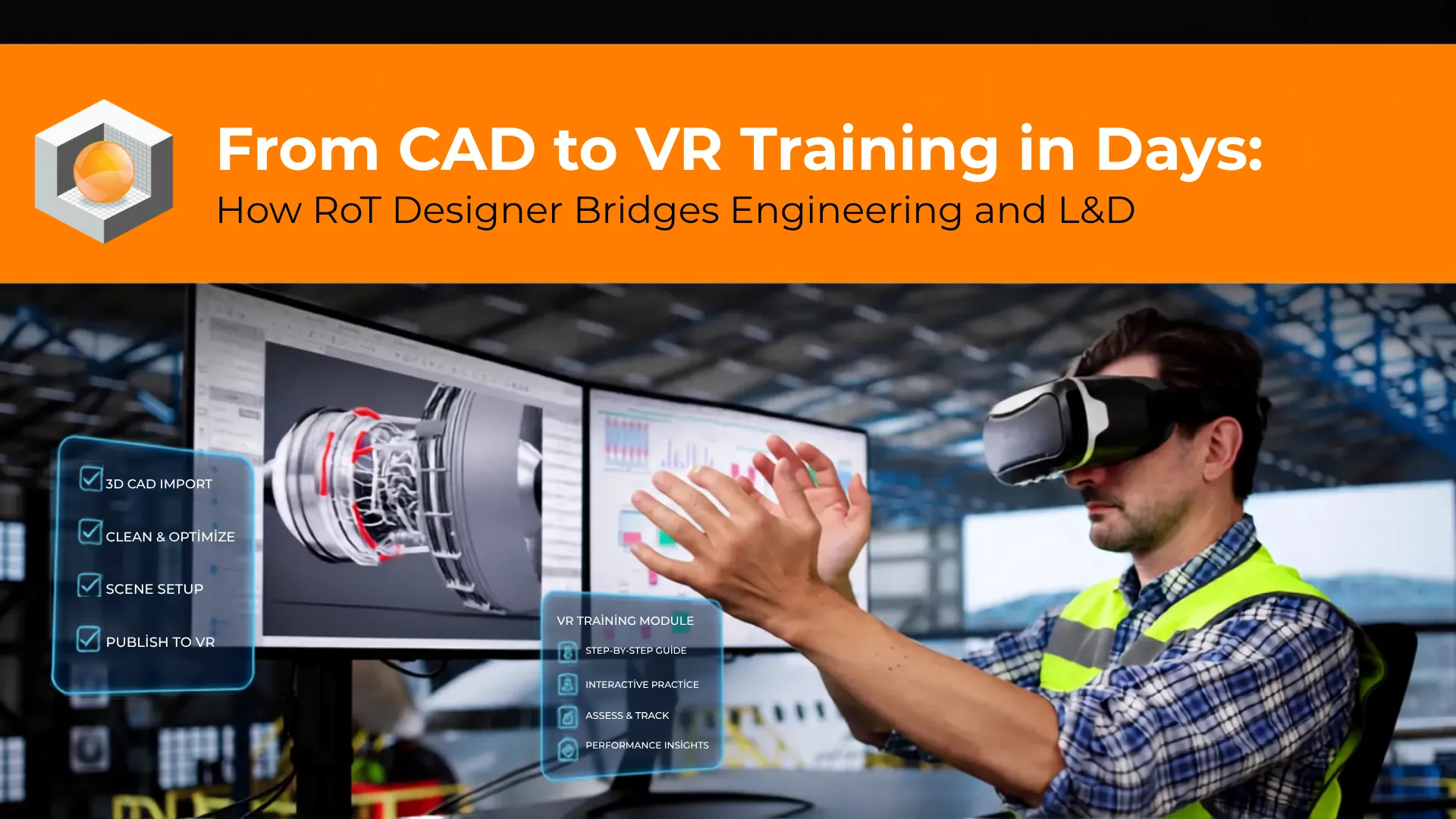
The design knowledge inside an engineering organization lives in the CAD environment. It is captured in geometry, tolerance stacks, assembly relationships, materials specifications, and the tacit rationale behind every decision that shaped the current product. It is the most authoritative record of what the product is and how it works, and it represents years of engineering investment that most organizations underexploit downstream of the release-to-manufacturing gate.
Meanwhile, the demand for immersive training content across manufacturing, HSE, industrial operations, service, and product introduction functions has moved well past the experimental threshold. VR-based procedural training is now standard operational infrastructure at industrial scale, with adoption spanning Ford Otosan Romania’s assembly line workforce transitions, Tosyalı Holding’s HSE deployments, and equivalent programs across manufacturing, mining, healthcare, and vocational education. The training content required to run these programs at scale has to come from somewhere, and the somewhere it has traditionally come from has been an external development studio that spent four to six months converting engineering assets into interactive VR scenarios using Unity or Unreal, at a per-scenario cost that only large organizations could sustain.
The gap between CAD and VR training has been an operational cost center for engineering-led organizations for a decade. The RoT Designer module of the RoT STUDIO License is the platform layer that closes it. This piece is for engineering managers, design engineering leads, and product engineering directors who are being asked by their downstream stakeholders whether the organization’s CAD investment can be extended into VR training content, and who need to understand what the operational answer looks like in 2026.
The Engineering Knowledge Silo Problem
Before evaluating the platform response, it is useful to name the underlying problem specifically. Engineering managers know this problem intimately because they live inside it every day, but framing it explicitly clarifies why the CAD-to-VR gap has been such a persistent friction point across industries.
The Tribal Knowledge Problem
Senior engineers hold the design intent that CAD models capture but do not fully explain. Why a particular tolerance was set at that value, which assembly sequence prevents the interference condition that a maintenance technician might otherwise encounter, why the material selection changed between the prototype and production revision, what the field failure history was on the analogous component in the previous product generation. This knowledge is nowhere in the PLM. It leaves the organization when the engineer retires, transfers, or moves. The workforce shortage across skilled engineering roles in 2026, documented across manufacturing employment data, has accelerated this transfer rate materially. The training content that captures this knowledge in an executable form is one of the few available structural responses.
The Prototype Cost Pressure
Physical prototypes remain expensive to build, iterate, and share across geographies. A design review that requires physical presence with a prototype delays engineering timelines and constrains stakeholder participation. Training material developed against prototypes becomes obsolete when the design revs, which happens frequently during product introduction phases. Every dollar of engineering time spent traveling to a prototype location, or waiting for a prototype iteration, is a dollar of engineering capacity not spent on the design work the organization actually needs.
Why Traditional VR Content Pipelines Fail Engineering Teams
The standard external-studio path for VR content creation asks engineering to hand off CAD assets to a game development team, wait through a scoping conversation, wait through a development cycle typically measured in months, review a draft, iterate, and eventually accept delivery of a scenario that reflects the CAD state at the moment of the initial handoff. When engineering releases a design revision, the process starts again. The cost structure and cycle time make this path viable only for training content that is expected to remain stable for years, which excludes exactly the categories where VR training would produce the highest engineering-time savings: new product introduction, assembly line changes, and equipment installations.
The CAD-to-VR Gap: Three Historical Paths and What Was Missing
Understanding what RoT Designer does requires understanding the three paths engineering teams have historically taken to move CAD content into VR-adjacent or VR-capable formats, and where each of those paths breaks down.
Path 1: Custom Unity or Unreal Development
The most capability-rich path. An external studio or in-house game engine team takes engineering-provided CAD assets, decimates and optimizes the geometry, rebuilds materials and lighting in the engine, authors interactivity through code, tests across target hardware, and delivers a compiled scenario. Full flexibility on the resulting experience. High cost per scenario, long cycle time, disconnected from CAD revision workflow, and requires either sustained investment in a game engine team or ongoing external vendor spend. Appropriate for flagship scenarios where the investment is justified by the value; unsuitable for the operational scale of training content that mid-size and large manufacturers actually need.
Path 2: CAD-Native Visualization Tools
Tools like CATIA Composer, Creo View, SolidWorks Composer, and equivalent visualization outputs from major CAD platforms extend CAD data into interactive review, animation, and technical publication workflows. These tools are excellent for design review, service documentation, and training material that operates at the level of illustrated procedures. They are not built for immersive VR training with hand-tracked interactivity, procedural error correction, session-level performance analytics, or the specific requirements of VR headset delivery on Meta Quest, PICO, or equivalent hardware. They close part of the gap but do not close the immersive-training portion of it.
Path 3: Engineering-Driven No-Code VR
The category that has matured through 2025 and 2026 and that RoT Designer occupies specifically. An engineering staff member takes a CAD file directly into a no-code authoring environment, builds an interactive VR scenario through drag and drop workflows, and deploys the scenario across target VR hardware without writing code, without engaging an external studio, and without breaking the connection between the CAD source and the training content it drives. This is the path the CAD-to-VR gap was actually waiting for, and it is the operational condition that finally allows engineering-owned VR training content to be produced at the velocity engineering itself operates at.
How RoT Designer Actually Works
RoT Designer is the first and foundational module of the RoT STUDIO License. It is the authoring environment where engineering staff take CAD models into interactive VR scenes. The capability set is scoped around what engineering managers actually need to move CAD content into training, without asking engineering to learn game development.
Direct 3D Model Import Across CAD and Visual Formats
The Designer imports both engineering-grade 3D CAD assets and visualization-grade 3D models, with no requirement for external conversion pipelines or manual geometry rebuilding. Once imported, models can be assigned textures, materials, and surface properties directly in the Designer environment. Scene realism can be enriched with lighting configurations, ambient and directional sound, 360-degree video overlays, and standard 2D video content embedded within the scene. This means engineering teams can take the CAD asset that already exists in the PLM and produce a visually appropriate VR scene against it, without the geometry rebuild step that traditionally dominates the early phase of external studio pipelines.
Task Nodes and Command Nodes: Where Interactivity Is Built
Interactivity in a Designer scene is authored through two graphical node categories that eliminate the coding step traditional VR authoring depends on. Task Nodes are associated with the objects in the scene and contain predefined interactions: touching, grabbing, snapping, and equivalent procedural task primitives. Command Nodes contain animations, sound cues, and video sequences that execute before, during, and after the tasks. Combined, they allow an engineering author to construct a full procedural training scenario, correctly sequenced with feedback and consequence logic, using only the graphical node interface. A maintenance technician training scenario, a hazard identification walkthrough, a component assembly sequence, or a compliance procedure can be built and iterated through the same node grammar.
Collaborative Design Review Across Locations
Beyond training authoring, RoT Designer includes multi-user design review functionality. Teams distributed across offices or facilities can meet in the same VR scene at full scale, walk through the design together, use the free-hand tool to annotate observations directly in the 3D environment, and take snapshots of specific review states for later reference. This is a differentiator against pure training-authoring tools: the same platform that produces training content also delivers immersive design review, which means engineering can use the same license infrastructure for two adjacent workflows. The broader positioning of RoT’s approach is captured in the RoT STUDIO License product architecture, of which Designer is the entry module.
Deployment Through the RoT STUDIO Viewer
Applications authored in Designer are delivered through the RoT STUDIO Viewer, which runs the compiled scenarios on standardized VR hardware. This decouples the authoring environment from the deployment environment: engineering authors on standard PC infrastructure while trainees receive the scenario on Meta Quest, PICO, or equivalent standalone VR devices. The two-day training course that RoT provides brings engineering staff to functional Designer proficiency, meaning the ramp cost to bring engineering-owned VR content authoring into an organization is measured in days per author rather than weeks.
What CAD-to-VR Workflows Actually Look Like in Practice
The operational value of engineering-owned VR authoring is easiest to see through the workflows that RoT customers have built against the Designer module. Three deployment patterns illustrate the range of what engineering teams do with the capability.
Assembly Line Procedural Training: Ford Otosan Romania
Ford Otosan Romania used the RoT STUDIO License to prepare its assembly line workforce for the transition into electric vehicle production. Vehicle design CAD assets became training scenarios for assembly workers on the new EV production line, delivered in the weeks required to align workforce competency with the timing of the line changeover rather than in the months a traditional external studio pipeline would have consumed. The underlying pattern (design engineering to workforce training, through engineering-owned authoring) is the operational model that manufacturers switching to VR-based workforce training have increasingly converged on across 2025 and 2026.
Design-to-Experience Journey: ErBatu Machine
ErBatu Machine’s engineering team used RoT STUDIO to build a design-to-experience journey that integrated engineering design review with downstream training and customer communication. The engineering team owned the pipeline from CAD authoring through VR scene construction, meaning design intent traveled without translation loss into the training and communication content that downstream teams consumed. Testimonial commentary from the ErBatu team explicitly identifies the CAD-knowledge-only requirement (no coding, no game engine skill) as the enabling condition that made the workflow operationally viable at engineering-team scale.
HSE Hazard Identification With Actual Site Geometry: Tosyalı Holding
Tosyalı Holding, a major Turkish industrial conglomerate, deployed RoT STUDIO License to build HSE training content anchored to actual facility geometry across production sites. The training scenarios cover hazard identification, PPE selection, and emergency response protocols, delivered in the specific environmental context of the facilities workers actually operate in. The value of engineering-owned authoring in this case is that facility geometry updates (equipment additions, layout changes, process modifications) flow into the training content on the engineering iteration timeline, rather than requiring an external content revision cycle. The pattern extends the industrial VR training model into HSE-specific operational domains where physical accuracy of the training environment is a training-quality determinant.
The Engineering Manager’s Business Case for Owning the VR Content Pipeline
The strategic argument for moving VR content authoring inside engineering (rather than continuing to outsource to external development studios or accepting the cycle-time cost of relying on other functions to produce it) rests on four operational advantages that emerge across the customer deployments and that engineering managers can present directly to executive stakeholders.
The Digital Thread Argument
The concept of the digital thread describes the connection between design intent (captured in CAD and PLM) and every downstream use of that design information: manufacturing planning, service documentation, training, quality, and product retirement. Engineering-owned VR content authoring extends the digital thread naturally into training. The same CAD asset that anchors the manufacturing bill of materials also anchors the training scenario, without a translation step that introduces geometric or intent inaccuracy. For organizations that have made digital thread a strategic priority, engineering-owned no-code VR is the operational move that puts training into the thread rather than leaving it as a downstream disconnection.
Time-to-Content and Iteration Velocity
The external studio pipeline that historically produced VR training content ran in four-to-six-month cycles at a per-scenario cost that constrained the total content library any organization could afford. Engineering-owned authoring inside the Designer environment reduces cycle time to weeks (often days for scenarios that build on previously authored assets) and moves the per-scenario cost from external-vendor spend to internal-engineering-time. For product introduction phases, assembly line reconfigurations, and equipment changeovers where training content must be current with the physical operation, this cycle time collapse is the difference between VR training being viable and VR training being aspirational.
Knowledge Capture and Retention
Senior engineer design intent that CAD does not fully capture can be encoded in the interactivity of a VR scenario: the sequence in which components must be assembled, the specific torque or fit or clearance conditions that matter, the failure modes that occur when a specific step is done incorrectly. When the senior engineer transitions or retires, this content persists in the scenario library and continues to train subsequent generations of technicians and operators. This is a workforce continuity value that traditional documentation captures poorly and that formal training curriculum captures at a level of abstraction that loses the practical detail engineering knows matters.
The Two-Day Ramp Cost
The two-day training course that brings engineering staff to Designer proficiency is a materially different investment profile than the multi-quarter ramp associated with hiring Unity or Unreal developers, or the ongoing external vendor spend of maintaining a studio relationship. Engineering managers can add VR content authoring capability to their staff without changing their hiring profile or their skill-development plan. The addition sits alongside existing CAD proficiency rather than requiring a separate specialist role.
Frequently Asked Questions
What CAD file formats does the Designer support for import?
The Designer supports import of both engineering-grade 3D CAD assets and visualization-grade 3D models. For specific format compatibility questions relative to the organization’s CAD stack (SolidWorks, CATIA, Creo, NX, Inventor, and equivalent), the recommended path is a technical scoping conversation with the RoT team during evaluation. Most industry-standard export formats from major CAD platforms translate cleanly into the Designer environment, and the Customized VR/XR Services scope can address any organization-specific format requirements that fall outside the standard import pathway.
How does Designer handle CAD revisions when the underlying design changes?
Because scene interactivity is authored through Task Nodes and Command Nodes attached to scene objects, the revision workflow is typically to update the 3D model in the scene and reconfirm that the interactivity nodes remain correctly attached to the updated geometry. Minor design revisions (surface changes, non-structural updates) rarely require scenario rebuild. Major structural changes may require more substantial scenario updates, but the workflow remains inside the engineering-owned Designer environment, which is materially different from returning to an external studio for a scenario revision.
Do engineering staff need any programming background to use RoT Designer?
No. The two-day training course that RoT provides is designed for engineering staff with CAD-level computer proficiency but no programming or game engine background. The core testimonial from the ErBatu Machine team explicitly identifies CAD-only knowledge as sufficient. This is the operational condition that makes engineering-owned authoring viable at team scale: the capability adds to existing engineering staff rather than requiring specialized hires.
Can the Designer produce scenarios that meet compliance documentation requirements for regulated training?
Scenarios authored in the Designer and deployed through the RoT STUDIO Viewer produce session-level performance data that supports competency documentation for internal training programs and, where applicable, for regulated compliance audit. For specific regulatory frameworks (OSHA, EU industrial safety directives, FDA compliance training, NHS clinical requirements), the documentation depth typically satisfies audit requirements, but organizations under specific compliance scrutiny should validate documentation scope against the relevant regulator’s expectations during evaluation.
How does Designer fit alongside the VR Training Catalogue and Customized VR/XR Services?
The three RoT products serve complementary purposes. The VR Training Catalogue delivers ready-made scenario modules across HSE, industrial safety, healthcare, and equivalent domains for organizations that need immediate deployment against standard training content. Customized VR/XR Services provides RoT-team scenario development for organizations that need custom content but do not have engineering-owned authoring in scope. The License, with Designer as the entry module, is the path for organizations that want to author and maintain content in-house at engineering velocity. Most large deployments combine the three: catalogue for immediate coverage, custom services for specialty scenarios, and License for organization-specific content that engineering owns.
What deployment hardware supports the scenarios authored in Designer?
The RoT STUDIO Viewer supports current-generation standalone VR headsets, including Meta Quest 3, Quest 3S, PICO 4, and equivalent devices, plus PC-tethered VR configurations. This aligns with the hardware standards that most enterprise VR training deployments now operate against. Multi-device deployment allows organizations to select target hardware based on operational context (standalone for distributed workforce, tethered PC for higher-fidelity fixed-station scenarios) without re-authoring the scenario content.
The Strategic Conclusion: Engineering-Owned VR Content Is the Operational Model for 2026
The CAD-to-VR gap that constrained engineering-led organizations for a decade has been closed by the maturation of no-code authoring platforms that operate at engineering iteration velocity. RoT Designer, as the foundation module of the RoT STUDIO License, occupies this platform layer specifically. The operational consequence for engineering managers is that VR training content, immersive design review, and downstream stakeholder communication move inside engineering, at engineering velocity, without requiring specialized hires or ongoing external vendor spend.
For engineering managers, design engineering leads, and product engineering directors evaluating how to extend CAD investment into training content, the strategic conclusion is that the tools now exist to do this without disrupting engineering workflow or hiring outside the engineering profile. The Ford Otosan Romania, ErBatu Machine, and Tosyalı Holding deployments demonstrate the operational pattern at scale, and the two-day proficiency ramp for engineering staff makes the capability addition a matter of staff time rather than organizational restructure.
Engineering knowledge is the most valuable underexploited asset in most industrial organizations. RoT Designer is the platform layer that extends it into training, review, and communication content, at the velocity engineering already operates at.
How RoT STUDIO Approaches This
The Designer module of the RoT STUDIO License is built around the operational reality that engineering teams need to author VR content at engineering velocity, without adopting game engine skill sets or committing to external vendor cycles. The platform’s node-based interactivity architecture, direct CAD and Visual model import, and multi-device deployment through the RoT STUDIO Viewer collectively enable engineering-owned authoring workflows that match the iteration cadence of the CAD environment.
For organizations that combine the Designer authoring capability with adjacent RoT products, the VR Training Catalogue provides immediate coverage against standard HSE and industrial scenarios while custom Customized VR/XR Services address specialty scenarios that require RoT-team engineering support. This three-product architecture is designed for the operational reality most industrial and healthcare organizations actually face: some content needs immediate deployment, some content requires custom development against specialized workflows, and some content the engineering team should own and iterate directly.
For engineering managers evaluating the CAD-to-VR content pipeline against the digital thread and iteration velocity requirements outlined above, the VR/XR Training Solutions portfolio from RoT STUDIO is the starting point. Get in touch with the team to walk through what an engineering-owned Designer deployment looks like for your specific CAD stack, product portfolio, and training scope.