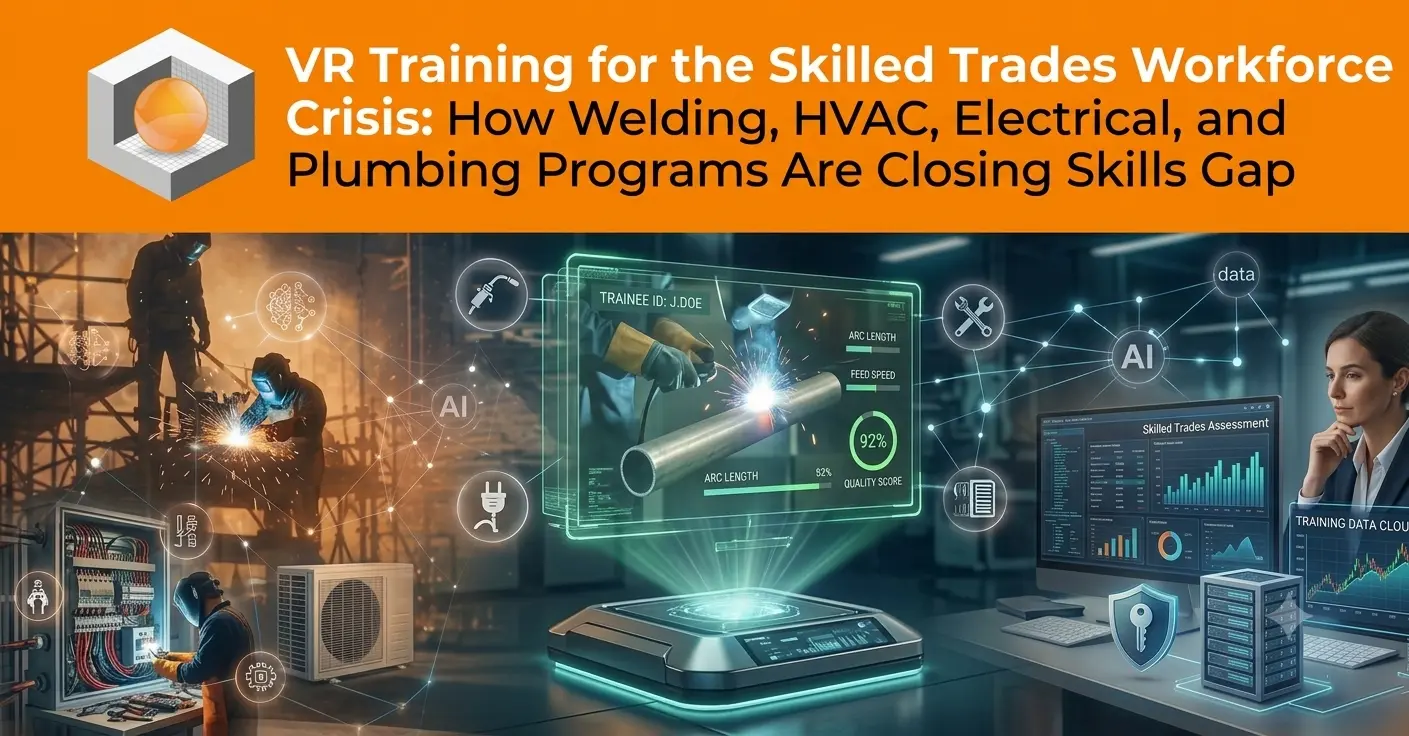
It now takes longer to hire an electrician than a software developer. Randstad’s 2026 analysis of more than 150 million U.S. job postings between 2022 and 2026 found that the average time-to-hire for skilled trades has reached 56 days, two days longer than the average for desk-based professional roles. This is not a small inversion. It is a labor-market reorientation that would have been unthinkable a decade ago, and it is the structural backdrop for what is now the largest workforce shortage in skilled trades since the U.S. began tracking the data.
The numbers across the four core trades are stark. Welding faces a projected shortage of more than 336,000 professionals by 2026, with 80,000 to 90,000 openings to fill annually through 2029 (American Welding Society). HVAC is short 110,000 technicians, with the number of certified technicians having dropped by approximately 50% over the past decade (ACHR News, ACCA). The construction industry needs 349,000 net new workers just for 2026, climbing to 456,000 for 2027 (Associated General Contractors). And the bottleneck is no longer just recruitment. It is the training capacity required to convert new entrants into certified, code-compliant, employable tradespeople at the pace demand now requires.
This piece is for workforce development directors, trade school program leads, L&D directors at large contractors, HR and talent leaders at trade-heavy enterprises, and apprenticeship coordinators across registered and union programs. The thesis is direct: the training capacity gap cannot be closed by hiring more instructors and building more equipment-heavy lab spaces, because the same workforce shortage that creates demand for trade graduates is also drying up the instructor pipeline and the budget for traditional infrastructure expansion. The leverage point that has emerged across 2025 and 2026 is virtual reality training, and its adoption across welding, HVAC, electrical, and plumbing programs has accelerated to the point where it is increasingly the structural answer rather than the experimental supplement.
The Skilled Trades Workforce Reality: Numbers That Reshape Training Strategy
Each of the four trades has its own demographic and demand profile, but they converge on a common pattern: an aging workforce, a thin replacement pipeline, accelerating demand, and a training infrastructure that has not scaled in fifty years.
Welding: 336,000 Needed by 2026, Average Worker Age 55
The American Welding Society projects approximately 336,000 new welding professionals needed by 2026, with 80,000 to 82,500 average annual openings through 2029. The average U.S. welder is 55 years old, compared with 42 for the general workforce, and approximately 157,000 experienced welders are nearing retirement. For every five welders retiring, only two are entering the field. Specialized welders (TIG, underwater, aerospace, robotic) routinely earn over $100,000, with top pipeline welders reaching $200,000. The shortage is most acute in pipefitting (17% of postings), structural ironwork (18%), and welding inspection (5%).
HVAC: 110,000 Unfilled Positions, Certified Techs Down 50% in a Decade
The Air Conditioning Contractors of America reports an HVAC technician shortage of approximately 110,000 unfilled roles. ACHR News data indicates that the number of certified HVAC technicians dropped by approximately 50% over the past decade, even as residential and commercial demand has continued to grow. BLS projects 40,100 annual openings through 2034 and 8% job growth, classified as much faster than average. BlackRock’s $100 million Future Builders initiative explicitly names HVAC technicians as a target workforce. Median pay reached $59,810 in 2024, with $85,000-plus markets for experienced technicians and six-figure earnings increasingly common in commercial and refrigeration specializations.
Electrical: The Number One Constraint on AI Data Center Expansion
Microsoft’s president recently called the electrician shortage “the number one problem” slowing the company’s data center expansion. Google has committed $15 million to the Electrical Training Alliance. Oracle has pushed data center project timelines back a full year due to electrician availability. Top electricians on data center projects are clearing $250,000 in 2026. Construction workers on data center projects average $81,800 annually, 32% more than equivalent non-data center work. Construction employment sits at approximately 8.2 million, near an all-time high, yet 92% of construction firms report difficulty finding workers to hire.
Plumbing: 56-Day Time-to-Hire, Aging Workforce, Infrastructure Demand Surge
Plumbing has tracked the same demographic and demand pattern as welding and HVAC, with the additional pressure of federal infrastructure spending acceleration through 2026-27. The Randstad analysis showing 56-day average time-to-hire for skilled trades is anchored most heavily by plumbing and electrical roles, where the credentialing pathway (typically four years of apprenticeship to journeyman, additional time to master plumber) imposes a structural floor on how quickly the workforce can expand even when interest is rising.
Why Traditional Training Capacity Has Hit Its Ceiling
Understanding why virtual reality has moved from supplementary tool to structural answer requires understanding the specific limits traditional trade training has reached.
The Instructor Bottleneck
Trade schools, community college vocational programs, and registered apprenticeship instructors are themselves part of the workforce shortage. The most experienced welders, electricians, and HVAC technicians are reaching retirement age at the same time they would otherwise be transitioning into instructor and master tradesperson roles. Many do not transition at all, because the wage differential between a journeyman in the field and a community college instructor often favors staying in the field. The result is that training programs are competing for a shrinking pool of qualified instructors, and the instructor-to-student ratio that determines program capacity has tightened, not loosened, despite rising enrollment interest.
Equipment, Lab Capacity, and Consumables Cost
A traditional welding lab requires booths, ventilation systems, gas, filler material, electricity, and PPE for each student station. Equivalent constraints exist in HVAC labs (refrigerants, equipment mockups, EPA-compliant facilities), electrical labs (panel boards, conduit, energized equipment for advanced training), and plumbing labs (water systems, fixtures, drainage simulations). Each of these constraints is a hard capital cost that does not scale linearly with enrollment growth. Many programs have waitlists not because they cannot recruit students but because they cannot expand lab capacity fast enough. The parallel argument from VR in vocational training applies across trades: physical infrastructure has become the binding constraint on training program scale.
Time-to-Competency Has Not Compressed
Despite decades of educational research, the time required to bring a new trade apprentice to journey-level competency has remained essentially flat. Welding certification still requires hundreds of hours of supervised practice. Electrical journey-level competency requires four years of registered apprenticeship plus exam preparation. HVAC EPA 608 certification can be earned faster, but full residential and commercial competency typically requires three to five years. The procedural skill requirements in the trades are not the kind that lecture or video can compress, because they are motor-skill and judgment skills that require physical repetition under instructional supervision.
Geographic Concentration of Training Capacity
Trade training capacity is unevenly distributed across regions. Specialized welding training (aerospace alloys, underwater, robotic) is concentrated in a small number of programs nationally. Advanced HVAC commercial refrigeration training has similar geographic concentration. Students in regions without local programs face the additional cost of relocation, which suppresses both enrollment and completion. The geographic constraint is one of the clearest places where VR delivers asymmetric value, because the same training content can be deployed at any location with headset access.
How VR Has Changed the Trade-Training Equation
Virtual reality training in skilled trades is not a new concept. Lincoln Electric’s VRTEX welding simulator has been in market since the early 2010s. What changed across 2025 and 2026 is that the cost, fidelity, and platform maturity reached the threshold where VR is now the operational backbone of multiple trade programs rather than a supplementary marketing piece.
Repetition Density: The Mechanism That Compresses Competency Time
Procedural skill in the trades is built through repetition under conditions that resemble the real work environment. A welding student who practices bead formation forty times in a VR scenario builds different motor competency than one who watches a demonstration once and gets one or two booth attempts per session. The mechanism is not technology novelty; it is repetition density. The same applies to HVAC refrigerant recovery sequences, electrical panel work, and plumbing fixture installation. VR removes the per-attempt cost (gas, electricity, water, fixture damage, instructor supervision time) that constrains repetition in physical lab settings.
Safety: Practicing Dangerous Procedures Without Consequence
Live welding exposes apprentices to UV radiation, fume inhalation, burn risk, and arc-flash hazards. OSHA data indicates that welders are 44% more likely to develop lung cancer than non-welders due to fume exposure. Electrical training that requires energized panel work carries arc-flash and shock risk. HVAC training that involves refrigerant handling has both health and environmental compliance exposure. VR-based practice removes all of these risks during the procedural learning phase, allowing the student to make every typical first-year mistake without producing physical or health consequence. The argument from how VR training reduces workplace accidents extends directly into trade training: safer practice produces safer field operators.
Geographic Flexibility and Asynchronous Delivery
The same VR scenario can run in a community college lab in rural Ohio, a workforce development center in Detroit, and an apprentice training site in El Paso, with identical content fidelity and assessment criteria. For workforce development boards trying to address geographic training gaps and for unions managing apprenticeship programs across multiple jurisdictions, this is a structural shift in how training capacity is distributed.
Industry Validation: VRSim, Interplay Learning, Lincoln Electric VRTEX, Transfr
The trade-VR market has matured to the point of having clear category leaders. VRSim, based in East Hartford CT, was recognized by Hartford Business Journal in 2025 for its work in skilled trades VR training, with deployments across multiple state community college systems. Interplay Learning has built a 3D and VR HVAC and skilled trades curriculum with a Lowe’s Track to the Trades partnership that has trained thousands of new entrants. Lincoln Electric’s VRTEX remains the industry-standard welding simulator with deployment across hundreds of training programs. Transfr has built a career exploration and skilled trades training pipeline that has scaled through public workforce development partnerships. The pattern across these vendors is consistent: VR is no longer experimental; it is integrated into the operational training infrastructure of mainstream programs.
Trade-by-Trade Deep Dive: How VR Maps to Each Discipline
The structural argument for VR in trades training applies across the four trades, but the specific mapping differs based on the procedural skills, regulatory requirements, and equipment dependencies of each discipline.
Welding VR Training
Welding has been the most mature trade-VR vertical for nearly a decade, with Lincoln Electric’s VRTEX establishing the operational template. The procedural elements that VR captures effectively include bead formation, torch angle, travel speed, electrode-to-workpiece distance, and movement consistency. Scenarios extend across MIG, TIG, stick, and flux-core processes; across position requirements (1G flat, 2G horizontal, 3G vertical, 4G overhead); and across joint configurations (butt, lap, T-joint, corner). The training value is highest in the first 100-200 hours of skill acquisition, where the cost of physical materials and instructor supervision is most prohibitive. Once a student reaches intermediate skill level, hybrid programs that combine VR for repetition density with live booth time for final certification preparation have become the predominant model.
HVAC VR Training
HVAC training maps to VR across multiple distinct skill clusters: refrigerant recovery and recharge procedures (EPA 608 critical), system troubleshooting workflows, electrical diagnostic sequences for HVAC equipment, refrigeration cycle visualization (where the abstract thermodynamics is otherwise difficult to teach), and equipment installation procedures. Interplay Learning’s catalogue has demonstrated that the combination of 3D visualization for system understanding plus VR for hands-on procedural practice produces measurable competency gains in HVAC apprentices, particularly in the EPA 608 certification preparation phase. For community college programs, the cost compression is meaningful: a single VR scenario library can replace tens of thousands of dollars annually in refrigerant, equipment mockups, and consumables.
Electrical VR Training
Electrical training is one of the strongest VR fit profiles because of the danger profile of live training. Energized work requires extensive PPE, OSHA-compliant facilities, and one-to-one instructor supervision that constrains how many apprentices can practice simultaneously. VR-based electrical training scenarios cover panel board layout and wiring, conduit bending and pulling, fixture installation, code compliance walkthroughs (NEC reference), troubleshooting workflows, and arc-flash hazard recognition. The training value extends into the journey-level continuing education space, where complex commercial scenarios (data center power infrastructure, three-phase systems, motor controls) can be practiced in VR with content fidelity that would be operationally impossible to replicate in a training facility.
Plumbing VR Training
Plumbing training has been slower to develop standardized VR content than welding or HVAC, but the underlying training-capacity argument is identical. Procedural skills that VR captures effectively include pipe layout and routing, fitting selection and installation, fixture installation sequences, drainage and venting code compliance, troubleshooting workflows for residential and commercial systems, and backflow prevention certification training. The opportunity for trade school programs is to commission custom VR scenarios that reflect the specific code requirements and equipment standards of their jurisdiction, which is a fit for the Customized VR/XR Services model rather than off-the-shelf catalogue content.
Shared Design Principles Across All Four Trades
Across the four trades, the VR training programs producing the strongest competency outcomes share design principles. They build for repetition density rather than novelty (the value is in the hundredth scenario completion, not the first). They incorporate corrective feedback at every decision point, so apprentices receive immediate correction rather than waiting for next-session instructor review. They produce session-level performance records that support competency documentation for certification bodies, registered apprenticeship reporting, and contractor compliance audit. And they are deployed as integrated components of a broader curriculum that retains physical lab time for final certification preparation and capstone projects, rather than positioning VR as a replacement for all hands-on training.
| Technical Note: Hybrid Training Programs Outperform Pure-VR or Pure-Physical Programs The strongest 2025-26 program outcomes are not coming from full VR replacement of physical training, nor from VR as marketing supplement on top of unchanged physical programs. They are coming from hybrid programs that use VR for the first 60-70% of skill acquisition (where repetition density and safety value are highest) and reserve physical lab time and field placements for advanced skill consolidation, certification preparation, and capstone work. This sequencing maximizes program capacity, instructor leverage, and competency outcomes simultaneously. Trade school directors and apprenticeship coordinators evaluating VR procurement should structure programs around this hybrid model rather than evaluating VR as a binary substitute for traditional methods. |
Who Is Adopting and How Programs Are Being Structured
The adoption pattern for VR in skilled trades follows a clear segmentation, with different program structures emerging across institutional categories.
Community Colleges and State Vocational Systems
Community college systems have become the largest single category of trade-VR adoption across 2025-26. Programs across multiple state systems have integrated VR welding (VRTEX), VR HVAC (Interplay), and VR electrical content into their core curricula, often funded through state workforce development grants and federal Perkins Act allocations. The driver is straightforward: state community college systems are under explicit mandate to expand trade program capacity, and VR is the only mechanism that scales without proportional capital investment in physical lab expansion.
Registered Apprenticeship Programs (DOL, Union, Non-Union)
Registered apprenticeships, both union (UA for plumbing/HVAC, IBEW for electrical, Sheet Metal Workers for HVAC sheet metal) and non-union (ABC, IEC), have integrated VR training as a structured component of the classroom portion of the apprenticeship. The April 2026 DOL initiative requiring AI training in registered apprenticeships reinforces the technology integration trajectory and signals federal alignment with the broader training modernization.
Contractor In-House Training Programs
Large contractors operating across multiple sites have built in-house training programs to address the workforce shortage at the firm level. These programs use VR for new-hire onboarding, technical skill upskilling for existing workforce, and certification preparation. Data center contractors specifically have moved aggressively in this direction, given that Microsoft, Google, Oracle, and equivalent hyperscalers are pressing electrician supply at exactly the moment when their data center demand is highest.
Workforce Development Boards and Public Sector
State and regional workforce development boards have funded VR training pilots across multiple trade categories, often as part of dislocated worker programs, career-transition initiatives, and incumbent worker training. Public sector adoption is generally slower than private but is now accelerating as the workforce gap moves from policy concern to operational emergency in trade-heavy state economies. The trajectory parallels the institutional adoption of manufacturers switching to VR-based workforce training, though with different funding structures.
Manufacturer-Sponsored Training Academies
HVAC equipment manufacturers (Carrier, Trane, Lennox) and electrical equipment manufacturers have built short-form academies in partnership with their dealer and distributor networks. VR has become a standard component of these academies because the manufacturers can build scenarios specific to their own equipment lines, ensuring that new technicians complete training oriented around the equipment they will actually service in the field.
Frequently Asked Questions
Can VR fully replace physical lab time in trade programs?
No, and that is not the goal of current hybrid program designs. VR is most effective for the first 60-70% of skill acquisition, where repetition density and safety value are highest. Final certification preparation, capstone projects, and field placements require physical equipment time. The strongest outcomes come from hybrid programs that sequence VR followed by lab time, not from full VR replacement.
Does VR training satisfy certification body requirements?
Increasingly yes, depending on the certification. AWS welding certifications still require physical weld testing for final qualification, but VR-based preparation is widely accepted by training programs as legitimate hours toward apprenticeship requirements. EPA 608 HVAC certification is exam-based and VR preparation is commonly used. Electrical journey-level licensure varies by state, but registered apprenticeship hours that include VR-based classroom components are accepted across all major jurisdictions. Plumbing certification follows similar patterns. The trajectory is toward broader certification body acceptance of VR-based training as legitimate credit toward apprenticeship and certification requirements.
What hardware do trade programs need to deploy VR training?
Current standalone VR headsets (Meta Quest 3, Quest 3S, PICO 4, and equivalents) have made deployment economically viable at trade program scale. A typical community college program might commit to 10-30 headsets per cohort, rotated across training sessions, at a per-headset cost that has fallen below the cost of equivalent physical training booth materials over a one-to-two-year amortization. Some welding-specific simulators (VRTEX) use proprietary hardware that more closely mimics the weight and feel of a welding torch, at higher per-station cost but with stronger feel-fidelity for the motor-skill training.
How do workforce development boards fund VR training pilots?
Funding pathways include state workforce development grants, federal Perkins Act allocations for vocational programs, WIOA Title I funds for dislocated worker programs, registered apprenticeship federal funding (DOL), state and local economic development funds for industry-specific workforce initiatives, and increasingly philanthropic capital (the BlackRock $100 million Future Builders initiative is one prominent example). The funding ecosystem is now mature enough that VR pilots rarely face a pure capital constraint; the binding constraint is more often program design and instructor capacity to integrate the technology.
What is the realistic timeline from procurement to operational deployment?
For programs using established VR trade-training content (VRTEX for welding, Interplay for HVAC), operational deployment is typically achievable within 4-8 weeks of procurement, primarily limited by instructor training and curriculum integration rather than technology setup. For programs commissioning custom content for trade-specific or jurisdiction-specific scenarios, development timelines extend to 3-6 months. Apprenticeship and certification body alignment for any new content typically adds an additional 2-3 months of validation work. Most programs that commit to VR adoption are operational within a single academic semester.
How does VR training apply to contractor in-house upskilling programs?
Contractor in-house programs typically focus on three categories: new-hire onboarding (rapid technical skill development for entry-level hires), incumbent worker upskilling (existing journeymen training on new technology, new equipment, or specialized procedures), and certification preparation (preparing existing workforce for advanced credentials that increase billable scope). VR is well-suited to all three but particularly effective for new-hire onboarding, where the combination of repetition density, safety, and instructor leverage produces the strongest cost-benefit profile.
The Conclusion: VR Has Become the Trades’ Most Important Training Technology
The Randstad finding that electricians now take longer to hire than software developers is not a temporary inversion. It is the leading indicator of a labor-market reorientation that will define the next decade of American workforce policy and industrial strategy. Federal infrastructure spending, AI data center expansion, semiconductor manufacturing onshoring, and energy infrastructure modernization all depend on tradespeople who do not yet exist in sufficient number, and the training pipeline that historically produced them cannot scale fast enough to close the gap through traditional means.
For workforce development directors, trade school program leads, contractor L&D leaders, HR and talent VPs across trade-heavy industries, and apprenticeship coordinators, the strategic conclusion is direct. The organizations that will reach the next decade with sufficient skilled workforce are the ones that built scalable, immersive training capacity in 2025-26. The organizations that treat VR as supplementary technology rather than structural training infrastructure will find themselves competing for graduates of programs that already have it.
The technology is not the differentiator. Repetition density is. Geographic flexibility is. Safety during the highest-risk learning phase is. Documentation that survives instructor turnover is. VR delivers all four. The question for procurement and program-design leaders in trade-heavy organizations is no longer whether to invest, but at what depth and with what content strategy.
How RoT STUDIO Approaches This
RoT STUDIO’s VR training platform supports trade-specific scenario development through Customized VR/XR Services, designed for the operational pattern that defines trade-program adoption: standardized procedural skill building combined with jurisdiction-specific, equipment-specific, and program-specific content variations. For trade schools, apprenticeship programs, and contractor in-house training operations that require scenarios beyond standard catalogue offerings, this customization capacity is the structural fit.
The no-code RoT STUDIO License platform extends the same model into ongoing curriculum control: trade program directors and L&D leads can author and update scenarios as code standards, equipment models, or training emphasis changes, without dependency on external development cycles. This is particularly relevant for programs operating under registered apprenticeship requirements where content must be updated as DOL standards evolve, including the new AI training mandate effective across registered programs through 2026 and beyond.
For workforce development organizations, trade schools, and contractor programs evaluating VR training architecture for trade-specific applications, the VR/XR Training Solutions from RoT STUDIO are the starting point. The broader catalogue including VR safety training and industrial VR training modules complements trade-specific custom scenarios for organizations that span industrial safety and trade skill development. Get in touch with the team to walk through how the platform supports your program’s specific trades, jurisdictions, and apprenticeship structure.