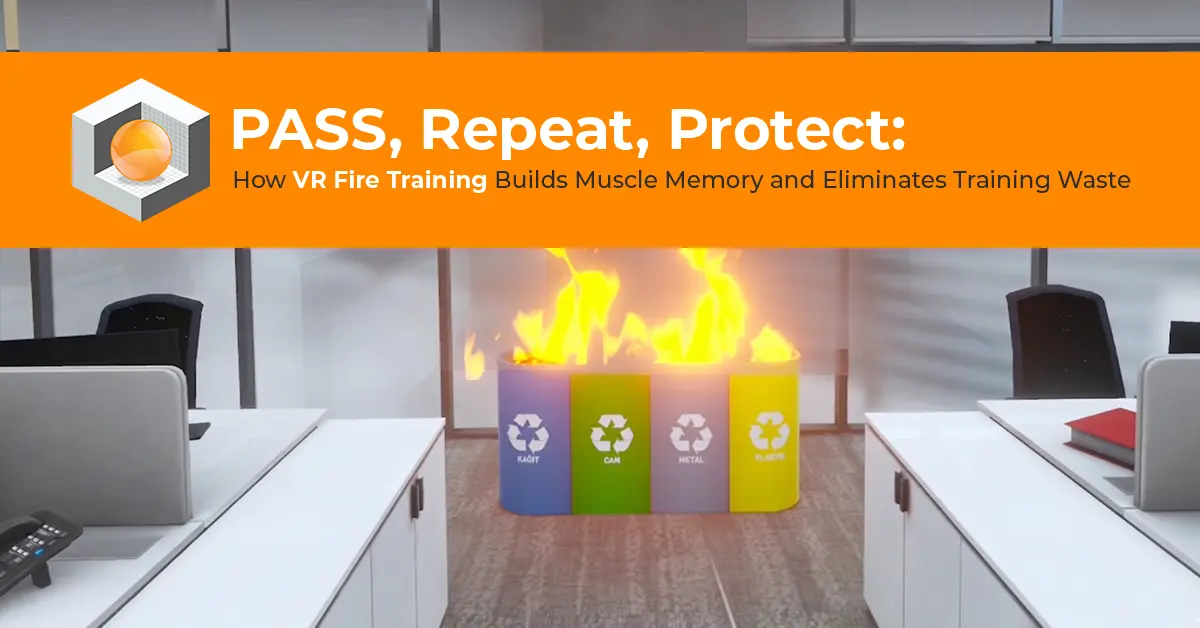
Ask any employee who completed fire extinguisher training six months ago to demonstrate the PASS sequence under pressure, on an unfamiliar extinguisher model. The hesitation that follows is not a training outcome. It is a training failure. Across industrial sites, manufacturing floors, and corporate buildings, fire extinguisher training typically happens once a year, covers the acronym, and produces a signed attendance record. It produces almost nothing else that survives the first moments of a real emergency.
This is a safety problem. It is also, increasingly, an environmental and financial one. Every live training discharge consumes physical agent, generates chemical waste, and requires logistical overhead that takes teams off production. Organizations running fire safety training at any meaningful scale are carrying costs and environmental liabilities that rarely appear in the line item where they are usually measured.
This post looks at what PASS-method training actually requires to work, what traditional training consistently fails to deliver, and why the sustainability calculus of live-discharge practice has shifted as simulation-based alternatives have matured.
Why Annual Fire Safety Training Does Not Build Real Emergency Readiness
The Gap Between Knowing PASS and Executing It
Pull. Aim. Squeeze. Sweep. Most employees who have attended health and safety training with VR or conventional instruction can recite the PASS acronym on request. Very few could execute it correctly, confidently, and quickly, on a specific extinguisher type, in a smoke-affected environment, while managing the stress response that a real fire produces.
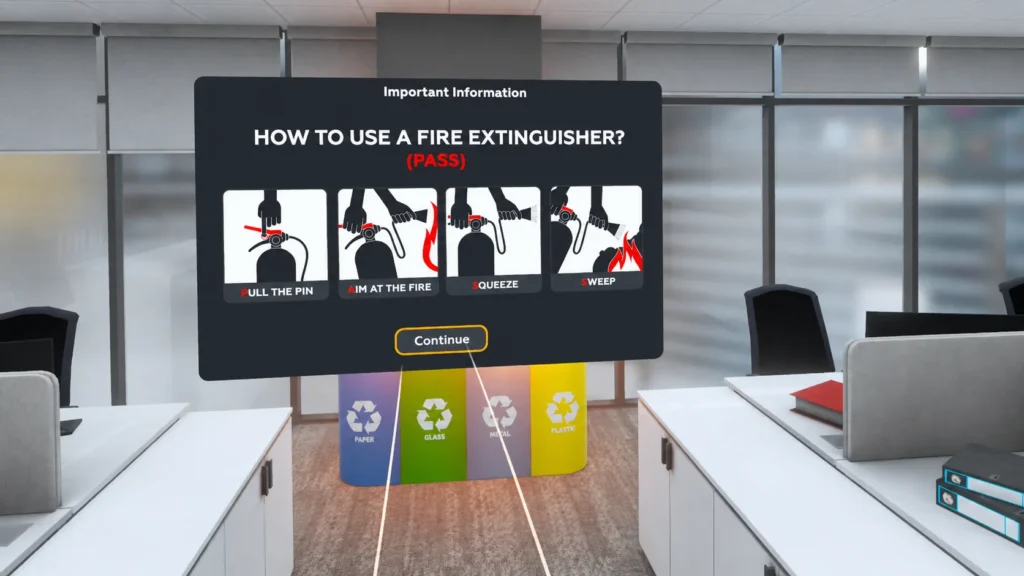
The distinction matters because fire response is a time-critical procedural skill. Research in emergency response training consistently shows that individuals perform significantly worse under stress than in neutral conditions, unless the procedure has been rehearsed to the point of automaticity. Knowing a process intellectually is not the same as being able to execute it without conscious deliberation. NFPA data on workplace fire incidents identifies delayed or incorrect first-response as a primary factor in fires that escalate beyond initial containment.
The Skill Retention Problem with One-Shot Training
Procedural skills practiced once and not reinforced degrade predictably. Without spaced repetition, motor knowledge reverts to surface-level familiarity within weeks. A worker who discharged an extinguisher during a January training session will not reliably execute the same sequence correctly in October, particularly on a different extinguisher type or in an unfamiliar environment.
This is not a failure of the worker. It is a structural failure of a training design that prioritizes scheduling convenience over learning science.
The PASS Method and the Science of Fire Response Muscle Memory
Procedural Memory vs. Declarative Knowledge
Muscle memory is the colloquial term for what cognitive psychologists call procedural memory: the type of long-term memory that stores learned physical sequences. Unlike declarative memory (knowing what PASS stands for), procedural memory encodes how to perform a sequence. It is developed through repeated physical execution, not through observation or verbal instruction.
For the PASS method to function as a reflex rather than a recalled checklist, each step must have been physically executed multiple times, with corrective feedback built in. Aim requires practiced distance calibration and sweep angle for the extinguisher type in use. Squeeze requires actual trigger pressure and discharge control mechanics. Sweep requires trained lateral movement across the fire base, not a mental image of it. None of these motor components are activated by watching a trainer demonstrate them from three meters away.
Stress, Cognitive Load, and Why Automaticity Matters
In a genuine fire emergency, cognitive load spikes rapidly. Noise, smoke, alarm sounds, and the physiological stress response all compete for working memory. The reason rehearsed procedures are more reliable under these conditions is that automaticity reduces the demand on conscious deliberation. When the PASS sequence has been executed enough times to become procedural, the body executes the steps while the mind manages the wider situation: other personnel, escape routes, escalation decisions.
This is the safety rationale for repetition that no annual drill can provide. One live discharge per year is a demonstration, not a training program.
| Expert Note: Why Extinguisher Type Matters for Muscle Memory Different extinguisher types require genuinely different physical technique. The sweep angle, operating distance, and trigger behavior of a CO2 unit differ from a dry powder model, which differs again from a water extinguisher. An employee trained only on one type may hesitate or misapply technique when reaching for a different model during an incident. Effective PASS training exposes trainees to multiple extinguisher types across multiple scenarios rather than a single representative demonstration. |
How VR Delivers the Repetition That Physical Training Cannot Scale
From Passive Observation to Active Execution
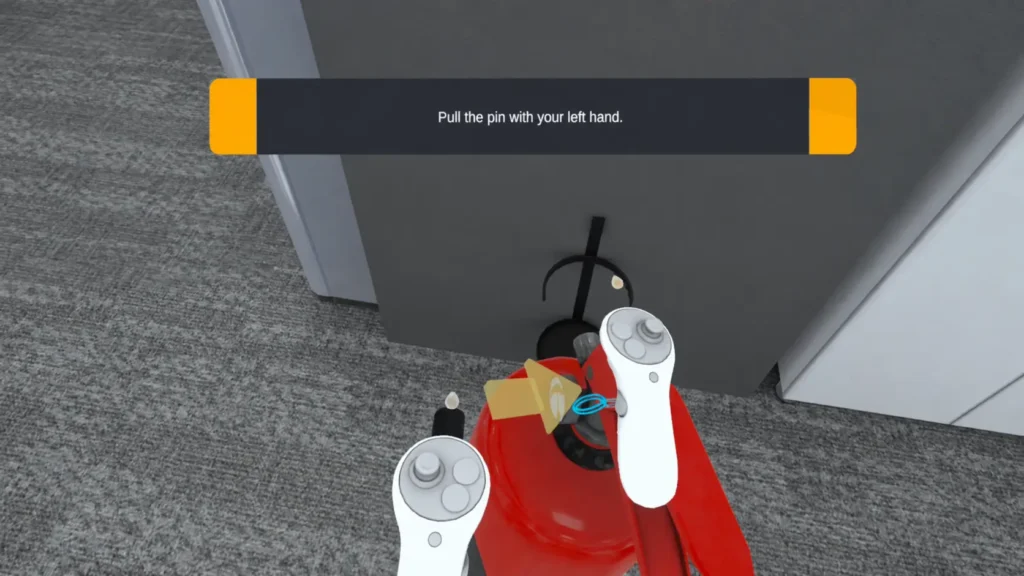
VR fire training converts each component of the PASS method into a physical interaction. Trainees operate controllers that replicate trigger pressure and sweep motion. The training environment replicates the visual and auditory conditions of a real fire scenario, on a manufacturing floor, in a server room, in a warehouse corridor, with consistent fidelity across every repetition. That fidelity is not incidental; it is the mechanism by which the training environment transfers to the real-world environment where the emergency will occur.
The scenarios can be varied across extinguisher types, fire classes (A, B, C, K), and environmental contexts without the logistical overhead of setting up a live-fire training area. For a broader overview of how this applies across VR safety training programs, the pattern is consistent: simulation removes the constraint that limits repetition in physical training.
Repetition at Scale, Without Consumables
Traditional live-discharge training faces a structural constraint: each discharge consumes a physical extinguisher charge. Every additional repetition increases cost, chemical waste, and scheduling overhead. The practical result is that trainees typically perform one or two discharges per training session, which is insufficient to drive procedural encoding at the level required for reliable emergency performance.
VR removes this constraint. Each scenario can be repeated without incremental cost or resource consumption. Training frequency becomes a program design choice rather than a budget problem. Refresher sessions can be deployed across teams and sites on demand, without coordinating external vendors or resetting physical training equipment.
To see how the VR-based fire extinguisher training module from RoT STUDIO can be integrated into your HSE program, get in touch with the team.
Talk to an Expert →The Environmental Cost of Traditional Fire Extinguisher Training
CO2 Discharge: The Invisible Training Emission
Every live CO2 extinguisher discharge during a training session releases compressed gas directly into the atmosphere. A standard 2kg CO2 fire extinguisher contains approximately 2kg of CO2, which is released in full when the unit is used for practice. Across a workforce of 200 employees completing annual practical training with CO2 units, this translates to hundreds of kilograms of direct greenhouse gas discharge per training cycle, before accounting for the energy and transport costs of recharging and logistics.
Dry powder extinguishers present a compounding problem. The monoammonium phosphate or sodium bicarbonate agents used in ABC dry powder units leave chemical residue that requires remediation after each outdoor or semi-contained training session. The quantities are not individually dramatic; aggregated across industrial and corporate training programs at scale, the cumulative contamination load is material, particularly in sectors with high employee turnover and frequent refresher requirements.
Water Waste and Foam Runoff from Live Practice
Water-based and foam extinguisher training introduces a different waste stream. A standard water extinguisher holds between 6 and 9 liters per unit. Training sessions using foam agents historically introduced fluorosurfactant-based compounds (AFFF) into drainage systems, with documented environmental persistence. Regulatory pressure on these compounds has accelerated across the EU and UK, making the environmental liability of foam-based training practice a compliance consideration for procurement teams, not merely an operational one.
VR training eliminates this waste stream entirely. Zero agent is discharged. Zero chemical residue is produced. Zero environmental remediation is required after the training session. This aligns directly with RoT STUDIO’s sustainability commitments, which position immersive training as an active contributor to reduced organizational environmental impact, not simply a more convenient training format.
Logistics, Transport, and the Full Training Footprint
Live fire training sessions require vendor coordination, equipment transport to site, training area preparation, and post-session cleanup. For organizations managing training across multiple facilities, the logistics overhead includes vehicle movements and associated emissions. These costs are largely invisible in HSE training budgets because they are distributed across facilities, operations, and procurement rather than captured in a single line. They are real nonetheless, and they scale with organizational size in ways that single-facility comparisons tend to understate.
| Technical Note: What ‘Zero Agent Discharge’ Means Operationally Beyond the environmental benefit, eliminating agent discharge from training has a direct operational consequence: the extinguisher fleet is not consumed by training cycles. Organizations running regular practical fire training with live equipment must maintain parallel stock for training use, to avoid depleting operational units, and absorb the recharge costs for every unit discharged. With VR training, the operational fleet is preserved intact, training costs become fixed rather than variable per-session, and the recharge procurement cycle is removed from the training program entirely. |
Business Continuity: What Fire Training Actually Costs Operations
Operational Disruption and the Real Price of Scheduling Training
Pulling workers from production, maintenance, or service roles for fire extinguisher training carries a cost that does not appear in the training budget. In manufacturing environments, a two-hour session that takes a team of 15 off the floor carries an opportunity cost measured against output rates, line speed, and shift structure. For organizations with multiple shifts, multiple sites, and rolling new-hire programs, the scheduling complexity is a recurring management burden that adds overhead to every training cycle.
External training providers add vendor dependency: fixed session dates, minimum group sizes, and logistical coordination that must be managed even when operational schedules change. If a session is cancelled or a key group misses the scheduled date, the entire cycle resets. VR training modules can be deployed within shifts, in shorter focused sessions, without vendor scheduling or site preparation requirements.
Recharge Costs, Compliance Records, and the Hidden Cost Stack
After every live-discharge training session, each used extinguisher must be recharged or replaced. Across a training program covering hundreds of workers annually, this consumable cost is significant and recurring. It is also poorly captured in most training budget models, which record the session fee but not the restocking and procurement overhead. The full cost of occupational health and safety training in virtual environments includes this comparison: a fixed platform cost against a variable per-session cost that grows with workforce size and training frequency.
On the compliance side, paper-based attendance records remain the default in many organizations. They confirm that a session occurred; they do not confirm that any individual employee can execute the PASS sequence correctly. This is the same documentation gap that creates audit exposure under OSHA 29 CFR 1910.157 and limits the training program’s defensibility under insurance review. VR-based training replaces this with session-level performance records: scenario completion, error flags, time-on-task, and repeat attempt data, stored automatically and available for export without additional administrative work.
Frequently Asked Questions
Does VR fire extinguisher training satisfy OSHA requirements?
VR fire extinguisher training can satisfy OSHA’s requirements when the program covers the required content areas and produces auditable competency records. OSHA 29 CFR 1910.157 requires that employees designated to use portable fire extinguishers receive annual training on fire extinguisher principles, hazards, and operation. VR programs that cover fire classes, extinguisher selection, and the PASS method against defined performance criteria meet these substantive requirements. Individual performance documentation is the critical component for compliance defensibility.
How does VR training replicate the physical feel of using an extinguisher?
VR training uses handheld controllers that replicate the physical interaction of operating an extinguisher: trigger mechanics, sweep motion, and distance calibration relative to the fire source. The visual and auditory feedback from the simulation environment reinforces the procedural sequence. The motor patterns of Pull, Aim, Squeeze, and Sweep are physically encoded through the controller interaction, which is the component most critical for procedural skill transfer to real emergency conditions.
Can VR fire training replace live drills entirely?
For PASS method and extinguisher selection training, VR can replace live-discharge sessions entirely, with stronger repetition and documentation outcomes. For broader emergency response drills involving building evacuation, fire warden coordination, and emergency services liaison, physical drills remain appropriate and are required in most jurisdictions. VR fire extinguisher training is most effective as the primary modality for individual competency building, with physical drills focused on site-level coordination that simulation cannot replicate.
How does VR fire training work for organizations with multiple sites?
VR fire training modules can be deployed across sites simultaneously without additional logistics or vendor coordination. The same scenario library covers all locations. Performance data is captured centrally, giving HSE managers a real-time view of completion rates, individual performance, and refresher needs across the organization. For multi-site enterprises, this centralized visibility over a training program that previously required separate vendor engagements at each location is one of the immediate operational benefits.
What fire scenarios can the training cover?
VR fire training modules can cover Class A (combustibles), Class B (flammable liquids), and Class C (electrical) fire scenarios across different site environments: manufacturing floors, server rooms, office kitchens, and warehouses. Multiple extinguisher types, CO2, dry powder, water, and foam, can be featured within the same program, ensuring that employees build extinguisher selection judgment alongside PASS technique and do not default to the first extinguisher they reach regardless of fire class.
From Compliance Checkbox to Competency Program: The Case for Rethinking Fire Training
The muscle memory required to act correctly in the first 30 seconds of a fire incident is not a product of annual awareness campaigns or signed attendance records. It is a product of repeated physical practice with corrective feedback, structured into a training program that treats fire response as a procedural skill rather than a knowledge test.
The sustainability case for simulation-based fire training reinforces the same conclusion from a different direction. Every live discharge that could have been a VR session represents a CO2 charge released without operational necessity, a chemical residue created and left to remediate, and a logistics chain run for a training outcome that a simulation environment could have delivered more effectively and on any schedule.
For HSE teams and L&D directors, the practical conclusion is direct: repetition is the mechanism, VR is the delivery system that removes the constraints on repetition, and the business case covers both the direct costs of consumables and the indirect costs of operational disruption and documentation overhead.
How RoT STUDIO Approaches This
RoT STUDIO’s Fire Extinguisher VR Training module is built around the principle that fire response skill is procedural, and that procedural skill requires physical repetition in conditions that resemble the actual environment where an emergency will occur. The module covers the full PASS method across multiple extinguisher types and fire classes, with scenario environments configurable for industrial, office, and operational site contexts.
The module is part of the RoT STUDIO VR Training Catalogue, which gives HSE teams access to ready-made training content that can be deployed across sites, repeated without incremental cost, and tracked through session-level performance records that satisfy compliance documentation requirements. Customized VR/XR Services extend this into site-specific environments when standard scenarios need to be adapted to a particular facility, equipment configuration, or operational workflow.
The no-code RoT STUDIO License allows HSE and L&D teams to build and update training content without development resources, which matters in programs where procedures or site configurations change regularly. The European headquarters at High Tech Campus Eindhoven (3EALITY), backed by infoTRON’s 3D engineering legacy, ensures that every training module meets the technical and content quality standards that enterprise HSE programs require.
For organizations ready to move fire extinguisher training from a compliance obligation to a competency-building program that also reduces environmental impact and operational disruption, the VR-based fire extinguisher training module from RoT STUDIO is the starting point. Get in touch with the team to walk through what deployment looks like for your workforce and sites.