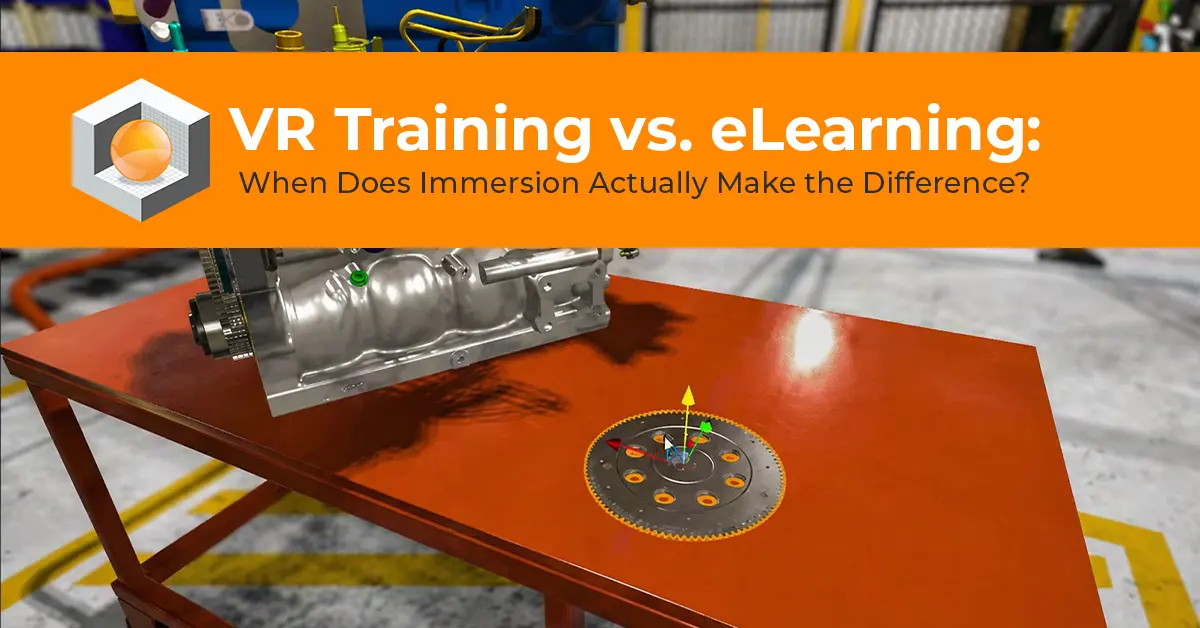
Here is a pattern familiar to most L&D directors: a new compliance or skills training requirement arrives, an eLearning module is commissioned, completion rates hit 90 percent, and three months later, a post-training assessment reveals that fewer than a quarter of employees can demonstrate the required competency under real conditions. The content was correct. The platform worked fine. The problem is that the format was never designed to produce the outcome being measured.
The question being debated in procurement meetings and L&D strategy reviews across manufacturing floors, clinical networks, and energy sector operations is no longer whether VR-based training is viable. That argument was settled by a body of deployment data accumulated across the past decade. The question now is more precise: for which training objectives does immersion produce measurably better outcomes than an eLearning module, and where does it not? Answering that question correctly is the difference between a technology investment that transforms workforce capability and one that generates impressive demonstration sessions but delivers no operational change.
This article addresses that decision directly. It is written for organizations that already have functional eLearning infrastructure and are evaluating where, and whether, VR-based simulation belongs alongside it.
What eLearning Does Well, and Where It Reaches Its Limit
eLearning solved a real and persistent problem in enterprise training: it made consistent, standardized content delivery possible at scale without requiring physical infrastructure, travel logistics, or instructor availability. For organizations managing hundreds or thousands of geographically distributed employees, that was a significant operational gain. The format works well for knowledge transfer that can be assessed through recognition and recall.
Regulatory compliance orientation, software feature familiarization, policy acknowledgment, and foundational theoretical knowledge are all appropriate applications. When the measurable outcome is “does this employee know the rule” rather than “can this employee execute the procedure under pressure,” eLearning performs adequately and cost-efficiently.
The limit emerges precisely at the point where knowing and doing diverge. Research on knowledge retention consistently demonstrates that passive consumption of digital content, regardless of how well-designed the interface is, produces short-term recall that degrades sharply without reinforcement. A PwC study examining immersive versus digital learning cohorts found that learners in VR-based environments were four times more focused than eLearning counterparts and retained confidence in skill application at nearly double the rate after one week. That retention gap matters enormously when the skill being trained has operational consequences.
The structural reason for this gap is not primarily about engagement or interactivity features. It is about how the brain consolidates learning that requires physical, spatial, or decision-based performance. Passive content delivery, no matter how gamified, does not engage the neural pathways that govern procedural memory and psychomotor skill acquisition. Immersive simulation does. Understanding that difference is the foundation of any rational format selection decision.
Three Training Scenarios Where Immersion Changes Outcomes
Not every training requirement benefits equally from a shift to immersive formats. The performance gap between eLearning and VR-based training is not uniform across all content types. It concentrates in three specific categories of training need.
Procedural and Psychomotor Skills
Any task that requires physical sequencing, tool handling, or spatial orientation to perform correctly falls into this category. Equipment inspection routines, maintenance procedures on industrial machinery, surgical instrument protocols, and emergency response sequences are representative examples. The defining characteristic is that the procedure cannot be adequately learned through observation alone because its successful execution depends on developing conditioned motor responses through repeated, consequential practice.
eLearning can present the correct steps in order. It can show the animation of a valve being isolated under a lockout/tagout procedure. What it cannot produce is the muscle-memory loop that allows an operator to complete that procedure correctly under time pressure, in low visibility, or when cognitive load is high from simultaneous alarm conditions. VR simulation creates that loop because the trainee physically enacts the procedure, makes errors within the simulation, and repeats until the movement sequence is automatic.
This is the core mechanism behind the documented results in health and safety training delivered through VR simulation: retention is not improved because the content is better presented, but because the learner’s nervous system has encoded the procedure through active physical repetition in a consequential context.
High-Stakes Decision-Making Under Pressure
Decision-making under pressure is a distinct cognitive skill from knowing the correct decision in a calm, reflective state. Emergency coordinators, supervisors managing chemical plant upset conditions, clinicians responding to patient deterioration, and safety officers assessing a multi-hazard construction environment all operate in conditions where the limiting factor is not informational but psychological. They must maintain cognitive function, prioritize correctly, and execute procedures while stress hormones are active and the environment is changing.
Training that emotional-cognitive state requires inducing it in a controlled environment. This is what VR simulation achieves through environmental fidelity, time pressure mechanics, and consequence signaling. An eLearning scenario can present the decision tree. It cannot replicate the physiological experience of making decisions when alarms are sounding and the scenario is evolving. Deployment data from high-consequence sectors consistently shows that personnel who have trained in immersive simulations perform more accurately and with shorter response latency under real emergency conditions than those trained exclusively through classroom or digital formats.
Hazard Recognition and Spatial Awareness
Hazard identification is the foundational skill underlying most health, safety, and environment training programs. It is also consistently the competency that eLearning fails to transfer to the real environment most completely. The reason is structural: a photograph or video of a hazardous situation is a two-dimensional representation. The actual skill being trained requires a three-dimensional perceptual process, scanning an environment spatially, assessing depth and proximity, identifying hazards that are partially obscured or exist in peripheral vision.
Immersive VR simulation trains that spatial scanning behavior directly. The trainee moves through a virtual environment and must actively search for hazards using the same physical head and body movements they would use on a real site. Studies examining safety training outcomes consistently find that this active spatial training transfers to real environments at measurably higher rates than passive video-based observation. The evidence basis for how VR training reduces workplace accidents through improved hazard recognition is among the most thoroughly documented in the immersive learning literature.
Technical Note
In immersive HSE simulations, the sequencing of hazard placement matters more than the number of hazards present. Practitioners designing risk-hunt environments typically cluster hazards in a way that forces the learner to complete a full spatial scan rather than allowing focal-point fixation. A simulation with eight well-placed hazards that require the trainee to look up, crouch, and move around obstacles will transfer significantly better than one with twenty hazards visible from a single standing position. This design principle is derived from perceptual learning research and is consistently validated in post-training assessment scores.
The Learning Science Behind the Retention Gap
The performance difference between immersive and passive training formats is not attributable to novelty effects or higher learner motivation, though both contribute to initial engagement. The underlying mechanism is neurological. Immersive simulation activates what cognitive scientists call embodied learning: the encoding of knowledge through physical interaction with an environment rather than through symbolic or representational processing.
When a learner physically executes a procedure, the brain encodes the experience across multiple memory systems simultaneously. Declarative memory stores the rule. Procedural memory encodes the movement sequence. Episodic memory records the experience of performing the task, including the emotional state and the environmental context. This multi-channel encoding is what produces the retention figures that distinguish VR-based training from eLearning in longitudinal assessments. Learning that is encoded episodically and procedurally degrades more slowly and is more readily accessed under the high-load conditions of real performance.
A frequently cited comparison from enterprise deployment studies shows that eLearning produces roughly 20 percent knowledge retention one week after training. Instructor-led classroom formats improve that figure to approximately 50 percent. Immersive VR environments consistently measure retention above 70 percent at the same interval, with some studies in high-fidelity simulation environments reporting figures above 80 percent at the one-year mark. These are not marginal improvements. They represent a categorical difference in what the training investment actually produces.
The practical implication is that for training objectives where post-training retention and real-world application matter, the effective cost per retained competency is often lower for VR-based simulation than for eLearning, despite the higher initial content development investment. Organizations that calculate training ROI at the point of content delivery rather than at the point of verified competency frequently underestimate the cost of eLearning and overestimate the cost of immersive training.
A Decision Framework: Matching Format to Training Outcome
The most productive starting point for format selection is not the question of which technology is more advanced, but what the training outcome actually requires of the learner’s nervous system. That framing produces a more reliable selection process than comparing feature lists or demonstration experiences.
Training objectives that require any of the following are strong candidates for immersive simulation:
– Repeated physical execution of a procedure until it becomes automatic
– Decision-making accuracy maintained under stress, time pressure, or sensory overload
– Spatial navigation, environment scanning, or three-dimensional hazard recognition
– Exposure to scenarios that are dangerous, costly, or impossible to replicate safely with real equipment
– Cross-site consistency in high-stakes procedural training without bringing equipment offline
The concept that captures several of these criteria together is the DICE framework, which defines training scenarios as candidates for immersive technology when they are Dangerous, Impossible, Costly, or Error-Prone to conduct in a live environment. A detailed examination of how immersive training addresses Dangerous, Impossible, Costly, or Error-Prone training scenarios provides a structured lens for evaluating any training program against this framework.
Training objectives that are well-served by eLearning share a different profile: the competency being developed is primarily informational, the assessment can be administered through recognition or recall tasks, repetition is not required for real-world performance, and the content does not require spatial or physical interaction. Policy acknowledgment, regulatory orientation, product knowledge, and foundational certification preparation typically fall here.
A third category exists where neither format alone is optimal: training programs that require both theoretical grounding and procedural application. In these cases, a blended architecture frequently produces the best outcome. eLearning delivers the conceptual and regulatory foundation; immersive simulation then provides the environment to apply and consolidate that knowledge under realistic conditions.
When eLearning Remains the Right Tool
Arguing for VR-based training where eLearning is appropriate is as problematic as arguing against it where VR is clearly necessary. Both errors produce waste. The organizations that extract the most value from immersive training investment are those that have been precise about which portions of their training architecture require it and which do not.
eLearning retains clear advantages in several practical dimensions. Content maintenance for regulatory updates is substantially easier in an eLearning environment than in a simulation that requires three-dimensional environment reconstruction. Rapid onboarding content for high-turnover roles where theoretical orientation is the primary need is efficiently served by digital modules. Global deployment of policy and compliance content, where the measurable standard is acknowledgment rather than demonstrated competency, continues to justify eLearning infrastructure.
Even within the domain of experiential training, certain soft skills programs can be effectively delivered through scenario-based eLearning when the behavioral competency being developed is not dependent on spatial presence. That said, the evidence from enterprise deployments of soft skills and leadership training in VR environments increasingly demonstrates that immersive formats produce measurably higher behavioral change in high-complexity interpersonal scenarios, particularly those involving difficult conversations, crisis communication, or team coordination under pressure.
The key distinction is whether the training objective requires the learner to be present in an environment, or simply to process information about one. That single question resolves the majority of format selection decisions without requiring a lengthy procurement evaluation.
Expert Note
One of the most consistent findings from multi-format training deployments is that organizations which introduce VR simulation without completing eLearning prerequisite content first see a measurable drop in simulation performance. The simulation environment assumes a baseline of conceptual knowledge: trainees who enter a virtual confined-space scenario without understanding atmospheric hazard categories make fundamentally different errors than those who do. A well-sequenced blended architecture treats eLearning as the entry requirement for simulation, not a parallel alternative to it. This sequencing decision is often overlooked in technology procurement discussions but is consistently one of the highest-impact configuration choices in actual deployment.
The Hidden Costs of Getting the Format Wrong
Choosing eLearning for a training objective that requires immersive practice does not produce neutral results. It produces invisible costs that accumulate across incident rates, retraining cycles, and operational error rates that are rarely attributed to the training format because the causal chain is not direct.
When a procedural safety skill is trained exclusively through digital content and the trained behavior does not transfer to the real environment under stress, the organization experiences the cost in the form of near-misses, incidents, and corrective actions. These events are investigated as operational or behavioral failures. The training program is recorded as completed with high compliance. The connection between the format limitation and the outcome failure is rarely captured in any reporting system.
The second category of hidden cost is retraining. Organizations that rely on annual compliance eLearning cycles for skills that decay without practice are effectively retraining the same content indefinitely without improving baseline competency. The cumulative cost of repeated eLearning modules that produce 20-percent retention can, over a five-year period, substantially exceed the cost of a single well-designed immersive training program that produces durable competency after two to three practice sessions.
Understanding these dynamics is essential context for any organization evaluating whether VR-based training is cost-justifiable. The relevant comparison is not the development cost of an immersive simulation against the licensing cost of an eLearning module. It is the total cost of achieving and maintaining the required competency over time, including the operational consequences of the gap when competency is not achieved.
Frequently Asked Questions
Is VR training more effective than eLearning for all types of content?
No. VR-based simulation produces significantly better outcomes for training objectives that require physical execution, spatial awareness, or decision-making under pressure. For content where the measurable objective is knowledge recall, regulatory acknowledgment, or foundational orientation, eLearning remains a cost-efficient and adequate format. The key is matching the format to what the competency actually requires of the learner, not defaulting to either technology across all content types.
How long does it take employees to complete VR training versus eLearning?
Completion times vary widely depending on the scenario complexity and the number of required repetitions, but enterprise deployments consistently show that VR training produces proficiency in procedural tasks up to four times faster than traditional methods. For skills that require practice until automatic, a well-designed simulation session of 20 to 40 minutes can replace multiple hours of classroom instruction combined with supervised practice time on live equipment.
Can VR training and eLearning be used together in the same programme?
Yes, and blended architectures typically outperform either format used alone for complex training programmes. The most effective sequencing uses eLearning to deliver the conceptual and regulatory foundation, then moves learners into VR simulation to apply and consolidate that knowledge under realistic conditions. This approach ensures trainees enter the simulation with the baseline knowledge required to make meaningful errors and learn from them, which is where the retention advantage of immersive training is produced.
What is the ROI of VR training compared to eLearning?
At small trainee volumes, eLearning has lower upfront cost. However, once deployment scales beyond several hundred learners, or once the cost of retained competency is used as the measurement standard rather than completion cost, immersive training consistently demonstrates stronger financial performance. Enterprise organizations deploying VR training at scale have reported average ROI exceeding 200 percent, with full payback periods under six months when reduced incident costs, retraining cycles, and faster time-to-competency are factored in.
How do I know if my current training content is a candidate for VR simulation?
Apply the following test to each training objective: Does successful real-world performance require physical execution, spatial navigation, or decision-making under stress? Does the current training format produce consistent competency that holds under operational conditions? Is the consequence of competency failure a safety incident, quality failure, or material operational error? If the answer to any of these is yes, the content is a strong candidate for evaluation as an immersive simulation scenario.
Choosing the Right Format Before Commissioning Content You Cannot Use
The practical takeaways from the evidence reviewed here resolve into three operational principles. First, format selection should follow a clear-eyed analysis of what real-world competency requires of the learner, not of what is most convenient to develop or deploy. Second, eLearning and VR-based simulation serve different competency development functions and are most powerful when sequenced together in a deliberate architecture. Third, the full cost of any training format must include the cost of competency failure in the real environment, not just the cost of content production and delivery.
Organizations that apply these principles consistently tend to build training architectures that are leaner overall, because they stop commissioning eLearning for objectives that eLearning cannot achieve, and they stop deferring VR investment for scenarios where the cost of the alternative is already being paid in operational incidents.
The direction of the field is toward increasingly granular assessment of competency transfer rather than completion rates, and toward training architectures that specify the format at the objective level rather than at the programme level. Organizations building those capabilities now are developing an institutional competency in workforce development that will compound in value as training requirements continue to grow in technical complexity.
How RoT STUDIO Approaches This
At RoT STUDIO, format selection decisions are built into the earliest stage of every client engagement. Before a single simulation scenario is designed, the team conducts a structured analysis of training objectives, the competencies required for real-world performance, and the points at which current training formats are producing verifiable gaps. That process determines not only whether VR simulation is appropriate, but what type of immersive experience the objective requires.
The RoT STUDIO License provides organizations with a no-code platform for building and maintaining their own VR training content, making it possible to develop and update simulations at the pace that operational change requires, without external development dependencies for every content iteration. For organizations that need ready-validated simulation content immediately, the VR Training Catalogue provides a library of proven scenarios across HSE, healthcare, manufacturing, energy, and HR contexts, deployable without a custom development cycle.
Where training scenarios require custom simulation design, RoT STUDIO’s engineering and 3D development legacy, rooted in infoTRON’s two decades of industrial 3D work, means that complex procedural environments are built from genuine domain knowledge rather than generalized game design practice. Haptic feedback integration for procedures requiring force-feedback realism, multi-site deployment architecture, and ongoing content maintenance are part of the delivery model, not add-ons negotiated separately after implementation.
The European headquarters at High Tech Campus Eindhoven (3EALITY) positions RoT STUDIO within one of the continent’s most active innovation ecosystems for industrial technology. That proximity, combined with active deployments across manufacturing, healthcare, energy, transportation, and aerospace, means that the team’s assessment of where immersive training creates measurable operational value is grounded in current field experience rather than theoretical frameworks. For organizations evaluating their training architecture, a structured conversation with that team is a practical starting point.