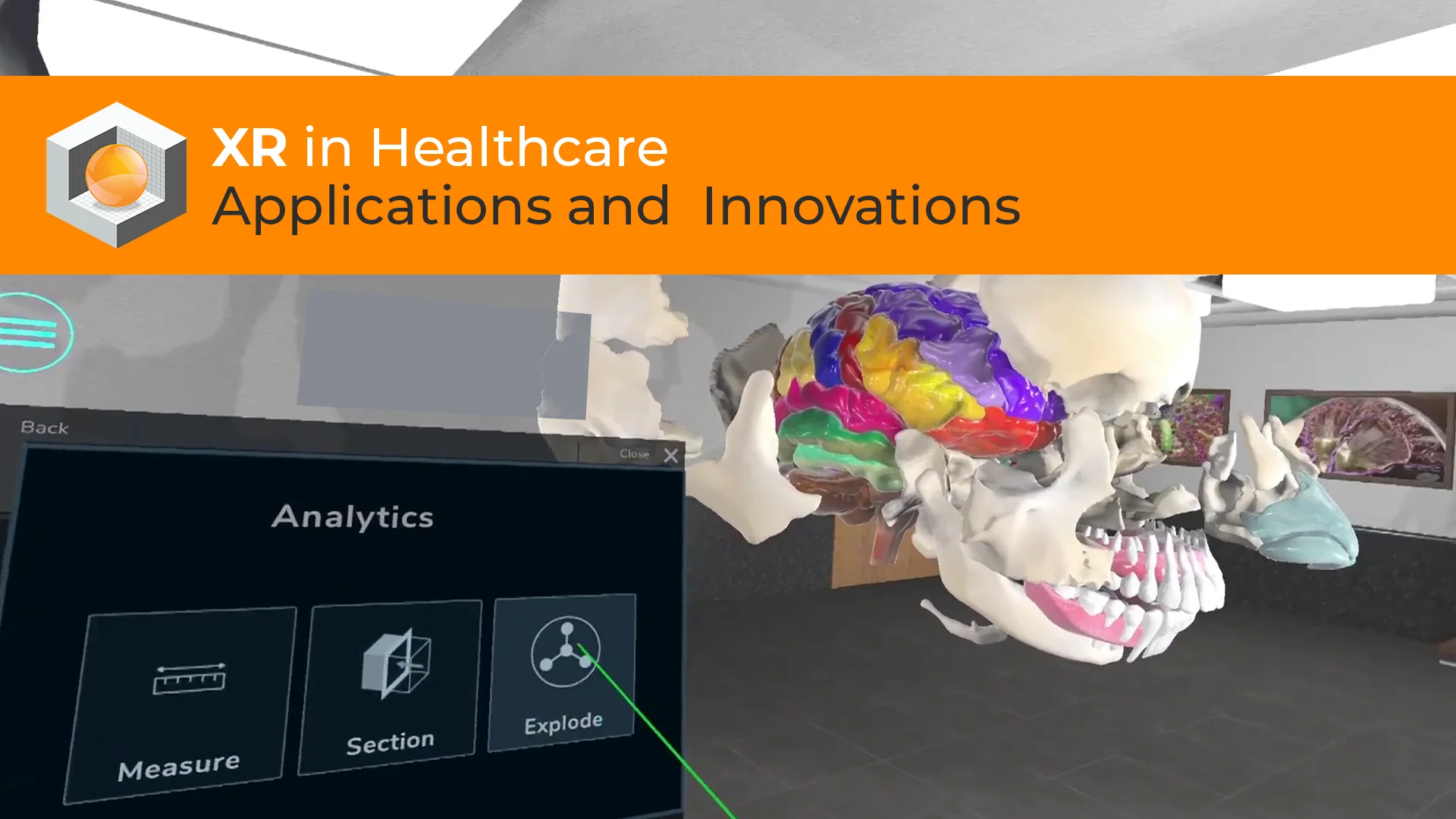
Extended Reality (XR) in Healthcare has moved from “nice-to-have visualization” into a pragmatic, measurable capability that can improve training throughput, procedural planning confidence, remote collaboration, and patient engagement—when implemented with the same rigor used for clinical IT and medical devices. XR is not one modality; it is the umbrella for augmented reality (AR), virtual reality (VR), and mixed reality (MR), spanning the reality–virtuality continuum that ranges from fully physical to fully virtual experiences.
Across hospitals, medical schools, and device manufacturers, adoption is being driven by persistent capacity constraints (training slots, simulators, expert time), the push toward standardized competency measurement, and the maturation of enabling technologies: high-resolution headsets, eye/hand tracking, haptics, cloud rendering, and improved healthcare interoperability patterns (DICOM for imaging, FHIR for clinical data exchange).
For XR initiatives that touch diagnosis, treatment planning, intraoperative guidance, or patient-facing therapy, regulatory classification, clinical validation, cybersecurity, and privacy are not optional—XR becomes part of the safety case and, in some contexts, may qualify as Software as a Medical Device (SaMD) or medical device software under regional rules.
This is where engineering-grade digital workflows become a differentiator. RoT STUDIO, rooted in infoTRON (described as Türkiye’s pioneer in 3D technologies and digital engineering solutions since 1994), positions XR not as a one-off app but as an integrated pipeline, linking CAD/CAM/CAE, VR/AR platforms, industrial 3D printing, and engineering & R&D workflows across multiple industries, including healthcare. RoT STUDIO’s healthcare offerings include a no-code XR/VR training platform (RoT STUDIO License), customized VR/XR services, and ready-made healthcare training modules—plus haptics-enabled surgical simulation capabilities.
What XR in Healthcare Means
XR is best understood as a continuum of experiences that blend digital content with the physical world to varying degrees—rather than a single technology. A widely used framing comes from the reality–virtuality continuum, which positions AR closer to the “real” end, VR at the “virtual” end, and MR in between as a class of mixed displays and interactions. In parallel, major XR standards bodies describe XR as inclusive of VR, AR, and MR, defining common interfaces to support cross-device runtime portability.
Definitions that matter operationally
Virtual reality (VR) places the user in a fully computer-generated environment. In healthcare, VR is most commonly applied to training, simulation, rehabilitation, and patient-facing therapeutic experiences where full immersion is beneficial and physical surroundings are not required.
Augmented reality (AR) overlays digital information onto the user’s view of the real world—often on mobile devices or head-mounted displays. In healthcare, AR is frequently linked to guidance, checklists, visualization overlays, and remote telementoring where seeing the physical scene is essential.
Mixed reality (MR) blends physical and digital worlds in a way that supports more spatially anchored, interactive content that “coexists” with the environment. Some technical ecosystems define MR as a specific interaction model enabled by computer vision, environmental understanding, and advanced input systems.
Market trends and growth
Market sizing for “XR in healthcare” varies significantly because analysts include different subsegments (training vs therapy vs surgical navigation vs “metaverse” categories), and because the boundary between XR software, digital therapeutics, and medical devices is not consistent across regions. As a result, executives should interpret growth figures as directional indicators rather than precise budgeting anchors.
Even with those constraints, multiple industry analyses point to rapid growth across healthcare XR categories through the late 2020s and early 2030s. Some estimates place the healthcare-focused XR market in the single-digit billions in the mid-2020s, with forecasts projecting multi-fold expansion over the next decade.
Key adoption drivers
Clinical and operational demand signals consistently cluster in five themes.
First, workforce capacity constraints and the need for competency-based training push institutions toward scalable simulation. Peer-reviewed syntheses increasingly support VR’s impact in healthcare education and procedural training, although effect sizes and study quality vary by specialty and intervention design.
Second, the shift to digital care and remote collaboration has normalized virtual workflows. Global guidance highlights telemedicine implementation as a health system capability, and AR-based real-time telementoring literature shows increasing experimentation with remote support models.
Third, hardware improvements are reducing friction: higher-resolution displays, better passthrough, richer sensor suites, and improved latency characteristics.
Fourth, regulators have moved from “novelty awareness” to more structured signaling—publishing lists and considerations for AR/VR medical devices, and continuing to update cybersecurity expectations for connected, software-driven products.
Fifth, digital engineering concepts (digital twins, simulation, CAD/CAM/CAE-to-visualization pipelines) are increasingly applied to healthcare, enabling patient-specific planning, device development, and training environments derived from imaging data.
Applications and innovations in clinical and operational workflows
XR’s healthcare value is easiest to evaluate when mapped to discrete workflows with measurable outputs: time, error rate, exposure, throughput, adherence, or clinical outcomes. What follows is an application taxonomy aligned to how hospitals and medical technology teams typically budget and govern change.
Surgical planning and patient-specific visualization
XR can turn preoperative planning into a spatial task rather than a mental reconstruction of 2D images. The most mature approach combines imaging-derived 3D models (typically from CT/MRI) with interactive 3D review—either on screens, in VR, or in MR—so teams can explore anatomy, pathology, and implant or approach options. RoT STUDIO underscores CT/MRI-derived realism in its healthcare training positioning, reflecting the broader industry movement toward data-accurate models.
The next innovation layer is the medical digital twin concept—patient-specific digital replicas used to inform decisions. Reviews propose definitions and frameworks for “patient digital twins,” emphasizing multidimensional patient-specific information that informs decisions, while also acknowledging feasibility limits and ongoing research gaps.
Where 3D printing is available, physical anatomical models or procedure-specific components can complement XR visualization—especially for complex geometry or team briefings. Regulatory guidance outlines technical considerations for additively manufactured medical devices and is relevant when models become patient-matched devices or guides rather than simple educational artifacts.
Intraoperative guidance and navigation
AR and MR are most compelling in the operating room when they reduce cognitive load (fewer attention shifts) or improve spatial localization without introducing unacceptable risk. In spine procedures, for example, augmented reality navigation systems have received regulatory authorizations describing AR guidance as an aid for locating anatomical structures in surgery.
In orthopedics, mixed-reality guidance systems for arthroplasty have also received marketing authorizations, and public regulatory listings document such devices in the U.S. market.
The innovation frontier is not merely “put a hologram in the OR.” It is robust registration (aligning model to patient), integration with validated navigation systems, workflow resilience, and human factors design—especially under constraints such as sterile fields, lighting, and team coordination. Recent clinical literature continues to assess mixed reality’s translational path and limitations, highlighting that broader adoption depends on validation, usability, and infrastructure maturity.
Medical training and simulation
VR’s most consistent near-term ROI is in workforce development because controlled repetition is difficult to achieve with live cases. Systematic reviews and meta-analyses increasingly report that VR-based healthcare education improves learning outcomes compared to conventional approaches in many contexts, including nursing and surgical education—while also noting heterogeneity and varying implementation quality.
Haptics is the major “fidelity upgrade” for procedural skills; controlled studies show improved task performance when VR simulation includes haptic feedback versus visual-only approaches for certain tasks. This aligns directly with RoT STUDIO’s emphasis on visio-haptic capabilities for surgical training, where force-feedback is positioned as a key mechanism for realistic motor learning.
RoT STUDIO’s healthcare training portfolio reflects several high-value training domains: anatomy modules, catheterization procedure training, nursing training scenarios, and an ophthalmic surgery simulator, supported by both catalog offerings and bespoke content development services.
Rehabilitation and therapy
VR-supported rehabilitation spans in-clinic and home-based models. Evidence synthesis is nuanced: some high-quality reviews conclude benefits may be modest or context-dependent, while newer umbrella reviews and specialty reviews report “promising” outcomes for stroke rehabilitation, particularly for motor recovery when integrated with conventional therapy.
For chronic pain, VR-based therapeutic programs have moved into regulated digital health territory. A De Novo authorization letter describes an immersive VR device intended for in-home reduction of pain and pain interference associated with chronic lower back pain, illustrating how XR can cross the threshold from “engagement tool” into regulated therapy.
From an operational perspective, therapy-grade XR must be evaluated like any other intervention: eligibility criteria, contraindications, adverse-event monitoring, and integration with clinical oversight. Regulatory materials also caution about risks and limitations of AR/VR in healthcare, including population-specific vulnerabilities and informed consent considerations.
Diagnostics and imaging collaboration
XR is not replacing PACS workstations; it augments how teams understand spatial relationships, especially for complex anatomy, surgical decision-making, or multidisciplinary conferences. A practical pattern is: imaging stored and transmitted via the DICOM standard, optionally accessed through web-based services (DICOMweb), and then transformed into 3D representations for XR visualization.
Clinical-grade use requires traceability: where the model came from, segmentation confidence, versioning, and whether the XR experience is “for information only” or is influencing a treatment decision (which can have regulatory consequences). Software qualification and classification guidance in the EU explicitly targets medical software manufacturers and provides frameworks for determining scope and class.
Telemedicine and remote care
XR can elevate telemedicine from “video visit” to “guided action” when remote expertise is needed. Literature reviews summarize AR use in real-time telemedicine and telementoring, documenting clinical experimentation with overlays, remote annotation, and guided procedures, while also identifying constraints such as connectivity, usability, and workflow integration.
At the health-system level, telemedicine guidance emphasizes implementation fundamentals—service design, governance, indicators, and operational maturity—creating a policy and operational foundation that XR-enabled remote services must still satisfy.
Technical enablers and interoperability
XR in healthcare is not “headsets + content.” Sustainable programs require an end-to-end pipeline: device strategy, content production, data integration, identity and access management, device management, analytics, and lifecycle updates. In healthcare, the strongest XR deployments function like engineered products—versioned, validated, and integrated.
Hardware building blocks
Current healthcare XR deployments typically use three hardware patterns.
Standalone VR headsets prioritize scalability and cost, supporting training and therapy at volume. Vendor specifications for mixed reality-capable standalone devices highlight display resolution and passthrough features that enable hybrid experiences.
Spatial computing / high-fidelity MR devices emphasize sensor richness, low latency, and high-resolution displays for “passthrough + digital” work, which can support advanced visualization and collaboration scenarios.
Enterprise AR/MR headsets focus on see-through optics, environmental understanding, and hands-free workflows; official documentation lists headset hardware characteristics relevant to field deployment and safety cases.
For simulator-grade fidelity, high-end headsets can offer wider field-of-view and high pixels-per-degree characteristics, which matter when reading fine labels, interpreting depth cues, or performing precision tasks in simulation environments.
Software platform and standards
Cross-platform portability reduces vendor lock-in and accelerates iteration. A core enabler is OpenXR: an open standard that defines APIs for XR applications across multiple devices, positioning the runtime as the interface layer between apps and headset ecosystems.
CAD/CAM/CAE and “digital engineering” integration
Healthcare XR increasingly intersects with engineering-grade workflows:
- CAD supports device design, surgical-tool modeling, and training environments for complex medical equipment.
- CAE can support simulation and “what-if” analysis (for example, stress behavior in device components, or computational models used in preoperative evaluation where applicable).
- CAM and industrial 3D printing enable physical artifacts—models, guides, fixtures—when validated and appropriate.
RoT STUDIO’s positioning explicitly emphasizes experience integrating CAD/CAM/CAE systems, VR/AR platforms, and industrial 3D printing into mission-critical workflows across industries including healthcare, reflecting a capacity to bridge clinical needs with engineering implementation discipline.
Data interoperability blueprint
Healthcare XR that uses clinical data must fit into existing interoperability realities:
- Imaging: DICOM remains the core standard for transmission, storage, and display of medical imaging; DICOMweb provides RESTful services for web-based access.
- Clinical data exchange: FHIR is a standard for exchanging healthcare information electronically and is widely used as a modern API-layer approach.
An XR “clinical integration” architecture commonly requires explicit mapping of data sources (PACS, EHR, LMS, device logs), patient identity constraints, and auditability—especially when experiences influence care decisions.
Regulation, Security, and Privacy
XR programs fail when they treat compliance as “paperwork at the end.” In healthcare, compliance is part of system design.
When XR becomes a regulated medical device
If XR software is intended for a medical purpose—diagnosis, treatment, mitigation, or driving clinical management—it can fall into SaMD or medical device software categories. Regulators define SaMD based on medical purposes performed by software without being part of a hardware medical device, and provide risk-based approaches for categorization.
In Europe, guidance exists specifically to support qualification and classification of software under the medical device regulations, emphasizing that classification depends on intended purpose and risk rules.
In the U.S., regulators have published AR/VR resources, including a list intended to identify AR/VR medical devices authorized for marketing and “questions to consider” for stakeholders.
Privacy requirements
XR devices can capture sensitive data (video passthrough, spatial mapping, eye tracking, audio). In the U.S., the Privacy Rule and Security Rule establish national standards for protected health information, including electronic PHI safeguards.
In Europe and other GDPR-aligned contexts, health data is treated as special category personal data with stricter conditions, affecting lawful basis, consent models, and data protection impact assessment expectations.
Cybersecurity and safety
Modern XR programs should assume “connected by default.” Device cybersecurity is not only IT risk; it can become patient-safety risk. Regulatory guidance in the U.S. recommends cybersecurity documentation in submissions based on cybersecurity risks and promotes total product lifecycle considerations.
Healthcare entities often operationalize security programs using practical mappings and controls guidance (for example, security guidance written to help entities safeguard ePHI and understand HIPAA Security Rule concepts).
A practical compliance checklist for XR in Healthcare
The following items are frequently “make-or-break” in executive approvals:
- Clear intended use statements (training vs clinical decision support vs therapy) mapped to regulatory pathways.
- Data classification: PHI/ePHI presence, special category data triggers, retention rules, and de-identification approach when applicable.
- Device management: patching, remote wipe, kiosk mode where needed, and clear policies for shared headset hygiene and access.
- Clinical risk management aligned to medical device risk principles when the product is regulated or safety-critical.
- Cybersecurity documentation aligned to current expectations for software-enabled devices and connected systems.
Implementation roadmap and procurement strategy
The most reliable XR programs treat implementation as a staged transformation with explicit success metrics, not a single procurement event. The roadmap below is written for healthcare executives, clinical leaders, and medical technologists who need clarity on sequencing, governance, and ROI measurement.
Needs assessment and use case selection
A healthcare XR program should start with a constrained set of “high-friction, high-cost, high-risk” workflows where XR has a credible mechanism to improve outcomes. Typical priority candidates include:
- High-acuity training bottlenecks (OR onboarding, rare complications, device setup procedures).
- Procedures where spatial planning is complex and time is expensive (complex anatomy, multidisciplinary planning).
- Rehab programs with adherence challenges, especially where remote care is strategic.
At this stage, the details of content scope, target users, and modalities should be treated as unspecified until stakeholder interviews and workflow observation confirm requirements.
Pilot design and integration into existing workflows
Pilot programs often fail because XR is added as a “parallel universe.” Sustainable pilots integrate with what organizations already use:
- LMS integration for training assignments and completion tracking.
- Credentialing and competency frameworks for measurable skill gates.
- PACS/EHR integration if patient data, imaging, or planning artifacts are used—often via DICOM/DICOMweb and FHIR patterns.
RoT STUDIO’s no-code platform positioning is relevant here: content ownership, rapid updates, and internal enablement reduce the “custom development bottleneck” that often stalls pilots after initial enthusiasm.
ROI metrics that executives can defend
XR ROI should be tracked with a balanced scorecard rather than a single financial metric. Commonly defensible metrics include:
Training and workforce metrics: – Time-to-competency reductions (measured by standardized assessments).
– Fewer supervised repetitions required before independent performance (specialty-dependent; may be unspecified until measured).
– Improved procedural task performance where validated (particularly when simulation includes haptics).
Clinical and operational metrics: – Reduced procedure variability (requires careful study design; typically unspecified until validated locally).
– Reduced rework or late-stage changes for device setup or equipment workflows (often strongest in device manufacturer contexts).
– Improved patient engagement or adherence for therapy programs (dependent on intervention design).
Procurement and scaling
Procurement should be structured around the reality that XR is a platform investment:
- Headsets and peripherals (including cleaning/hygiene infrastructure).
- Content creation capability (internal, vendor-built, or hybrid).
- Device management and security controls.
- Analytics and integration costs.
Because interoperability and portability are recurring pain points, platform strategies that incorporate cross-platform standards can reduce long-term migration costs.
RoT STUDIO perspective, case studies, and future outlook
A key decision for healthcare leaders is whether XR will remain a set of isolated “apps” or evolve into an institutional capability. RoT STUDIO’s positioning is aligned to the second approach: it frames XR through training platforms, bespoke development, and engineering-grade workflows, backed by a parent-company heritage in digital engineering integration.
RoT STUDIO services mapped to healthcare XR needs
RoT STUDIO License is described as a no-code VR solution for creating, managing, and deploying immersive training content with drag-and-drop workflows, and also includes an immersive 3D environment review capability (“Designer Module”) plus a “Trainer Module” for training authoring and deployment. This architecture maps naturally to hospital training teams and medical schools that need iterative scenario updates without long vendor cycles.
Customized VR/XR Services are positioned as tailored content/training creation based on organizational needs, with benefits such as real-time feedback and scalable deployment.
RoT Healthcare is presented as a healthcare-focused offering that develops bespoke VR/XR surgical training solutions (including laparoscopic and other scenarios), uses CT/MRI-derived data to support realism, and supports training for complex OR equipment and biomedical teams.
Haptics is presented as a visio-haptic feature providing realistic force feedback for surgical training scenarios, including investigation of force values for eye-layer operations and development of actuator infrastructure.
Real-world case study signals
A published case study describes collaboration with Gazi University, Faculty of Medicine to integrate VR into anatomy education, describing it as Türkiye’s first interactive VR anatomy lesson and referencing use of a “Designer Module” for interactive 3D medical models intended to enhance comprehension and retention.
This matters strategically because it demonstrates a pattern: XR deployed not as a one-time visualization, but as a repeatable educational product with institutional adoption.

Hypothetical RoT STUDIO-aligned project examples
The following examples are illustrative. Specific clinical details, budgets, and outcome estimates are unspecified until discovery, clinical governance review, and local validation.
Patient-specific surgical planning workflow with XR and 3D printing
A tertiary hospital wants to reduce planning uncertainty and OR time for complex craniofacial reconstruction. The program could combine DICOM-derived anatomical segmentation, VR-based planning review, team rehearsal, and optional 3D printed anatomical models when appropriate. The engineering side would apply additive manufacturing technical considerations when outputs are patient-matched devices or guides, and would preserve traceability from imaging to model.
How RoT STUDIO fits: their positioning explicitly bridges XR with industrial 3D printing and engineering workflows, while their training platform supports repeatable rehearsal and instruction design.
Intraoperative AR guidance proof-of-value for spine navigation
A spine service line explores AR-guided navigation as an aid in locating anatomical structures in open/percutaneous procedures, aligned to existing regulatory indications for AR navigation systems. A pilot would prioritize workflow and usability validation, risk management, cybersecurity documentation, and integration into sterile workflow protocols.
How RoT STUDIO fits: beyond content development, their engineering heritage (CAD/CAM/CAE integration) could support accurate 3D content pipelines and structured development artifacts (requirements, verification, usability testing) needed in regulated contexts.
Therapeutic VR program for chronic pain or post-discharge rehab
A health system wants a home-based VR adjunct program for chronic pain management or post-stroke rehabilitation, aligned to telemedicine expansion. The design would incorporate clinical screening, monitoring, and outcomes collection, acknowledging that some VR therapeutic products have regulatory authorizations for pain indications and that evidence for rehab varies by domain.
How RoT STUDIO fits: their XR training orientation could be adapted for structured therapeutic education and engagement modules, while clinical partners would govern therapeutic claims and clinical pathways. (Therapeutic regulatory status and reimbursement pathways remain unspecified until product selection and jurisdiction-specific review.)
Barriers that must be managed
Cost and procurement complexity remains a top barrier, especially when total cost includes device management, content lifecycle, training time, analytics, and integration—not only headsets.
Clinical validation is a second barrier: training outcomes are easier to measure than patient outcomes, and intraoperative guidance requires stronger evidence, robust risk management, and workflow resilience.
User adoption and human factors are a third barrier: comfort, motion sickness, hygiene logistics, and perceived value can determine utilization rates more than technical capability.
Interoperability and data governance are a fourth barrier: XR experiences that use imaging or clinical data must align to DICOM/FHIR realities and to privacy and security constraints for sensitive health data.
Future innovations shaping XR in Healthcare
Several innovation clusters are converging:
- AI + XR for adaptive tutoring, automated performance feedback, and decision support overlays—raising both capability and regulatory complexity.
- Haptics as a realism multiplier for surgical simulation, where evidence supports benefits in certain tasks and where RoT STUDIO has explicit visio-haptic positioning.
- Cloud XR and edge rendering to deliver high-fidelity visuals without tethered workstation constraints (implementation details are typically vendor-specific and may be unspecified until architecture design).
- Digital twins and personalized medicine integrating imaging, physiology, and data architectures; peer-reviewed work proposes definitions and underscores both potential and translational challenges.