Ophthalmic surgery operates at a scale that has no parallel in most other specialties. The structures a surgeon manipulates — the corneal layers, the trabecular meshwork, the retinal surface — are measured in micrometers. The instruments enter spaces just millimeters wide. A hand tremor that would be inconsequential in abdominal surgery can cause irreversible damage inside an eye. And yet, for most of the history of ophthalmic surgical education, residents have been expected to develop these precision motor skills through a combination of wet lab animal models, occasional cadaveric practice, and live patient procedures supervised by senior surgeons. The inadequacy of that model has become increasingly difficult to defend. As the global demand for ophthalmic care accelerates and training time in operating rooms tightens, the gap between the skills residents need and the structured repetition they receive has turned into a structural problem — one that virtual reality simulation is uniquely positioned to address.
Training Problems in Ophthalmic Surgery
Ophthalmic surgery has always demanded an unusually long and structured learning curve. The surgical field is small, the operative movements are measured in fractions of a millimeter, and the consequences of an error — posterior capsular rupture during cataract surgery, misplaced sutures in corneal transplantation, incorrect pressure management in glaucoma procedures — are not always recoverable. Unlike many other surgical specialties where a trainee can develop technique progressively on larger anatomical structures before tackling delicate cases, ophthalmology residents move from theory directly to operating on the most sensitive tissue in the body.
Traditional training models carry significant limitations in this context. Postmortem porcine eyes have been the dominant wet lab material for decades, used across cataract, glaucoma, corneal, and strabismus training. But they come with real constraints: inconsistent tissue behavior compared to living human eyes, procurement and ethical complexity, high cost per session, and the logistical difficulty of scheduling consistent access. Synthetic eye models improve availability but still cannot replicate the full range of intraoperative conditions a surgeon will encounter in practice. Beyond materials, the core problem with the apprenticeship model in ophthalmology is its dependence on patient throughput. Residents practice when patients arrive and when the operating schedule allows — not on a structured competency progression.
There is also the issue of objective assessment. For much of ophthalmology’s training history, the evaluation of surgical skill has been subjective. An attending surgeon rates a resident’s performance based on observation, but without standardized metrics for tremor, efficiency of movement, instrument handling, or complication frequency, it is difficult to know whether a trainee is actually ready to operate independently. VR simulation changes this by generating objective, quantifiable performance data on every training session.
A Shrinking Surgeon Pipeline and a Widening Demand Curve
The pressures on ophthalmic surgical training do not exist in isolation — they are compounded by a widening workforce gap that makes accelerating competency development a genuine public health priority. Workforce modeling published in Ophthalmology in 2024 projects that U.S. ophthalmology supply will decline by approximately 12% by 2035 while demand increases by 24%, producing a projected adequacy rate of just 70% — placing ophthalmology among the two worst-served of 38 medical and surgical specialties studied. Globally, the picture is equally pressured. Between 2015 and 2020, UK ophthalmology outpatient attendance rose by 12% while the training workforce grew by only 2.3%, and a 2022 census found that 76% of NHS ophthalmology units lacked sufficient physician coverage to meet patient demand.
The arithmetic is straightforward: if the number of ophthalmologists entering the workforce each year cannot neutralize attrition, the only lever available is to make each training pathway more efficient and to ensure that the surgeons produced are fully competent from the day they operate independently. Extending training duration is not a viable solution under current systems. Reducing the quality of preparation would be clinically unacceptable. The answer lies in increasing the density of deliberate practice within the existing training window — and VR simulation is the mechanism that makes this possible.
In some training centers, this recognition has already been translated into formal policy. A global survey published in Scientific Reports in 2025 found that across 25 training centers in 12 countries, VR simulation has become a mandatory prerequisite for patient access, functioning as a kind of surgical license. Residents must demonstrate competency on the simulator before being permitted to perform procedures on live patients. The fact that this model is being adopted across such a range of institutional contexts is evidence that the field has moved well past the experimental phase.
How VR Ophthalmology Training Works
Recreating the Microscope Environment
The foundational challenge of building an ophthalmic VR simulator is fidelity — not just visual, but spatial. Ophthalmic surgery is performed under a surgical microscope, in a highly constrained three-dimensional workspace, using instruments with fulcrum mechanics that differ from anything a trainee has previously handled. The simulation system must reproduce the stereoscopic depth of a microscope’s view, the resistance and behavior of ocular tissue, the behavior of irrigation and aspiration dynamics, and the real-time consequences of instrument pressure and movement.
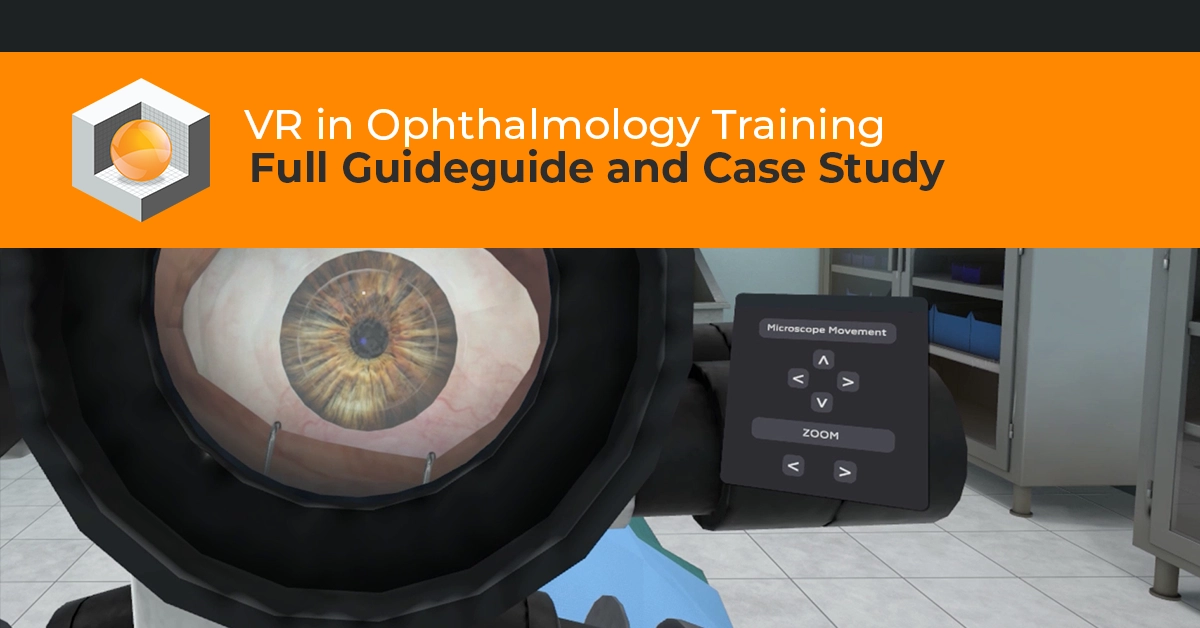
The most widely deployed systems in the field achieve this through a combination of physical and virtual elements: a mannequin head containing a model eye, through which the trainee inserts physical instruments, while a connected software environment tracks all movements and renders them within a virtual representation of the surgical field. The trainee sees a simulated microscope view while their hands interact with physical probes that communicate force, position, and trajectory to the system. Metrics captured in real time include instrument tremor, tissue contact time, surgical efficiency, complication incidence, and overall task scores — all of which can be reviewed after each session to guide targeted improvement.
Modular Procedure Coverage: From Anterior Segment to Vitreoretinal
Modern VR ophthalmic simulators are not single-procedure tools. They are modular platforms covering multiple phases of surgical education. At the anterior segment level, modules address capsulorhexis, phacoemulsification, irrigation and aspiration, cortical clean-up, and intraocular lens implantation. More advanced platforms have extended coverage to vitreoretinal procedures — simulating epiretinal membrane peeling, endolaser application on retinal breaks, core vitrectomy, and scleral buckling. Newer systems are also addressing glaucoma surgery, strabismus correction, and corneal transplantation procedures, areas that have historically been underserved by simulation technology.
The modular architecture matters for institutional deployment. Rather than requiring trainees to advance through a single linear curriculum, residency programs can prescribe specific modules based on where each trainee is in their clinical progression, and can design proficiency thresholds that gate access to the next level of complexity. This flexibility allows simulation to integrate into the training curriculum as a genuinely structured competency scaffold — not a one-time orientation experience.
Technical Note
One of the most persistent design challenges in ophthalmic surgical simulation is fluid dynamics. In real anterior segment surgery, changes in intraocular pressure cause shifts in anterior chamber depth, which affect instrument handling and increase the risk of specific complications. Most current VR systems do not model this behavior, which means trainees practicing on simulators may develop blind spots around pressure management. When evaluating simulation platforms, clinical educators should specifically ask whether fluid dynamics and anterior chamber response are modeled, not just visual fidelity. A visually convincing simulation that omits pressure physics can build partial skill sets.
Haptic Feedback and the Sensorimotor Challenge
Microsurgery is as much a tactile discipline as a visual one. Surgeons learn to feel the resistance of corneal tissue, the tension of a suture, the pressure threshold of entering an anterior chamber. In the absence of accurate tactile feedback, a simulator produces a visual rehearsal without a sensorimotor one and the motor memory that emerges will be incomplete.
This is where haptic feedback integration becomes one of the most technically demanding elements of high-fidelity ophthalmic simulation. The challenge is not simply adding a vibration response; it requires accurately modeling the variable stiffness of eye tissues, the fulcrum mechanics of instruments entering through small incisions, the pressure response of corneal and scleral tissue under different intraocular pressure conditions, and the tactile signal of correct versus incorrect suture tension. Some systems provide dual haptic engines that deliver differentiated feedback for different instrument types and tissue interactions — simulating, for example, the distinct resistance felt during incision creation versus tissue retraction.
Research published in Scientific Reports (2025) highlighted that a lack of haptic feedback measurably affects eye-hand coordination and the sense of embodiment in VR, reinforcing that the quality of tactile response is not an optional enhancement but a core training variable. For procedures like corneal transplantation, where suture placement precision directly determines post-operative astigmatism outcomes, training on a system that cannot deliver accurate tactile signals risks building inaccurate motor patterns that trainees will need to relearn under supervision in the operating room.
The maturation of haptic technology in ophthalmic simulation is therefore closely tied to the degree of real-world skill transfer that simulation produces. Platforms that combine high-quality visual rendering with physically accurate haptic response represent a significant step forward in bridging the gap between simulated and operative performance.
What the Clinical Evidence Shows
Reducing Intraoperative Complications
The most clinically meaningful test of VR simulation is not whether trainees score well on simulators, but whether those skills translate into better patient outcomes in the operating room. The evidence on this question has strengthened considerably over the past decade. A systematic review and meta-analysis published in Eye (2025), analyzing 17,623 eyes across seven studies, found a statistically significant reduction in posterior capsular rupture (PCR) — one of the most serious intraoperative complications in cataract surgery — among trainees who completed structured VR simulation before operating on patients, compared to those who did not. Posterior capsular rupture is directly linked to increased rates of visual loss, and reducing its incidence in trainee-operated cases represents a concrete patient safety benefit.
Earlier evidence from the BMC Medical Education scoping review (2024) found encouraging safety outcomes associated with VR simulator training for cataract surgery, with multiple studies reporting reduced complication rates and improved operating times among residents who had completed formal simulation curricula. Across the broader literature, the pattern is consistent: structured repetition on a validated simulator reduces the frequency of the specific errors that cause the most harm during a surgeon’s early operative cases.
Construct Validity: Does Simulator Skill Predict Operative Skill?
A training tool is only as useful as the degree to which performance on it correlates with real-world proficiency. Construct validity — the ability of a simulator to differentiate between operators of different skill levels — has been demonstrated repeatedly in ophthalmic simulation research. In multicentre studies, staff ophthalmologists consistently achieve significantly higher scores than senior residents, who score significantly higher than junior residents, who score significantly higher than medical students, on identical simulator protocols. The metrics that track this differentiation — total task time, instrument tremor, tissue contact quality, complication incidence — are the same metrics that distinguish novice from experienced surgeons in the operating room.
For skills that transfer across procedure types, the evidence is also accumulating. A 2024 study found that residents who had passed a phacoemulsification VR proficiency assessment subsequently performed better on their first attempt at a manual small-incision cataract surgery simulator, with advantages concentrated precisely in the steps analogous between the two procedure types. This cross-procedure skill transfer suggests that VR simulation is building fundamental microsurgical competencies — not just procedure-specific pattern matching.
Beyond the OR: Diagnostic and Pre-Procedural VR Applications
The scope of VR in ophthalmology training extends well beyond surgical skill development. In clinical settings, VR-based platforms are being used to train residents and general practitioners in fundoscopy — the technique of examining the posterior segment of the eye — using modules that teach students how to locate the red reflex, navigate the retina, and recognize common pathologies before they reach the ophthalmology clinic. A 2024 study by Rao et al. reported that both doctors and medical students found VR-based fundoscopy training would allow others to learn the technique more rapidly than traditional clinical exposure alone.
VR is also being applied to slit-lamp examination training, strabismus diagnosis, and pre-operative patient assessment protocols. A 2021 study published in Scientific Reports demonstrated the usefulness of VR-based training for diagnosing strabismus, a condition where accurate pre-operative classification directly determines the correct surgical approach. In a field where misclassification has real operative consequences, giving trainees repeated exposure to varied presentations in a simulated environment — rather than waiting for the right patient to present in the clinic — represents a meaningful improvement in preparation quality.
Pre-procedural training is another emerging application. Simulators that allow trainees to review a specific patient’s ocular anatomy in a virtual environment before entering the operating room — effectively previewing patient-specific conditions rather than practicing on a generic model — are beginning to appear in the research literature, and represent the next evolution in personalized surgical preparation.
Expert Note
One underappreciated use case for ophthalmic VR simulation is pre-operative case rehearsal for complex or atypical presentations. Routine cataract cases account for the majority of training volume, but the complications that most affect trainee confidence occur in cases with shallow anterior chambers, weak zonules, or dense brunescent cataracts. A simulation system that allows educators to dial in these specific anatomical challenges — rather than relying on them occurring naturally in the case mix — gives trainees structured exposure to the scenarios where their preparation is most incomplete. Institutions that have implemented case-specific simulation libraries report measurable reductions in supervisor-rated trainee anxiety on complex cases.
Corneal Transplant, Glaucoma, and Strabismus: Procedure-Specific Training
While cataract surgery has attracted the majority of ophthalmic simulation research due to its high volume and the maturity of available platforms, the field’s training challenges extend equally to other complex procedures. Corneal transplantation, in particular, has historically been one of the most underserved areas of simulation. The precise suturing technique required for penetrating keratoplasty — where misplaced sutures directly determine post-operative refraction — demands a level of tactile precision that wetlab animal models struggle to reproduce consistently, and that traditional supervisor observation cannot systematically assess. RoT STUDIO’s Ophthalmic Surgery VR Training Simulator specifically addresses this gap with a dedicated corneal transplantation training module — a capability that clinicians at Kırıkkale University have validated as filling a genuine absence in available ophthalmic simulation tools.
Glaucoma surgery training through simulation is also advancing. Trabeculectomy and MIGS (minimally invasive glaucoma surgery) procedures require precise incision placement and tissue manipulation under high magnification, and VR platforms are increasingly capable of modeling the anatomy and instrument interactions specific to these procedures. Strabismus surgery, meanwhile, presents a different kind of simulation challenge: the trainee must learn to identify and adjust the tension of extraocular muscles under a wide range of anatomical variation, and must understand the predictive relationship between intraoperative muscle adjustment and postoperative alignment. VR training for strabismus has demonstrated construct validity in distinguishing novice from experienced surgeons, and offers the clear advantage of allowing trainees to practice on variable anatomy rather than the limited case presentations available during a typical training rotation.
The consistent thread across all of these procedures is the same: VR simulation allows trainees to build deliberate, measurable, repeatable practice in environments that carry no risk to patients, in a volume that traditional clinical exposure alone cannot provide.
What Healthcare Organizations Need to Know
For medical schools, residency programs, and hospital clinical skills departments evaluating VR ophthalmology simulation, the decision involves more than platform selection. The evidence from institutions that have deployed these systems at scale points to several operational factors that determine whether simulation programs generate genuine competency gains or become underused equipment.
Curriculum integration matters more than hardware choice. Platforms that are placed in skills labs without being tied to formal curriculum milestones, objective performance thresholds, or documented competency requirements tend to produce inconsistent usage patterns. The programs that consistently show operating room performance improvements are those where simulation is a mandatory step in the training pathway, not an optional supplement. In 25 training centers across 12 countries, VR simulation functioning as a mandatory prerequisite for patient access has been shown to significantly increase both usage frequency and the seriousness with which trainees engage with each session.
Faculty engagement is a second critical factor. Simulators generate rich objective data — tremor metrics, task completion times, complication frequencies, session-by-session improvement curves. That data is most valuable when clinical educators are actively reviewing it and using it to direct targeted remediation. Without an institutional commitment to using performance data in the feedback loop, the quantitative advantage of simulation over traditional supervision is largely lost.
Portability and accessibility are practical constraints that affect deployment in ways that are often underestimated at the procurement stage. A simulation platform that can only be used at a single fixed location within a hospital will see utilization drop as resident schedules fragment across clinical rotations. Standalone, portable systems that can be transported between departments and campuses — and in resource-limited settings, between institutions — represent a meaningful advantage for programs trying to maximize training hours per resident.
Case Study: Structured VR in Ophthalmology Education
The direction of ophthalmology training is clear. The clinical evidence for VR simulation’s impact on operative performance has moved from preliminary to well-established, the technology has matured from expensive fixed installations to portable, accessible platforms, and the workforce pressures driving demand for more efficient training pathways show no sign of easing. Three practical takeaways emerge for institutions and training program directors evaluating this space.
First, the question of whether to integrate VR simulation has largely been answered by the evidence — the more pressing institutional question is how to integrate it effectively. Curriculum embedding, faculty engagement with performance data, and formal proficiency thresholds are the operational factors that separate programs that see genuine skill transfer from those that accumulate underused equipment.
Second, the scope of simulation coverage should not be determined by what is familiar. Cataract surgery has driven most of the research, but the institutions seeing the broadest improvements in residency outcomes are those that have extended simulation across multiple procedure types — including corneal, glaucoma, and vitreoretinal modules. A simulation program designed only around high-volume procedures leaves trainees underprepared for the complex, low-frequency cases that most test their surgical foundation.
Third, haptic fidelity is a training variable, not a product feature. Institutions that have not fully evaluated the tactile response quality of their simulation platforms may be producing trainees with well-developed visual familiarity but incomplete sensorimotor preparation. As simulation technology continues to evolve, the integration of accurate haptic feedback will be one of the primary drivers of improving skill transfer rates. Exploring the RoT Healthcare platform offers a direct view of what this integration looks like in a purpose-built clinical training context.
How RoT STUDIO Approaches This
At RoT STUDIO, the development of the Ophthalmic Surgery VR Training Simulator was driven by a specific gap in the available simulation landscape: the absence of validated training tools for corneal transplantation and the limited coverage of glaucoma and strabismus procedures in existing platforms. The simulator was built with three independent modules — corneal transplant, glaucoma surgery, and strabismus surgery — covering both the procedural steps and the pre- and post-operative protocols that complete a surgeon’s preparation for each intervention. The development process included validation by intern doctors and ophthalmology residents in clinical settings, with feedback from Assoc. Dr. faculty at Kırıkkale University confirmed that the corneal transplantation module specifically addresses a gap that has existed in ophthalmic simulation tools for some time.
The platform integrates haptic feedback support throughout all surgical modules, recognizing that sensorimotor fidelity is a core training requirement rather than an enhancement. The approach to haptic design draws on experience across RoT STUDIO’s broader haptic simulation work, applying the same physics-based tactile modeling principles to ophthalmic tissue and instrument interaction that have been developed through industrial and multi-sector training deployments.
RoT STUDIO’s broader healthcare simulation portfolio — developed under the RoT Healthcare line alongside surgical and anatomy modules across multiple clinical specialties — reflects a consistent implementation philosophy: simulation tools should be portable, curriculum-integrated, and measurable. Every module in the catalogue is designed to generate objective performance data usable in clinical assessment workflows, and the platform’s portability allows deployment across hospital departments and campuses without infrastructure dependency.
For institutions looking to build or expand their ophthalmic simulation programs without the development overhead of commissioning bespoke content, the RoT STUDIO License provides a no-code platform through which existing scenario content can be accessed, configured, and deployed across training cohorts. For institutions with specific procedural or anatomical requirements that fall outside standard catalogue coverage, the customized VR/XR development service supports end-to-end build from scenario design through clinical validation and ongoing content update.
RoT STUDIO operates from its European headquarters at High Tech Campus Eindhoven, supported by infoTRON’s 3D engineering and simulation legacy and by project delivery experience across manufacturing, healthcare, energy, and industrial sectors. For institutions ready to move from evaluating simulation to implementing it, the RoT STUDIO team is available to discuss how ophthalmic VR training can be structured for your specific clinical education context.
Frequently Asked Questions
Can VR simulation actually replace wet lab training in ophthalmology?
VR simulation is not intended to replace all physical training models but to complement them at scale. Wet lab practice on physical eye models provides a different sensory experience that remains valuable for certain procedural steps. However, VR offers advantages in terms of objective assessment, case variability, and the volume of deliberate repetition possible within a training window. Many leading programs now use both in sequence, with VR providing early-stage skill acquisition and case volume while wet lab and live surgery provide the final stages of preparation.
How does VR ophthalmology training reduce surgical complications?
A 2025 meta-analysis across 17,623 eyes found a statistically significant reduction in posterior capsular rupture rates among trainees who completed structured VR simulation before operating on patients. The mechanism is straightforward: VR allows trainees to make and correct mistakes in a consequence-free environment, building the correct motor patterns before those patterns are tested on live patients. The simulation captures and tracks errors in real time, giving both trainees and supervisors the objective data needed to identify and address specific technique weaknesses before they present in the operating room.
Is haptic feedback necessary for effective ophthalmic surgical simulation?
For diagnostic and pre-procedural training, haptic feedback is less critical. For surgical training — particularly procedures involving suturing, incision creation, and tissue manipulation — the quality of tactile feedback directly affects the completeness of motor memory formation. Training without accurate haptic response builds visual and cognitive familiarity with a procedure without the sensorimotor encoding that real operative skill requires. High-fidelity ophthalmic simulation platforms integrate haptic systems that model tissue resistance, instrument mechanics, and pressure response.
Which ophthalmic procedures are currently trainable on VR simulators?
The most mature and extensively validated simulation coverage is for cataract surgery, particularly phacoemulsification and manual small-incision techniques. Vitreoretinal procedures — including epiretinal membrane peeling and endolaser application — have seen significant platform development in recent years. Corneal transplantation, glaucoma surgery, strabismus correction, fundoscopy, and slit-lamp examination are areas of active development with growing validation evidence. Coverage of the full ophthalmic surgical curriculum through simulation is an emerging reality rather than a distant goal.
How do institutions verify that simulation performance predicts real surgical skill?
Construct validity — the ability of a simulator to differentiate operators of different experience levels — has been demonstrated in multiple multicentre studies. Staff ophthalmologists consistently outperform senior residents, who outperform junior residents, on the same simulator protocols, using metrics such as instrument tremor, task completion time, and tissue contact quality. Correlation studies have also found that residents who score higher on VR proficiency assessments perform better on their early live cases, as measured by operating time and complication rates.
What is a proficiency-based progression model in ophthalmic simulation?
A proficiency-based progression model sets objective performance thresholds — specific simulator scores or complication-rate benchmarks — that a trainee must reach before advancing to the next level of clinical exposure. Rather than progressing through a training program based on time served or case numbers alone, the trainee progresses based on demonstrated competency. Twenty-five training centers across twelve countries have implemented this model, making VR simulator completion a mandatory prerequisite for live patient access. Research consistently shows that programs using proficiency-based thresholds produce better trainee outcomes than those treating simulation as an optional resource.
References
- Berkowitz ST, Finn AP, Parikh R, Kuriyan AE, Patel S. “Ophthalmology Workforce Projections in the United States, 2020 to 2035.” Ophthalmology, 131(2):133–139, 2024.
- Carr L, McKechnie T, Hatamnejad A, Chan J, Beattie A. “Effectiveness of the Eyesi Surgical Simulator for ophthalmology trainees: Systematic review and meta-analysis.” Can J Ophthalmol, 59(3):172–180, 2024.
- Dormegny L, et al. “Virtual reality simulation and real-life training programs for cataract surgery: a scoping review of the literature.” BMC Medical Education, 2024.
- Ong CW, et al. “The impact of extended reality simulators on ophthalmic surgical training and performance: a systematic review and meta-analysis of 17,623 eyes.” Eye, 2025.
- Antaki F, et al. “Democratizing Vitreoretinal Surgery Training With a Portable and Affordable Virtual Reality Simulator in the Metaverse.” Translational Vision Science & Technology (TVST), ARVO, 2024.
- Lavoie E, et al. “How a lack of haptic feedback affects eye-hand coordination and embodiment in virtual reality.” Scientific Reports, 15:25219, 2025.
- Ní Dhubhghaill S, et al. “Global trends and practice patterns in virtual reality simulation training for ophthalmic surgery: an international survey.” Scientific Reports, 2025.
- Surgical capacity in ophthalmology: the unmet need for sustainable solutions. Eye, 2025.
- Deuchler S, et al. “Simulator-Based versus traditional training of fundus biomicroscopy for medical students.” Ophthalmology Therapy, 2024.
- Moon HS, et al. “Usefulness of virtual reality-based training to diagnose strabismus.” Scientific Reports, 11:5891, 2021.