Most organizations lose more to poor time management than they realize. Not in dramatic project failures or missed deadlines that land in board reports — but in the daily friction of misaligned priorities, reactive task-switching, and decisions deferred until urgency replaces judgment. Studies on workforce productivity consistently estimate that employees spend less than half their working hours on work that directly serves their core responsibilities. The gap between how people intend to manage their time and how they actually behave when the day gets busy is the central problem that time management training must solve — and it is a problem that most training formats are structurally unequipped to address.
This article examines why virtual reality has become the most effective medium for developing time management and priority-setting skills, what the research says about immersive soft skills training, and how organizations across industries are using VR simulations to close the gap between knowing how to manage time and actually doing it under pressure.
The Gap Between Knowing and Actually Doing
Time management is rarely a knowledge problem. Most professionals who struggle with it can articulate the right frameworks: prioritize high-impact tasks, protect focused work blocks, avoid reactive scheduling. They have read the books and sat through the workshops. The gap appears when they face an inbox of competing requests at 9 a.m. on a Monday, or when a senior stakeholder asks for something urgent just as they had committed the hour to deep work. Behavior, not knowledge, is where time management breaks down.
This is the fundamental limitation of traditional time management training. A classroom session or e-learning module can transfer concepts accurately. It can explain priority matrices, teach the distinction between urgent and important tasks, and provide frameworks for weekly planning. What it cannot do is create the felt experience of time pressure — the cognitive load, the interruption management, the emotional pull of reactive responding — and give learners a safe space to practice different responses to it.
Skill development in behavioral domains requires repetition inside realistic conditions. When the conditions are artificial or low-stakes, the transfer to real work environments is weak. Participants leave energized, return to their desks, and within a week have reverted to their previous patterns. This is not a failure of motivation; it is a failure of methodology.
Why Soft Skills Training Has Always Been Harder to Scale
Hard skills training has a measurable endpoint. A technician either executes the assembly procedure correctly or does not. A surgeon performs the suture correctly or needs to repeat the module. Outcome clarity makes both the training design and the assessment straightforward. Soft skills are different because they are contextual, relational, and often invisible until they fail.
Time management in a professional context involves reading situational urgency, negotiating competing priorities with colleagues, making judgment calls about what can be deferred, and sustaining focus in environments that are not designed to support it. These are not skills that can be assessed with a quiz. They emerge — or fail to emerge — in conditions that replicate the actual texture of working life: interruptions, ambiguity, and accountability.
The scaling challenge compounds the problem. An organization that needs to build time management capability across several departments cannot run repeated, facilitated role-play sessions cost-effectively. The trainer-to-learner ratio required for meaningful behavioral coaching makes traditional delivery expensive and inconsistent. Research on 10 corporate training challenges that VR addresses directly identifies inconsistent delivery and the inability to create practice scenarios at scale as two of the most persistent barriers to effective soft skills development — and both apply squarely to time management.
What Changes When You Train in a Simulated Environment
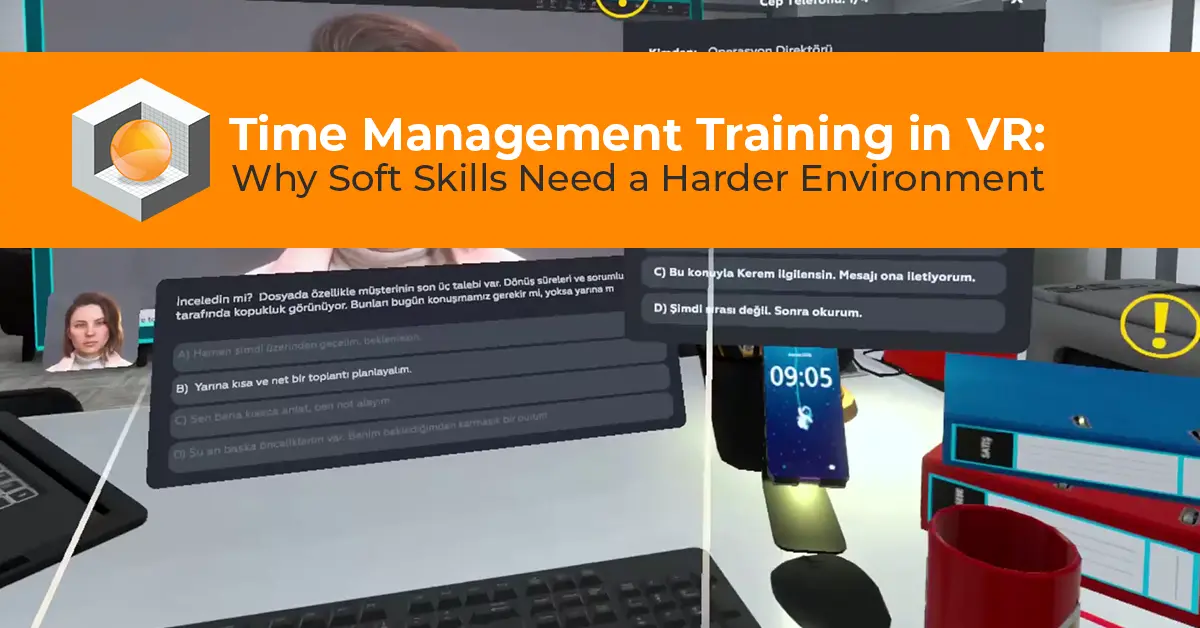
Virtual reality changes the training equation for soft skills because it can reproduce the conditions that activate the behavioral patterns you are trying to change. A VR time management simulation does not tell employees how to prioritize tasks — it puts them inside a virtual workspace where tasks accumulate, notifications appear, a simulated colleague interrupts with an urgent request, and the clock is running. The employee must make decisions, and those decisions carry consequences within the scenario.
The cognitive and emotional state this produces is qualitatively different from what a classroom exercise can generate. Presence — the subjective sense of actually being in the simulated environment — is the mechanism that makes VR effective for behavioral training. When the brain processes a simulated situation as real, it activates the same neural pathways that would engage in the actual situation. Practice inside that state builds genuine behavioral readiness, not just conceptual understanding.
The research data on this effect is consistent across methodologies. A large-scale study conducted by PwC found that VR-trained employees were 275% more confident to act on what they had learned, compared with a 40% improvement for classroom learners. The same study found that emotional engagement with training content was 3.75 times greater in VR than in classroom settings. Across industries, VR training has demonstrated retention rates of up to 80% after one year, against retention rates of roughly 10 to 30% for lecture or video-based formats.
| Expert Note One pattern that consistently appears across soft skills VR deployments is the value of the debrief session immediately after the simulation. The scenario itself produces behavioral data: response times, task sequencing choices, deferral decisions — and reviewing that data with the learner in the moments after the experience is when the deepest behavioral reflection happens. Organizations that skip the post-simulation debrief recover significantly less of the training value. The technology creates the experience; the structured review is where the insight converts into changed behavior. |
Priority Management and Decision-Making Under Pressure
Time management training in VR is most effective when scenarios are designed around the specific pressure patterns employees face in their actual roles. A senior executive dealing with competing board-level demands has different priority conflicts than a logistics coordinator managing inbound delivery exceptions, or an HR manager navigating simultaneous hiring cycles. Generic time management content addresses surface-level frameworks. Role-specific simulation builds the judgment that applies within the real context.
Well-designed simulations present learners with scenarios where the correct prioritization is genuinely ambiguous — not exercises with obvious right answers, but situations that require weighing incomplete information, recognizing what can and cannot be deferred, and making calls that feel consequential. The system tracks how learners respond: which tasks they address first, which they postpone, how they react when an urgent interruption appears mid-task. This behavioral data is what makes VR-based time management training measurable in a way that traditional formats are not.
Decision-making under time pressure also has a physiological dimension. When employees feel the cognitive weight of competing demands, cortisol levels rise, working memory narrows, and the tendency toward reactive rather than deliberate decision-making increases. Training that only operates in calm, low-stakes conditions does not prepare learners for those moments. VR simulations can calibrate the intensity of the scenario to progressively build tolerance for pressure, in the same way that physical training uses progressive overload to build performance capacity.
Focus Management and Distraction Handling
Distraction is one of the most consistent barriers to effective time use across modern work environments. Open-plan offices, constant digital notifications, and the cultural norm of rapid response to messages create conditions that fragment attention and raise the cognitive cost of switching between tasks. Research on attention recovery suggests that each significant interruption requires an average of over twenty minutes for a worker to return to the same depth of focus they had before.
VR simulations can introduce controlled distraction events — a simulated message, a colleague appearing with a question, a system alert — and measure how learners respond. Learners who reflexively engage every interruption can see, through their own session data, how this behavior affects their task completion rates and the quality of the output they produce on priority work. That visibility is difficult to create in real work environments without invasive monitoring; in a simulation, it is built into the design.
| Interested in how VR-based soft skills training can be deployed across your organization? Explore RoT STUDIO’s VR business training solutions to see what structured immersive training looks like in practice. |
Measuring What Was Once Immeasurable
One of the persistent frustrations with soft skills training investment is the difficulty of demonstrating its impact. When an organization spends on technical skills training, the output difference is typically observable: defect rates, process time, certification pass rates. When it spends on time management training through a workshop, the return is largely invisible — or at least not captured in any structured way.
VR-based training fundamentally changes the measurement picture. Because every learner interaction inside the simulation is recorded, training analytics can surface patterns that would otherwise remain anecdotal. Organizations can see average task prioritization accuracy, response latency to urgent items, frequency of task-switching, and how individual performance changes across repeated simulation runs. This data can be aggregated at team level to identify systemic priority management weaknesses that are not visible through self-reporting. For more on how immersive technology translates into measurable productivity gains, 5 ways VR training boosts employee productivity provides additional context on the outcome metrics organizations typically track.
The transition from intuitive assessment (“I think the workshop was useful”) to data-supported evaluation (“completion time on priority tasks improved by X% after three simulation sessions”) changes how L&D teams can communicate value to leadership. It also enables adaptive training design — when data shows that a specific decision pattern is consistently weak across a cohort, the simulation scenario can be adjusted to add targeted repetitions of that exact pressure point.
| Technical Note When deploying time management simulations at scale, the scenario calibration process is where most of the implementation complexity sits. Scenarios that are too obviously structured around right-versus-wrong choices stop feeling real within the first few minutes, and the presence effect collapses. Effective simulation design requires a layered decision tree — where each early choice generates downstream consequences that the learner encounters later in the session — rather than a linear sequence of isolated prioritization tasks. Organizations that invest in scenario architecture review after the first deployment cohort consistently see significantly better engagement and transfer data in subsequent cohorts. |
Who Benefits Most from VR Time Management Training
The target audience for VR-based time management training maps closely to the roles where priority conflicts and decision-making under pressure have the highest operational stakes. Senior executives and potential leaders sit at the top of that list, because their prioritization decisions affect not just their own output but the pace and direction of entire teams. Poor time management at leadership level cascades: when a senior decision-maker is chronically reactive, teams wait for approvals, projects stall, and the cost is absorbed across the organization.
HR teams and people managers represent another high-value deployment target. The role of a people manager inherently involves managing competing demands — performance conversations, hiring cycles, policy implementation, team development — in an environment where the structural support for time management is often minimal. VR simulation gives this group a space to practice triaging those demands without the real-world cost of getting it wrong during a high-stakes week.
Entrepreneurs and founders, particularly those scaling businesses, are another audience for whom time management training in VR has strong relevance. The transition from doing everything to delegating effectively, and from reactive operational involvement to strategic focus, is one of the most difficult behavioral shifts in organizational life. Simulations that specifically model this transition — presenting scenarios where delegation is the correct answer rather than personal execution — can accelerate that shift significantly.
Teams that operate across time zones or in high-uncertainty environments, such as manufacturing operations, aerospace, and energy, also benefit substantially. In these contexts, time management failures translate directly into operational and safety risk. VR simulations can model the specific pressure dynamics of shift handover, concurrent incident management, or multi-site coordination in ways that no classroom exercise can replicate.
The Investment Case for Immersive Soft Skills Training
The cost argument against VR training is familiar: higher upfront investment in hardware, scenario development, and deployment infrastructure. That argument misses the denominator. When training effectiveness is factored in — specifically, the time required to achieve a given level of behavioral change, and the durability of that change — VR consistently shows a different cost picture at scale. PwC’s research found that VR training achieved cost parity with classroom delivery at 375 learners, and became 52% more cost-effective than classroom formats at 3,000 learners.

For time management training specifically, the calculation extends to the downstream cost of poor time management across an organization. When productivity analysis translates into aggregate hours, the cost of reactive, low-priority work crowding out high-value activity is substantial. An intervention that durably shifts the prioritization behavior of managers and executives across a large organization has a return that is difficult to achieve through conventional training spend.
The question of whether to develop bespoke simulation content or deploy from an existing training library depends on the specificity of the role context. Why customized VR training is a strategic investment for organizations where time management challenges are tied to proprietary workflows or specific operational environments, bespoke scenario design typically delivers stronger transfer. For organizations where the priority conflicts are more universal, deploying from a structured catalogue of ready-made modules can achieve strong results with a faster implementation timeline.
Frequently Asked Questions
Can VR training actually improve time management skills, or is it just a novelty?
VR training produces measurable behavioral change because it creates the conditions — cognitive load, time pressure, competing demands — inside which time management skills are actually activated. Research from PwC and other enterprise deployments consistently shows that VR-trained employees demonstrate significantly higher confidence in applying what they have learned compared to classroom or e-learning counterparts. Novelty effects dissipate within the first few minutes of a well-designed scenario; what remains is genuine practice inside a realistic environment.
What specific time management behaviors can a VR simulation address?
A well-designed time management VR simulation can target task prioritization under competing demands, focus maintenance in the presence of interruptions, delegation decision-making, reactive versus proactive task sequencing, and planning behavior before and during high-pressure periods. The behaviors targeted should be selected based on the specific performance gaps identified in the organization — not as a generic curriculum, but as a mapped intervention.
How does VR time management training differ from a standard e-learning course?
The core difference is the presence of real decision pressure. An e-learning module presents concepts and assessments in a low-stakes environment where the learner knows the correct answer is available after a wrong choice. A VR simulation places the learner inside a scenario where competing demands appear in real time, choices carry visible consequences within the scenario, and the emotional and cognitive state more closely approximates actual work conditions. This state-dependent practice is what drives behavioral transfer.
How long does a VR time management training session typically take?
Most enterprise-grade VR time management modules are designed for sessions of 15 to 30 minutes, with multiple scenario variants available for repeat practice. The optimal structure for behavioral development typically involves three to five spaced sessions over several weeks, with data review between sessions to direct where repetition is most needed. This compares favorably to multi-hour classroom workshops that produce significantly less durable behavioral change.
Is VR time management training suitable for senior executives?
Senior executives are among the most valuable audiences for this type of training precisely because the prioritization decisions they make have the widest organizational impact. Well-designed executive scenarios model the specific pressure dynamics of leadership roles — board-level competing demands, strategic versus operational triage, delegation under uncertainty — rather than generic priority management tasks. The data feedback component is particularly valued at this level, because it provides objective insight that peer feedback and self-assessment often fail to surface.
How is learner progress tracked in VR time management training?
Learner progress in VR training is captured through session analytics generated during the simulation: task completion sequences, response latency, task-switching frequency, and overall scenario score. These metrics can be reviewed by the learner immediately after the session and tracked over multiple sessions to show behavioral change over time. At the organizational level, aggregate data reveals cohort-level patterns that can inform both individual coaching conversations and broader process design decisions.
Embedding Time Management Into Organizational Culture
Time management training fails most often not because the content is wrong but because it is delivered in conditions that cannot produce behavioral change. The three takeaways for organizations considering this investment are straightforward. First, the method of delivery matters more than the quality of the curriculum — behavioral skills require behavioral practice, and that practice must happen inside conditions that approximate the real context. Second, measurement matters as much as the training itself: without data on how learners respond inside scenarios, there is no basis for targeted follow-up or for demonstrating return on the investment. Third, the population scope of the deployment matters: time management improvement at the individual level creates localized benefits, but deployment across management layers creates systemic change in how an organization processes and prioritizes work.
The trajectory of VR-based soft skills training points toward increasing specificity and personalization. As scenario design tools become more accessible, the distance between a generic time management simulation and one that reflects the exact workflow context of a particular role will continue to narrow. Organizations that build experience with VR-based behavioral training now — developing the internal expertise to design scenarios, run deployments, and interpret training data — will be better positioned to translate those capabilities into competitive advantage as the technology matures.
How RoT STUDIO Approaches This
At RoT STUDIO, the design of time management VR training is grounded in a core principle: the scenario must feel consequential, or the behavioral practice does not transfer. The RoT STUDIO Time Management Training module, developed in partnership with the Minerva program, places learners inside realistic workplace simulations where priority conflicts, time pressure, and interruption events are calibrated to reflect the actual demands of their role context. Learners develop decision-making, task prioritization, and planning skills through repeated practice inside these conditions — not through content review.
RoT STUDIO – Time Management VR Training CTA
Discover how Time Management VR Training — developed by RoT STUDIO in partnership with Minerva — helps employees prioritize tasks, reduce cognitive load, and build sustainable productivity habits through immersive scenario-based learning. Download the brochure to explore the module details, deployment options, and ROI benchmarks.
Download PDF →The technical foundation for this training is the RoT STUDIO License, a no-code VR builder that enables organizations to adapt, update, and extend simulation scenarios without specialized development resources. For organizations that need tailored scenarios reflecting their specific operational environment, the Customized VR/XR Services team designs and builds bespoke content from the ground up — from scenario architecture and branching logic to final deployment and analytics configuration.
For organizations looking to deploy without a long development cycle, the RoT STUDIO VR Training Catalogue includes ready-made modules across a range of soft skills and operational training categories, allowing deployment to begin within weeks. The catalogue is supported by RoT STUDIO’s end-to-end delivery model, which covers hardware provisioning, facilitator guidance, and ongoing scenario updates as role requirements evolve.
With its European headquarters at High Tech Campus Eindhoven — home to 3EALITY — and offices in Istanbul and Ankara, RoT STUDIO brings together multi-industry deployment experience across manufacturing, energy, aerospace, healthcare, and HR. The team’s roots in infoTRON’s 3D engineering legacy give the scenario design process a technical precision that distinguishes it from content-first VR training providers. If you are assessing how VR-based time management training could fit your organization’s current training architecture and workforce goals, the RoT STUDIO team is available to consult on scenario design, deployment planning, and measurement frameworks.