The factory floor has never looked like this before. Robotic arms move with surgical precision alongside human workers. Sensors embedded in machinery stream real-time data to dashboards half a world away. Autonomous guided vehicles navigate warehouse aisles without a driver in sight. Welcome to Industry 4.0 : the fourth industrial revolution, where cyber-physical systems, the Internet of Things (IoT), artificial intelligence, and advanced automation converge to redefine how the world makes things.
But there is a paradox at the heart of this transformation. The more automated and digitally complex industrial environments become, the more critical human competence becomes, not less. Operators need to understand systems they cannot always see. Technicians must troubleshoot machinery that behaves in ways no manual fully captures. Safety officers must anticipate hazards that emerge from unprecedented combinations of human and machine interaction. The skill demands of Industry 4.0 are not shrinking, they are expanding at a pace that traditional classroom instruction, paper-based manuals, and even conventional on-the-job training simply cannot keep up with.
This is precisely why industrial virtual reality (VR) training has moved from niche experiment to strategic necessity. Immersive, simulation-based learning is quickly becoming the most effective tool organizations have for bridging the growing gap between the workforce they have and the workforce Industry 4.0 demands. And at the forefront of this shift is RoT STUDIO, a specialist VR/XR training company with over three decades of deep-rooted experience in industrial simulation and visualization technologies.
What Is Industrial VR Training?
Industrial VR training places workers inside a photorealistic, fully interactive virtual replica of their actual work environment. Using a VR headset, they can walk an assembly line, operate heavy machinery, respond to a fire alarm, or perform a lockout/tagout procedure, all without touching real equipment, risking real injury, or halting real production.
Unlike traditional e-learning, which presents information on a flat screen and asks learners to answer multiple-choice questions, VR training demands physical and cognitive engagement. Trainees reach out to manipulate virtual controls. They make decisions under simulated pressure. They experience the consequences of their actions , whether those consequences are a safely completed task or a simulated accident , in a way that activates the same neural pathways as real experience.
This matters enormously in industrial settings. Research across training science consistently confirms that experiential, simulation-based learning dramatically outperforms passive instruction when it comes to retention, skill transfer, and behavioral change on the job. In environments where a single mistake can cost a life or shut down an entire production line, the quality of training is not an HR formality , it is a critical safety and operational variable.
Why Industry 4.0 Makes VR Training Essential
Industry 4.0 is not just adding new tools to old workflows. It is fundamentally restructuring the nature of industrial work. Several intersecting forces make immersive training not merely useful but necessary:
The skills gap is accelerating. As factories become smarter, the gap between available workforce skills and the skills actually needed is widening rapidly. Technical roles now require competency in areas like data interpretation, collaborative robotics, programmable logic controllers, and digital maintenance systems , areas where few workers have been traditionally trained. Organizations cannot afford a multi-year lag between technology deployment and workforce readiness.
High-hazard environments demand zero-mistake training. Heavy industry, manufacturing, mining, energy, and chemical processing are among the most dangerous work environments in the world. In these sectors, sending an undertrained worker into a live environment to “learn by doing” is not an option. VR training allows workers to encounter and correctly handle every critical scenario , from equipment failures and chemical spills to earthquake emergencies , before they ever face those situations in reality.
Global operations require standardized, scalable training. Multinational manufacturers cannot rely on training quality varying by facility, region, or trainer. VR training delivers the same scenario with the same fidelity every time, across every location , making it the most reliable tool for standardizing safety culture and operational competency at scale.
The workforce is changing. The generation entering the industrial workforce grew up with digital interactivity. They learn faster through immersive, gamified environments than through lectures or static e-learning modules. Organizations that invest in engaging, VR-based training are also investing in talent attraction and retention.
The Science Behind Immersive Learning
Understanding why VR training works requires a brief look at how the brain processes experience. When a person physically moves through and interacts with a simulated environment, the brain encodes the experience using the same mechanisms it uses for real events. This is sometimes called “presence” , the sense of actually being somewhere, doing something.
Presence has a powerful effect on memory consolidation. Passive learners forget most of what they hear within days. Active, embodied learners retain far more , and, critically, they are more likely to apply what they learned when a real situation arises. The muscle memory, spatial awareness, and decision-making routines built during immersive VR training do not disappear when the headset comes off.
This is why industrial organizations that have deployed VR training consistently report significant reductions in workplace incidents, faster onboarding times, and higher scores on post-training assessments. The return on investment is not theoretical , it is measurable and repeatable.
Importantly, VR training also enables something traditional training cannot: the ability to practice rare but critical scenarios repeatedly. A worker might encounter an actual equipment emergency once or twice in a career. In VR, they can rehearse the correct response dozens of times, building genuine procedural fluency rather than fragile theoretical knowledge.
Key Applications of Industrial VR Training in Industry 4.0
Health, Safety & Environment (HSE) Training
Safety training is among the highest-stakes applications of VR in industrial settings, and it is one of the areas where the technology delivers the clearest, most measurable results. Traditional safety training , watching a video, reading a procedure document, attending a once-a-year seminar , creates compliance on paper. VR safety training creates competence in behavior.
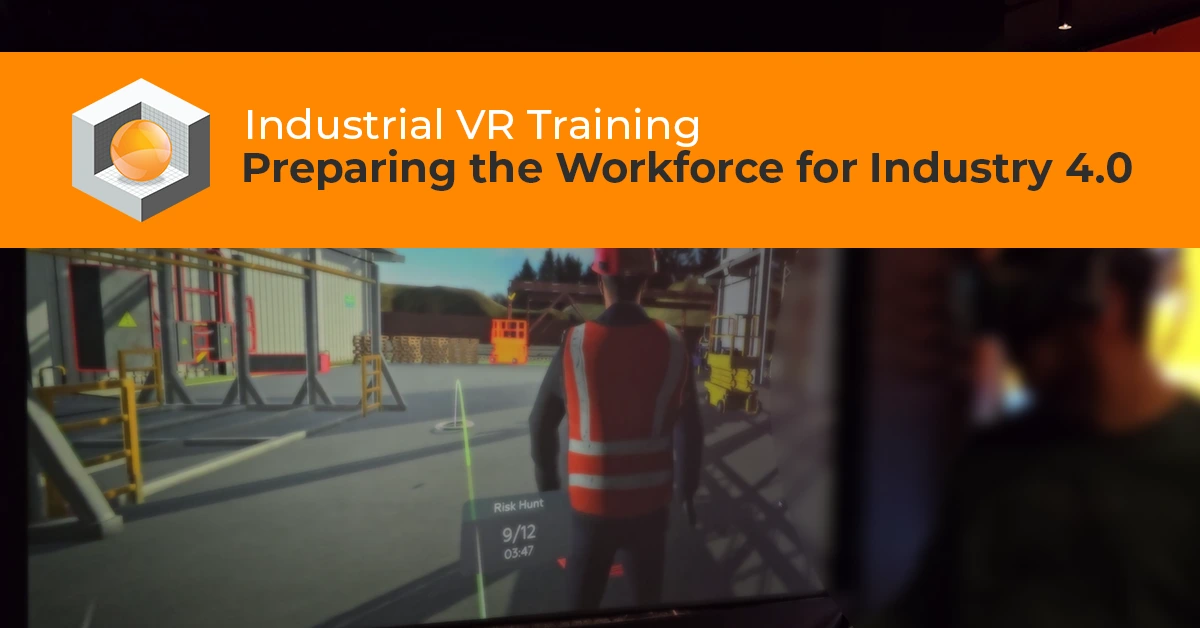
In a VR HSE scenario, a trainee walks through a simulated plant and is challenged to identify hazards in real time. They do not read about a poorly stored chemical container , they see it, assess it, and decide how to respond. They do not memorize a lockout/tagout procedure , they physically execute every step of it in virtual space before being cleared to perform it on live equipment.
This approach directly addresses one of the central challenges of HSE training: closing the gap between knowing a rule and actually following it under pressure. Immersive experience builds habits, not just knowledge.
RoT STUDIO has developed a robust suite of HSE VR training programs grounded in this philosophy. The HSE Risk Hunt Training places workers inside realistic industrial environments and tasks them with identifying and responding to a wide range of workplace hazards , turning passive safety awareness into active, practiced behavior. The LoTo Lock Training delivers full procedural training for lockout/tagout protocols, one of the most critical , and most frequently misapplied , safety procedures in heavy industry.
For sectors with specialized risk profiles, RoT STUDIO has developed the Underground Mining Risk Hunt Training, designed specifically for the unique and severe hazard landscape of mining operations, and the Earthquake Risk Hunt Training, which prepares workers for seismic events in industrial environments. These are not generic modules repurposed from other sectors , they are purpose-built, scenario-specific experiences that reflect the real conditions workers face.
Equipment Operation and Maintenance Training
Modern industrial equipment is expensive, complex, and unforgiving of errors. Training workers to operate and maintain it using the real thing is increasingly impractical: the equipment cannot always be taken offline, errors can cause costly damage, and not all workers can access the physical machine simultaneously.
VR creates a perfect parallel: a virtual replica of the equipment that trainees can interact with freely, repeatedly, and without consequence. They can disassemble a virtual engine, diagnose a virtual fault, and reassemble the system , as many times as needed, with instant feedback, until the procedure is embedded in their working memory.
For manufacturers undergoing significant technology transitions, this capability is transformative. When Ford Otosan Romania needed to prepare its assembly line workers for the shift to electric vehicle production, they partnered with RoT STUDIO to develop a VR training solution that brought workers into the electric future before the production lines made the switch. The result was a workforce that arrived at the new assembly process already fluent in its demands , dramatically reducing the learning curve and the risk of production errors during the critical transition period.
Similarly, Tosyalı Holding, a major player in the iron and steel industry, deployed RoT STUDIO’s VR training solutions to deliver high-quality, on-site training that met the exacting standards of one of the world’s most demanding industrial environments.
Onboarding and Induction Training
The first weeks on the job are among the most dangerous for new industrial workers. They are navigating unfamiliar environments, learning complex systems, and absorbing enormous amounts of new information , all under the pressure of trying to perform productively. Workplace injury rates among new employees are disproportionately high across most industrial sectors.
VR onboarding addresses this risk systematically. Before a new employee sets foot on the actual plant floor, they can spend hours in a virtual version of it , learning the layout, identifying safety zones and hazard areas, practicing emergency procedures, and building the spatial familiarity that reduces cognitive overload in the real environment. By the time they begin live work, they are not beginners. They are rehearsed.
This also has significant efficiency implications. Organizations that deploy VR induction training routinely reduce onboarding time, lower early-tenure incident rates, and see new employees reach full productivity faster.
Soft Skills and Leadership Development
Industry 4.0 is not only a technical transformation. It is also a managerial and cultural one. Organizations undergoing digital transformation need leaders who can communicate through uncertainty, manage cross-functional teams, and maintain performance culture under pressure. These are not skills that develop through reading a management textbook.
VR creates immersive environments for exactly this kind of development. Teams can practice high-stakes communication scenarios, simulate difficult conversations, and rehearse crisis response , building the behavioral fluency that effective leadership requires.
RoT STUDIO expanded into this dimension with the launch of HR Leadership Training in 2025, reflecting a growing recognition that the same immersive methodology that transforms technical skill training can be equally powerful for developing the human capabilities that Industry 4.0 organizations need.
The Role of Haptics: Training That You Can Feel
One of the most significant recent advances in VR training technology is haptic feedback , the integration of physical sensation into the virtual experience. When a trainee reaches out in VR and “touches” a virtual object, haptic gloves or controllers can simulate the resistance, texture, or vibration of that object. The result is a training experience that engages not just vision and hearing but the sense of touch , the sense most closely associated with procedural skill.
For industrial training, this matters enormously. The correct execution of many industrial tasks is as much about feel as it is about visual procedure. A valve that is properly torqued has a different feel from one that is under-tightened. A correctly secured harness fits and sits differently from one that is dangerously loose. Haptic training allows workers to develop the tactile fluency these tasks require , safely, repeatedly, and measurably.
RoT STUDIO has invested significantly in haptic integration, recognizing that the next frontier of VR training effectiveness is the full sensory immersion that haptics enable. Their haptics capability represents a meaningful advancement over standard VR training platforms, moving the technology closer to truly replicating the physical experience of industrial work.
Measuring What Matters: Data-Driven Training Outcomes
One of the most underappreciated advantages of VR training over traditional methods is its inherent measurability. Every action a trainee takes in a VR environment is a data point. The system knows which hazards were identified and which were missed. It records how long each procedural step took, where the trainee hesitated, and how many attempts were needed before successful completion. This data can be aggregated across individuals, teams, sites, and time.
The implications for training management are profound. Organizations can move beyond the blunt instrument of completion certificates , “attended the training” , to genuine competency analytics. They can identify specific knowledge gaps at the individual and team level, target refresher training with precision, and track improvement over time. They can also demonstrate training effectiveness to regulators, insurers, and leadership in ways that traditional training records simply cannot support.
For organizations operating in heavily regulated industries , where documented safety competency is not optional , this auditability is a significant operational advantage.
Scalability: One VR Solution, Many Sites, One Standard
Among the practical challenges that have historically slowed the adoption of high-quality training in large industrial organizations is the difficulty of delivering consistent quality at scale. Training quality depends on the trainer, the facility, the language, the time available , and a thousand variables that erode standardization across a global or multi-site operation.
VR training changes this equation fundamentally. A training scenario built once can be deployed globally, in any language, to any number of workers, at any time, without degradation of quality. The 100th worker to train on a RoT STUDIO HSE Risk Hunt module experiences exactly the same scenario as the first , with the same level of challenge, the same fidelity of environment, and the same quality of feedback.
This is not merely a convenience. For organizations managing safety culture across multiple sites in multiple countries, it is the difference between a safety program and a safety culture.
RoT STUDIO: Where Three Decades of Expertise Meet the Future of Training
Not all VR training providers are equal. The quality of a VR training experience depends on a combination of engineering depth, domain expertise, instructional design sophistication, and technical execution that takes years , often decades , to develop.
RoT STUDIO stands apart in this regard. Established in 2023 as a spin-off of infoTRON , a company that has been at the leading edge of 3D technology, simulation, and digital engineering in industries from automotive and aerospace to defense and healthcare since 1994 , RoT STUDIO brings more than 30 years of industrial simulation expertise to its VR training solutions.
This heritage is not incidental. It means that when RoT STUDIO builds a virtual replica of an industrial plant, the physics are right, the procedural logic reflects real operational requirements, and the scenarios are designed by people who understand what it actually means to work in these environments. The result is training that industrial professionals take seriously , not a gamified approximation of work, but a genuine preparation for it.
With offices at our European headquarters at the prestigious High Tech Campus Eindhoven in the Netherlands (home to some of Europe’s most innovative technology companies) and in Istanbul and Ankara, Turkey as well, RoT STUDIO operates at the intersection of industrial tradition and technological frontier.
Their VR training catalogue spans the full spectrum of industrial and healthcare needs. On the industrial side, the HSE Risk Hunt Training, LoTo Lock Training, Information Security Risk Hunt Training, Earthquake Risk Hunt Training, and Underground Mining Risk Hunt Training represent a carefully developed portfolio of scenario-based safety and operational training modules. For organizations with specialized or proprietary training requirements, the Customized VR/XR Services offering allows RoT STUDIO to build bespoke training environments that mirror the specific equipment, processes, and hazard profiles of the client’s operations.
The RoT STUDIO License platform provides organizations with the infrastructure to deploy, manage, and track VR training at scale , combining the content quality of a specialist training developer with the operational flexibility of an enterprise platform.
The company’s track record speaks directly. Their partnership with Carmeuse Turkey delivered a training program that contributed to a zero-accident initiative and earned recognition with a prestigious ILA Technology Award in 2023. Their work with Gazi University’s Faculty of Medicine brought anatomy education into virtual reality, allowing medical students to explore the human body with a spatial depth that no textbook or cadaver can replicate. Their Mersin Municipality project demonstrated the application of Mixed Reality (MR) for earthquake preparedness , training citizens and emergency workers for scenarios that are, by nature, impossible to rehearse in reality.
Each of these engagements reflects a consistent RoT STUDIO approach: deep collaboration with the client to understand the real operational context, meticulous scenario design grounded in actual work processes, and technically sophisticated delivery that makes the training genuinely immersive.
Addressing the Common Objections
Organizations considering VR training for the first time often raise a predictable set of concerns. It is worth addressing them directly.
“Is it too expensive?” The cost of a well-designed VR training program needs to be compared not to the cost of doing nothing, but to the full cost of the alternatives , instructor time, facility costs, equipment downtime, travel for multi-site training, and, most significantly, the financial and human cost of the incidents that inadequate training produces. When measured against these true comparators, the economics of VR training become compelling quickly.
“Our workforce isn’t tech-savvy enough.” Modern VR hardware is designed for ease of use. RoT STUDIO’s training programs are built with accessibility in mind , the immersive environment itself does most of the work of orientation. In practice, organizations consistently find that workers adapt to VR training environments rapidly, often faster than learning management systems and other digital training tools.
“We have very specific equipment and processes , can VR really replicate that?” Yes , and this is precisely where RoT STUDIO’s customized development capability becomes critical. Rather than attempting to adapt a generic module to a specific operational context, RoT STUDIO builds virtual environments that are faithful replicas of the client’s actual facilities and equipment. The result is training that workers immediately recognize as relevant to their real work, which dramatically increases engagement and retention.
VR, AI, and the Training of Tomorrow
The technology underpinning industrial VR training continues to evolve. Artificial intelligence is beginning to enable adaptive training experiences that respond to the individual learner’s performance in real time , making scenarios harder when a trainee is succeeding and providing targeted support when they struggle. Digital twin technology is enabling training environments that stay synchronized with real operational changes , so when a factory reconfigures its production line, the training environment updates accordingly.
Mixed Reality (MR) , the integration of virtual elements into the real physical environment , opens further possibilities, particularly for on-the-job coaching and just-in-time procedural guidance. The boundary between training and real-time operational support is beginning to blur in ways that will transform how industrial organizations think about workforce development.
RoT STUDIO is already operating at this frontier. Their earthquake awareness training for Mersin Municipality leveraged Mixed Reality to deliver a training modality that neither pure VR nor traditional instruction could replicate. As the technology continues to mature, organizations that have built their training infrastructure on VR/XR platforms will be best positioned to incorporate these advances , while those still relying on legacy training methods will face an accelerating competency gap.
Conclusion
Industry 4.0 is not a future state. It is the present reality of manufacturing, energy, logistics, mining, healthcare, and every other sector that depends on the intersection of human skill and advanced technology. The organizations that will thrive in this environment are those that invest now in workforce capabilities that match the demands of the environments they are building.
Industrial VR training is not a luxury. It is the most effective, most scalable, most measurable, and , when properly implemented , most cost-efficient tool available for developing those capabilities. It makes workers safer, more competent, more confident, and more adaptable. It makes organizations more resilient, more compliant, and more competitive.
RoT STUDIO has built its platform, its catalogue, and its client relationships on a simple but profound conviction: that the quality of training determines the quality of performance, and that the future of training is immersive. With over three decades of heritage behind it, a world-class team of engineers, designers, and domain experts, and a growing portfolio of real-world deployments across automotive, heavy industry, healthcare, mining, and public safety, RoT STUDIO is uniquely equipped to help organizations prepare their workforces for the demands of Industry 4.0 , and for whatever comes after.
The question for industrial leaders is no longer whether VR training belongs in their workforce development strategy. The question is whether they can afford to wait any longer to make it central to it.
To learn how RoT STUDIO can transform your organization’s training approach, explore their VR Training Catalogue, Customized VR/XR Services, and case studies.